Efficient and Scalable Physics-Informed Deep Learning and Scientific Machine Learning on top of Tensorflow for multi-worker distributed computing

Overview

TensorDiffEq logo

Package Build Package Release pypi downloads python versions

Notice: Support for Python 3.6 will be dropped in v.0.2.1, please plan accordingly!

Efficient and Scalable Physics-Informed Deep Learning

Collocation-based PINN PDE solvers for prediction and discovery methods on top of Tensorflow 2.X for multi-worker distributed computing.

Use TensorDiffEq if you require:

  • A meshless PINN solver that can distribute over multiple workers (GPUs) for forward problems (inference) and inverse problems (discovery)
  • Scalable domains - Iterated solver construction allows for N-D spatio-temporal support
    • support for N-D spatial domains with no time element is included
  • Self-Adaptive Collocation methods for forward and inverse PINNs
  • Intuitive user interface allowing for explicit definitions of variable domains, boundary conditions, initial conditions, and strong-form PDEs

What makes TensorDiffEq different?

  • Completely open-source

  • Self-Adaptive Solvers for forward and inverse problems, leading to increased accuracy of the solution and stability in training, resulting in less overall training time

  • Multi-GPU distributed training for large or fine-grain spatio-temporal domains

  • Built on top of Tensorflow 2.0 for increased support in new functionality exclusive to recent TF releases, such as XLA support, autograph for efficent graph-building, and grappler support for graph optimization* - with no chance of the source code being sunset in a further Tensorflow version release

  • Intuitive interface - defining domains, BCs, ICs, and strong-form PDEs in "plain english"

*In development

If you use TensorDiffEq in your work, please cite it via:

@article{mcclenny2021tensordiffeq,
  title={TensorDiffEq: Scalable Multi-GPU Forward and Inverse Solvers for Physics Informed Neural Networks},
  author={McClenny, Levi D and Haile, Mulugeta A and Braga-Neto, Ulisses M},
  journal={arXiv preprint arXiv:2103.16034},
  year={2021}
}

Thanks to our additional contributors:

@marcelodallaqua, @ragusa, @emiliocoutinho

Comments
  • Latest version of package

    Latest version of package

    The examples in the doc use the latest code of master branch but the library on Pypi is still the version in May. Can you build the lib and update the version on Pypi?

    opened by devzhk 5
  • ADAM training on batches

    ADAM training on batches

    It is possible to define a batch size and this will be applied to the calculation of the residual loss function, in splitting the collocation points in batches during the training.

    opened by emiliocoutinho 3
  • Pull Request using PyCharm

    Pull Request using PyCharm

    Dear Levi,

    I tried to make a Pull Request on this repository using PyCharm, and I received the following message:

    Although you appear to have the correct authorization credentials, the tensordiffeq organization has enabled OAuth App access restrictions, meaning that data access to third-parties is limited. For more information on these restrictions, including how to whitelist this app, visit https://help.github.com/articles/restricting-access-to-your-organization-s-data/

    I would kindly ask you to authorize PyCharm to access your organization data to use the GUI to make future pull requests.

    Best Regards

    opened by emiliocoutinho 1
  • Update method def get_sizes of utils.py

    Update method def get_sizes of utils.py

    Fix bug on the method def get_sizes(layer_sizes) of utils.py. The method was only allowing neural nets with an identical number of nodes in each hidden layer. Which was making the L- BFGS optimization to crash.

    opened by marcelodallaqua 1
  • model.save ?

    model.save ?

    Sometimes, it's useful to save the model for later use. I couldn't find a .save method and pickle (and dill) didn't let me dump the object for later re-use. (example of error with pickle: Can't pickle local object 'make_gradient_clipnorm_fn..').

    Is it currently possible to save the model? Thanks!

    opened by ragusa 1
  • add model.save and model.load_model

    add model.save and model.load_model

    Add model.save and model.load_model to CollocationSolverND class ref #3

    Will be released in the next stable.

    currently this can be done by using the Keras integration via running model.u_model.save("path/to/file"). This change will allow a direct save by calling model.save() on the CollocationSolverND class. Same with load_model().

    The docs will be updated to reflect this change.

    opened by levimcclenny 0
  • 2D Burgers Equation

    2D Burgers Equation

    Hello @levimcclenny and thanks for recommending this library!

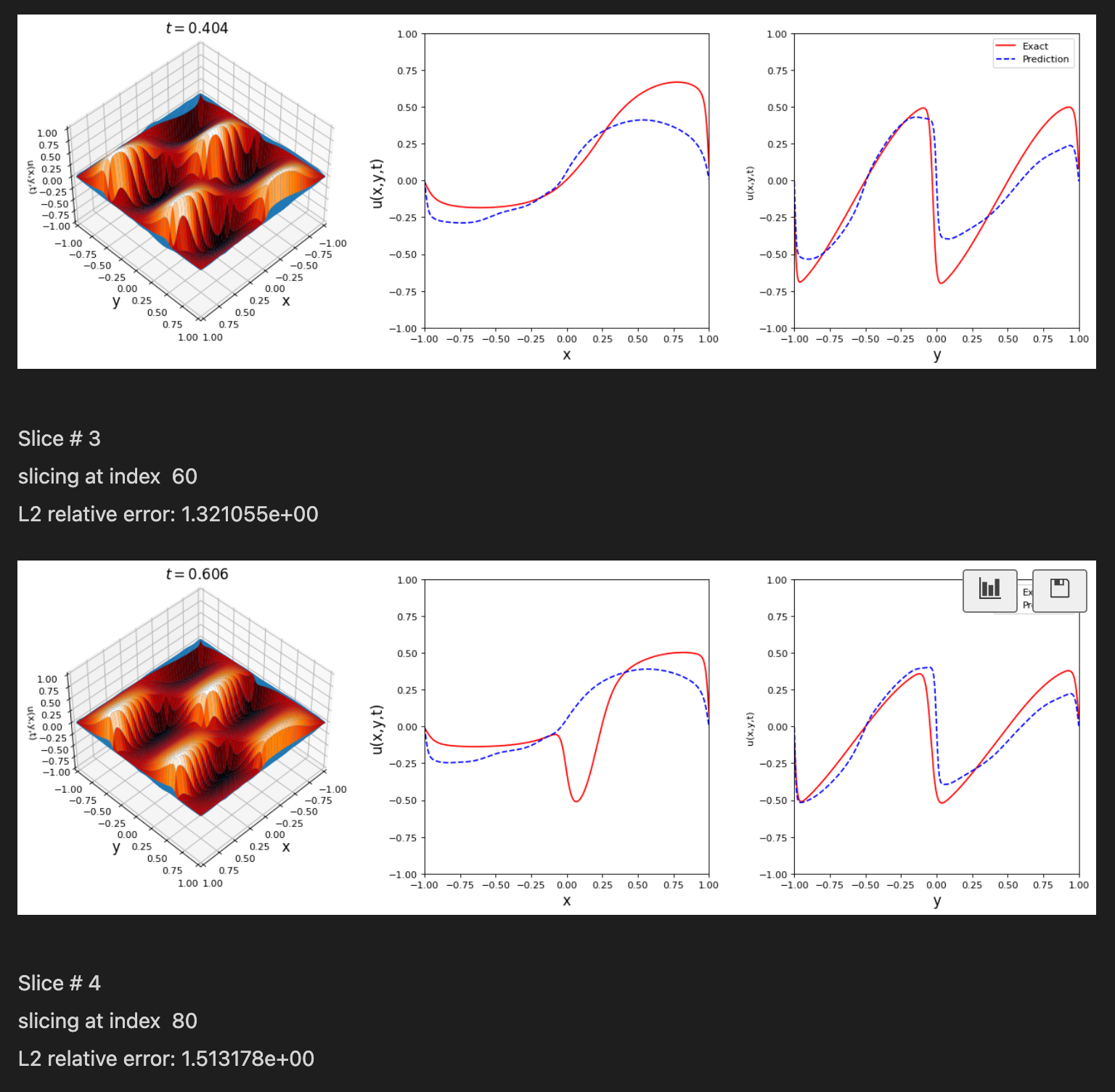
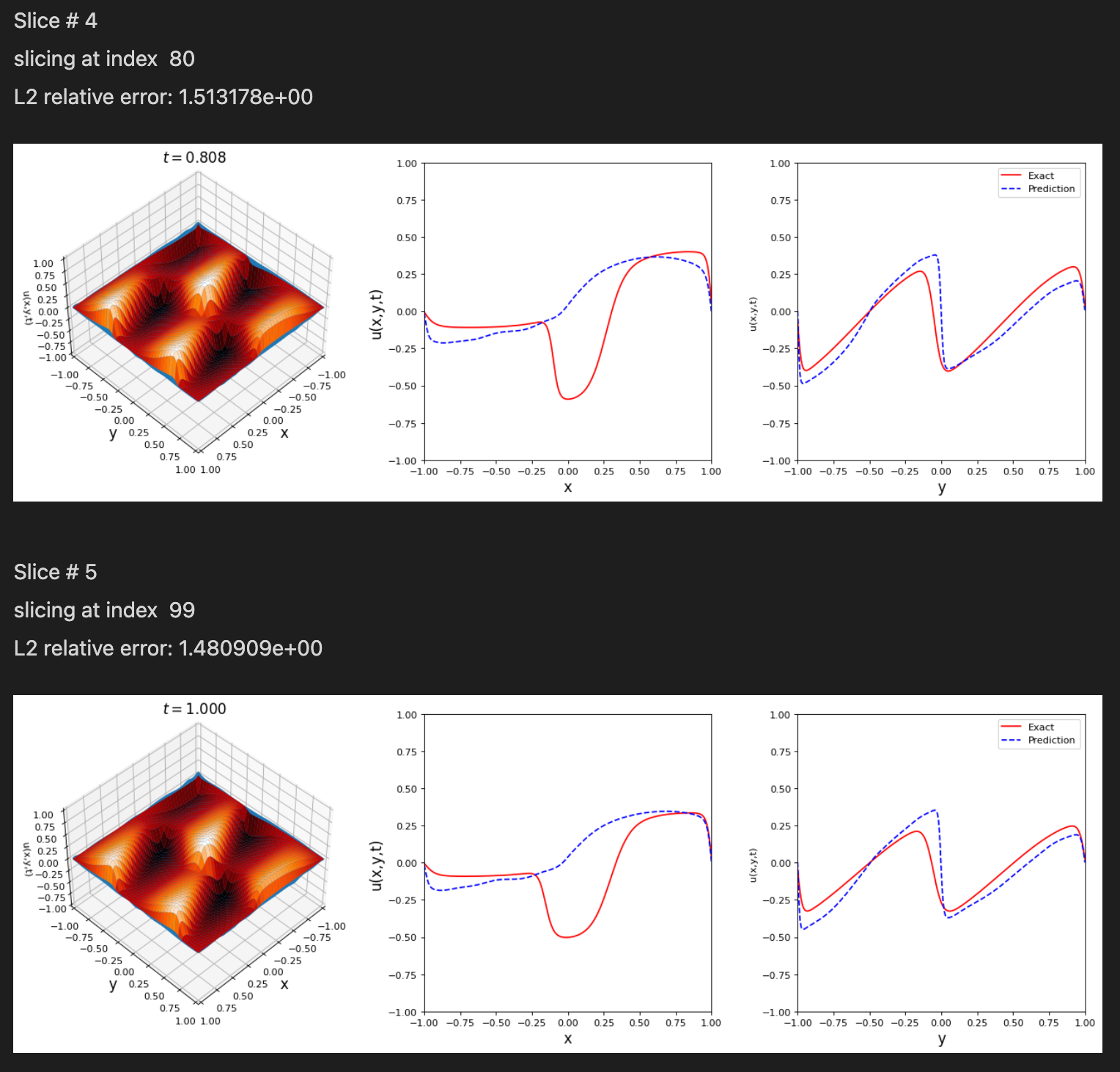
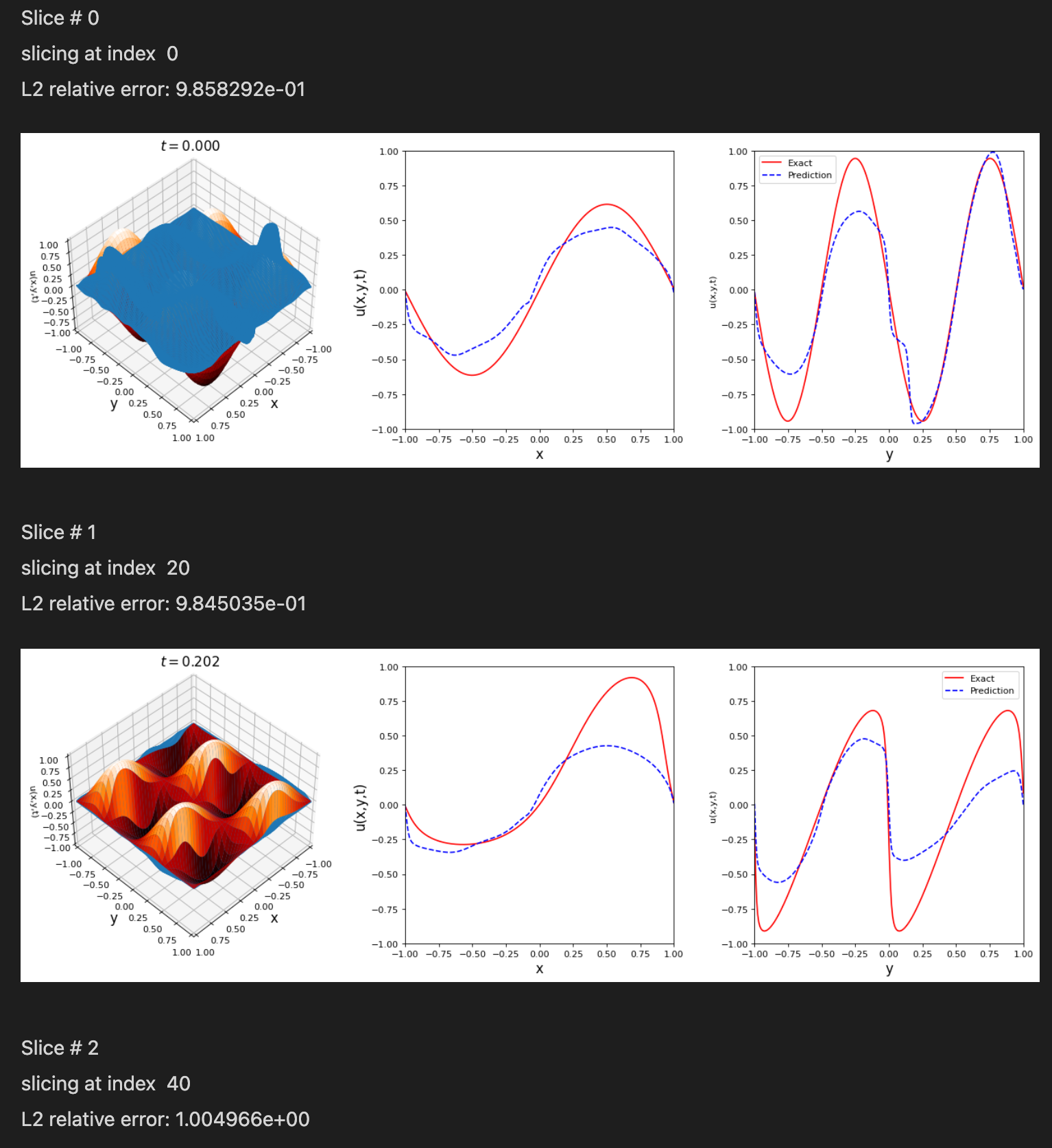
    I have modified the 1D burger example to be in 2D, but I did not get good comparison results. Any suggestions?

    import math
    import scipy.io
    import tensordiffeq as tdq
    from tensordiffeq.boundaries import *
    from tensordiffeq.models import CollocationSolverND
    
    Domain = DomainND(["x", "y", "t"], time_var='t')
    
    Domain.add("x", [-1.0, 1.0], 256)
    Domain.add("y", [-1.0, 1.0], 256)
    Domain.add("t", [0.0, 1.0], 100)
    
    N_f = 10000
    Domain.generate_collocation_points(N_f)
    
    
    def func_ic(x,y):
        p =2
        q =1
        return np.sin (p * math.pi * x) * np.sin(q * math.pi * y)
        
    
    init = IC(Domain, [func_ic], var=[['x','y']])
    upper_x = dirichletBC(Domain, val=0.0, var='x', target="upper")
    lower_x = dirichletBC(Domain, val=0.0, var='x', target="lower")
    upper_y = dirichletBC(Domain, val=0.0, var='y', target="upper")
    lower_y = dirichletBC(Domain, val=0.0, var='y', target="lower")
    
    BCs = [init, upper_x, lower_x, upper_y, lower_y]
    
    
    def f_model(u_model, x, y, t):
        u = u_model(tf.concat([x, y, t], 1))
        u_x = tf.gradients(u, x)
        u_xx = tf.gradients(u_x, x)
        u_y = tf.gradients(u, y)
        u_yy = tf.gradients(u_y, y)
        u_t = tf.gradients(u, t)
        f_u = u_t + u * (u_x + u_y) - (0.01 / tf.constant(math.pi)) * (u_xx+u_yy)
        return f_u
    
    
    layer_sizes = [3, 20, 20, 20, 20, 20, 20, 20, 20, 1]
    
    model = CollocationSolverND()
    model.compile(layer_sizes, f_model, Domain, BCs)
    
    # to reproduce results from Raissi and the SA-PINNs paper, train for 10k newton and 10k adam
    model.fit(tf_iter=10000, newton_iter=10000)
    
    model.save("burger2D_Training_Model")
    #model.load("burger2D_Training_Model")
    
    #######################################################
    #################### PLOTTING #########################
    #######################################################
    
    data = np.load('py-pde_2D_burger_data.npz')
    
    Exact = data['u_output']
    Exact_u = np.real(Exact)
    
    x = Domain.domaindict[0]['xlinspace']
    y = Domain.domaindict[1]['ylinspace']
    t = Domain.domaindict[2]["tlinspace"]
    
    X, Y, T = np.meshgrid(x, y, t)
    
    X_star = np.hstack((X.flatten()[:, None], Y.flatten()[:, None], T.flatten()[:, None]))
    u_star = Exact_u.T.flatten()[:, None]
    
    u_pred, f_u_pred = model.predict(X_star)
    
    error_u = tdq.helpers.find_L2_error(u_pred, u_star)
    print('Error u: %e' % (error_u))
    
    lb = np.array([-1.0, -1.0, 0.0])
    ub = np.array([1.0, 1.0, 1])
    
    tdq.plotting.plot_solution_domain2D(model, [x, y, t], ub=ub, lb=lb, Exact_u=Exact_u.T)
    
    
    Screen Shot 2022-03-04 at 11 15 31 PM Screen Shot 2022-03-04 at 11 15 44 PM Screen Shot 2022-03-04 at 11 15 18 PM
    opened by engsbk 3
  • 2D Wave Equation

    2D Wave Equation

    Thank you for the great contribution!

    I'm trying to extend the 1D example problems to 2D, but I want to make sure my changes are in the correct place:

    1. Dimension variables. I changed them like so:

    Domain = DomainND(["x", "y", "t"], time_var='t')

    Domain.add("x", [0.0, 5.0], 100) Domain.add("y", [0.0, 5.0], 100) Domain.add("t", [0.0, 5.0], 100)

    1. My IC is zero, but for the BCs I'm not sure how to define the left and right borders, please let me know if my implementation is correct:
    
    def func_ic(x,y):
        return 0
    
    init = IC(Domain, [func_ic], var=[['x','y']])
    upper_x = dirichletBC(Domain, val=0.0, var='x', target="upper")
    lower_x = dirichletBC(Domain, val=0.0, var='x', target="lower")
    upper_y = dirichletBC(Domain, val=0.0, var='y', target="upper")
    lower_y = dirichletBC(Domain, val=0.0, var='y', target="lower")
            
    BCs = [init, upper_x, lower_x, upper_y, lower_y]
    

    All of my BCs and ICs are zero. And my equation has a (forcing) time-dependent source term as such:

    
    def f_model(u_model, x, y, t):
        c = tf.constant(1, dtype = tf.float32)
        Amp = tf.constant(2, dtype = tf.float32)
        freq = tf.constant(1, dtype = tf.float32)
        sigma = tf.constant(0.2, dtype = tf.float32)
    
        source_x = tf.constant(0.5, dtype = tf.float32)
        source_y = tf.constant(2.5, dtype = tf.float32)
    
        GP = Amp * tf.exp(-0.5*( ((x-source_x)/sigma)**2 + ((y-source_y)/sigma)**2 ))
        
        S = GP * tf.sin( 2 * tf.constant(math.pi)  * freq * t )
        u = u_model(tf.concat([x,y,t], 1))
        u_x = tf.gradients(u,x)
        u_xx = tf.gradients(u_x, x)
        u_y = tf.gradients(u,y)
        u_yy = tf.gradients(u_y, y)
        u_t = tf.gradients(u,t)
        u_tt = tf.gradients(u_t,t)
    
    
        f_u = u_xx + u_yy - (1/c**2) * u_tt + S
        
        return f_u
    

    Please advise.

    Looking forward to your reply!

    opened by engsbk 13
  • Reproducibility

    Reproducibility

    Dear @levimcclenny,

    Have you considered in adapt TensorDiffEq to be deterministic? In the way the code is implemented, we can find two sources of randomness:

    • The function Domain.generate_collocation_points has a random number generation
    • The TensorFlow training procedure (weights initialization and possibility of the use o random batches)

    Both sources of randomness can be solved with not much effort. We can define a random state for the first one that can be passed to the function Domain.generate_collocation_points. For the second, we can use the implementation provided on Framework Determinism. I have used the procedures suggested by this code, and the results of TensorFlow are always reproducible (CPU or GPU, serial or distributed).

    If you want, I can implement these two features.

    Best Regards

    opened by emiliocoutinho 3
Releases(v0.2.0)
Owner
tensordiffeq
Scalable PINN solvers for PDE Inference and Discovery
tensordiffeq
Pytorch implementation of our paper under review — Lottery Jackpots Exist in Pre-trained Models

Lottery Jackpots Exist in Pre-trained Models (Paper Link) Requirements Python = 3.7.4 Pytorch = 1.6.1 Torchvision = 0.4.1 Reproduce the Experiment

Yuxin Zhang 27 Jun 28, 2022
Implementation of Diverse Semantic Image Synthesis via Probability Distribution Modeling

Diverse Semantic Image Synthesis via Probability Distribution Modeling (CVPR 2021) Paper Zhentao Tan, Menglei Chai, Dongdong Chen, Jing Liao, Qi Chu,

tzt 45 Nov 17, 2022
PyQt6 configuration in yaml format providing the most simple script.

PyamlQt(ぴゃむるきゅーと) PyQt6 configuration in yaml format providing the most simple script. Requirements yaml PyQt6, ( PyQt5 ) Installation pip install Pya

Ar-Ray 7 Aug 15, 2022
SNE-RoadSeg in PyTorch, ECCV 2020

SNE-RoadSeg Introduction This is the official PyTorch implementation of SNE-RoadSeg: Incorporating Surface Normal Information into Semantic Segmentati

242 Dec 20, 2022
A Multi-modal Model Chinese Spell Checker Released on ACL2021.

ReaLiSe ReaLiSe is a multi-modal Chinese spell checking model. This the office code for the paper Read, Listen, and See: Leveraging Multimodal Informa

DaDa 106 Dec 29, 2022
Strongly local p-norm-cut algorithms for semi-supervised learning and local graph clustering

Strongly local p-norm-cut algorithms for semi-supervised learning and local graph clustering

Meng Liu 2 Jul 19, 2022
A Simple Framwork for CV Pre-training Model (SOCO, VirTex, BEiT)

A Simple Framwork for CV Pre-training Model (SOCO, VirTex, BEiT)

Sense-GVT 14 Jul 07, 2022
A tight inclusion function for continuous collision detection

Tight-Inclusion Continuous Collision Detection A conservative Continuous Collision Detection (CCD) method with support for minimum separation. You can

Continuous Collision Detection 89 Jan 01, 2023
🦙 LaMa Image Inpainting, Resolution-robust Large Mask Inpainting with Fourier Convolutions, WACV 2022

🦙 LaMa Image Inpainting, Resolution-robust Large Mask Inpainting with Fourier Convolutions, WACV 2022

Advanced Image Manipulation Lab @ Samsung AI Center Moscow 4.7k Dec 31, 2022
Code for the paper "Ordered Neurons: Integrating Tree Structures into Recurrent Neural Networks"

ON-LSTM This repository contains the code used for word-level language model and unsupervised parsing experiments in Ordered Neurons: Integrating Tree

Yikang Shen 572 Nov 21, 2022
GenshinMapAutoMarkTools - Tools To add/delete/refresh resources mark in Genshin Impact Map

使用说明 适配 windows7以上 64位 原神1920x1080窗口(其他分辨率后续适配) 待更新渊下宫 English version is to be

Zero_Circle 209 Dec 28, 2022
Source code for CVPR 2021 paper "Riggable 3D Face Reconstruction via In-Network Optimization"

Riggable 3D Face Reconstruction via In-Network Optimization Source code for CVPR 2021 paper "Riggable 3D Face Reconstruction via In-Network Optimizati

130 Jan 02, 2023
Official pytorch implementation of the paper: "SinGAN: Learning a Generative Model from a Single Natural Image"

SinGAN Project | Arxiv | CVF | Supplementary materials | Talk (ICCV`19) Official pytorch implementation of the paper: "SinGAN: Learning a Generative M

Tamar Rott Shaham 3.2k Dec 25, 2022
GPT, but made only out of gMLPs

GPT - gMLP This repository will attempt to crack long context autoregressive language modeling (GPT) using variations of gMLPs. Specifically, it will

Phil Wang 80 Dec 01, 2022
Convolutional Neural Network for 3D meshes in PyTorch

MeshCNN in PyTorch SIGGRAPH 2019 [Paper] [Project Page] MeshCNN is a general-purpose deep neural network for 3D triangular meshes, which can be used f

Rana Hanocka 1.4k Jan 04, 2023
Decentralized Reinforcment Learning: Global Decision-Making via Local Economic Transactions (ICML 2020)

Decentralized Reinforcement Learning This is the code complementing the paper Decentralized Reinforcment Learning: Global Decision-Making via Local Ec

40 Oct 30, 2022
用强化学习DQN算法,训练AI模型来玩合成大西瓜游戏,提供Keras版本和PARL(paddle)版本

用强化学习玩合成大西瓜 代码地址:https://github.com/Sharpiless/play-daxigua-using-Reinforcement-Learning 用强化学习DQN算法,训练AI模型来玩合成大西瓜游戏,提供Keras版本、PARL(paddle)版本和pytorch版本

72 Dec 17, 2022
Exact Pareto Optimal solutions for preference based Multi-Objective Optimization

Exact Pareto Optimal solutions for preference based Multi-Objective Optimization

Debabrata Mahapatra 40 Dec 24, 2022
[CIKM 2019] Code and dataset for "Fi-GNN: Modeling Feature Interactions via Graph Neural Networks for CTR Prediction"

FiGNN for CTR prediction The code and data for our paper in CIKM2019: Fi-GNN: Modeling Feature Interactions via Graph Neural Networks for CTR Predicti

Big Data and Multi-modal Computing Group, CRIPAC 75 Dec 30, 2022
Official code for "Maximum Likelihood Training of Score-Based Diffusion Models", NeurIPS 2021 (spotlight)

Maximum Likelihood Training of Score-Based Diffusion Models This repo contains the official implementation for the paper Maximum Likelihood Training o

Yang Song 84 Dec 12, 2022