Panoptic NeRF
Project Page | Paper | Dataset
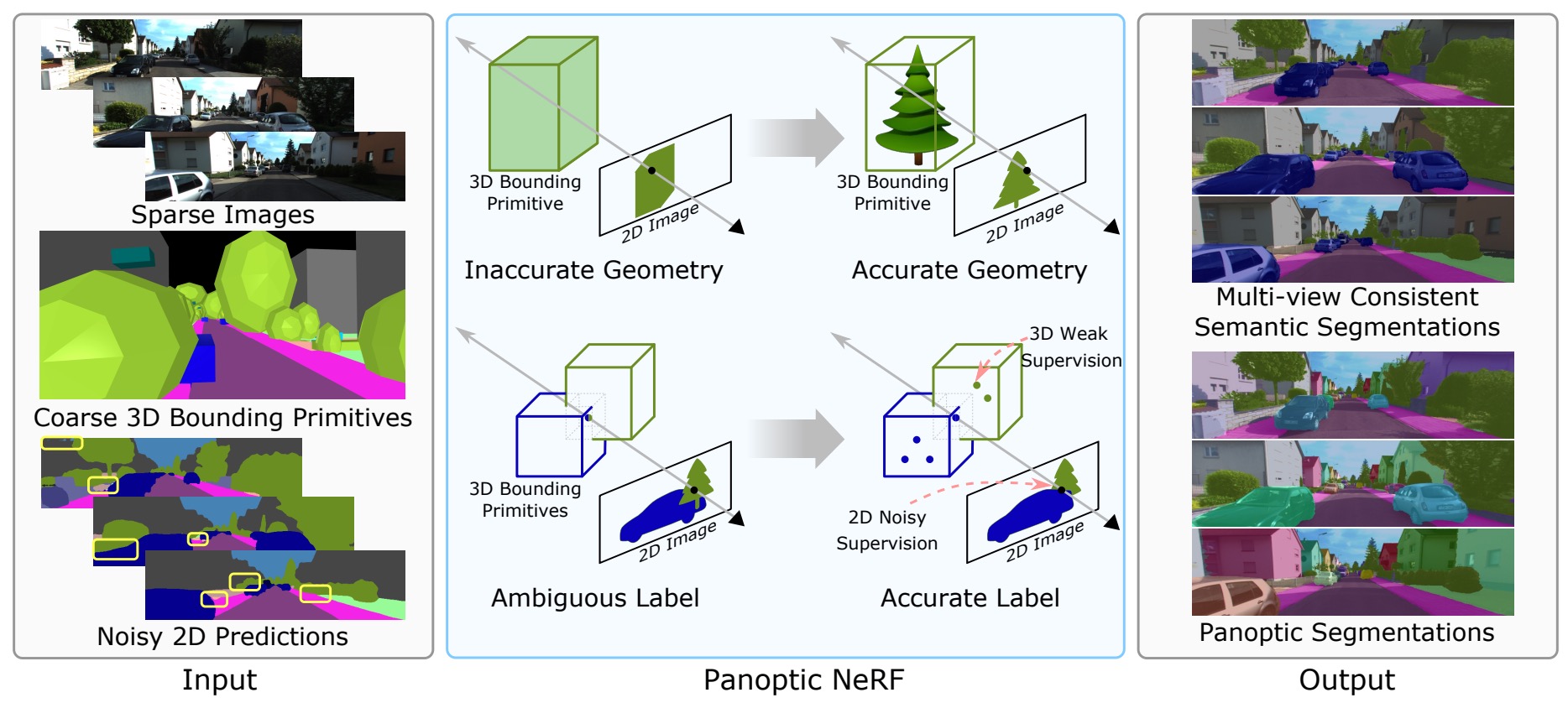
Panoptic NeRF: 3D-to-2D Label Transfer for Panoptic Urban Scene Segmentation
Xiao Fu*, Shangzhan zhang*, Tianrun Chen, Yichong Lu, Lanyun Zhu, Xiaowei Zhou, Andreas Geiger, Yiyi Liao
arXiv 2022
Installation
- Create a virtual environment via
conda.conda create -n panopticnerf python=3.7 conda activate panopticnerf - Install
torchandtorchvision.conda install pytorch torchvision torchaudio cudatoolkit=11.3 -c pytorch - Install requirements.
pip install -r requirements.txt
Data Preparation
-
We evaluate our model on KITTI-360. Here we show the structure of a test dataset as follow. You can download it from here and then put it into
$ROOT(RGBs should query the KITTI-360 website).├── KITTI-360 ├── 2013_05_28_drive_0000_sync ├── image_00 ├── image_01 ├── bbx_intersection ├── *_00.npz ├── *_01.npz ├── calibration ├── calib_cam_to_pose.txt ├── perspective.txt ├── data_3d_bboxes ├── data_poses ├── cam0_to_world.txt ├── poses.txt ├── pspnet ├── sgm ├── visible_idfile Intro image_00/01stereo RGB images pspnet2D pseudo ground truth sgmweak stereo depth supervision visible_idper-frame bounding primitive IDs data_posessystem poses in a global Euclidean coordinate calibrationextrinsics and intrinsics of the perspective cameras bbx_intersectionray-mesh intersections, containing depths between hitting points and camera origin, semantic label IDs and bounding primitive IDs -
Generate ray-mesh intersections (
bbx_intersection/*.npz). The red dots and blue dots indicate where the rays hit into and out of the meshes, respectively. For the given test scene,START=3353,NUM=64.# image_00 python mesh_intersection.py intersection_start_frame ${START} intersection_frames ${NUM} use_stereo False # image_01 python mesh_intersection.py intersection_start_frame ${START} intersection_frames ${NUM} use_stereo True

- Evaluate the origin of a scene (
center_pose) and the distance from the origin to the furthest bounding primitive (dist_min). Then accordingly modify the.yamlfile.python recenter_pose.py recenter_start_frame ${START} recenter_frames ${NUM}
Training and Visualization
-
We provide the training code. Replace
resume Falsewithresume Trueto load the pretained model.python train_net.py --cfg_file configs/panopticnerf_test.yaml pretrain nerf gpus '1,' use_stereo True use_pspnet True use_depth True pseudo_filter True weight_th 0.05 resume False -
Render semantic map, panoptic map and depth map in a single forward pass, which takes around 10s per-frame on a single 3090 GPU. Please make sure to maximize the GPU memory utilization by increasing the size of the chunk to reduce inference time. Replace
use_stereo Falsewithuse_stereo Trueto render the right views.python run.py --type visualize --cfg_file configs/panopticnerf_test.yaml use_stereo False
-
Visualize novel view appearance & label synthesis. Before rendering, select a frame and generate corresponding ray-mesh intersections with respect to its novel spiral poses by enabling
spiral poses==Trueinlib.datasets.kitti360.panopticnerf.py.
Evaluation
├── KITTI-360
  ├── gt_2d_semantics
  ├── gt_2d_panoptics
  ├── lidar_depth
-
Download the corresponding pretrained model and put it to
$ROOT/data/trained_model/panopticnerf/panopticnerf_test/latest.pth. -
We provide some semantic & panoptic GTs and LiDAR point clouds for evaluation. The details of evaluation metrics can be found in the paper.
-
Eval mean intersection-over-union (mIoU)
python run.py --type eval_miou --cfg_file configs/panopticnerf_test.yaml use_stereo False
- Eval panoptic quality (PQ)
sh eval_pq_test.sh
- Eval depth with 0-100m LiDAR point clouds, where the far depth can be adjusted to evaluate the closer scene.
python run.py --type eval_depth --cfg_file configs/panopticnerf_test.yaml use_stereo False max_depth 100.
- Eval Multi-view Consistency (MC)
python eval_consistency.py --cfg_file configs/panopticnerf_test.yaml use_stereo False consistency_thres 0.1
News
12/04/2022Code released.29/03/2022Repo created. Code will come soon.
Citation
@article{fu2022panoptic,
  title={Panoptic NeRF: 3D-to-2D Label Transfer for Panoptic Urban Scene Segmentation},
  author={Fu, Xiao and Zhang, Shangzhan and Chen, Tianrun and Lu, Yichong and Zhu, Lanyun and Zhou, Xiaowei and Geiger, Andreas and Liao, Yiyi},
  journal={arXiv preprint arXiv:2203.15224},
  year={2022}
}
Copyright © 2022, Zhejiang University. All rights reserved. We favor any positive inquiry, please contact [email protected].

 104 Jan 05, 2023
 157 Dec 23, 2022
 57 Dec 04, 2022
 85 Dec 13, 2022
 0 Dec 17, 2021
 74 Dec 03, 2022
 1 Jan 11, 2022
 1 Nov 07, 2022
 0 Jan 20, 2022
 31 Sep 27, 2022
 11 Dec 23, 2022
 1 Oct 11, 2021
 33 Nov 27, 2022
 13 May 11, 2022
 116 Jan 05, 2023
 29 Dec 07, 2022
 44 Nov 29, 2022
 2.3k Dec 29, 2022
 165 Nov 04, 2022
 304 Jan 03, 2023