Pytorch implementation of Make-A-Scene: Scene-Based Text-to-Image Generation with Human Priors

Overview

Make-A-Scene - PyTorch

Pytorch implementation (inofficial) of Make-A-Scene: Scene-Based Text-to-Image Generation with Human Priors (https://arxiv.org/pdf/2203.13131.pdf)

results Figure 1. from paper

Note: this is work in progress.

Everyone is happily invited to contribute --> Discord Channel: https://discord.gg/hCRMGRZkC6

We would love to open-source a trained model. The model is a billion parameter model. Training it requires a lot of compute. If anyone can provide computational resources, let us know.

Paper Description:

Make-A-Scene modifies the VQGAN framework. It makes heavy use of using semantic segmentation maps for extra conditioning. This enables more influence on the generation process. Morever, it also conditions on text. The main improvements are the following:

  1. Segmentation condition: separate VQVAE is trained (VQ-SEG) + loss modified to a weighted binary cross entropy. (3.4)
  2. VQGAN training (VQ-IMG) is extended by Face-Loss & Object-Loss (3.3 & 3.5)
  3. Classifier Guidance for the autoregressive transformer (3.7)

Training Pipeline
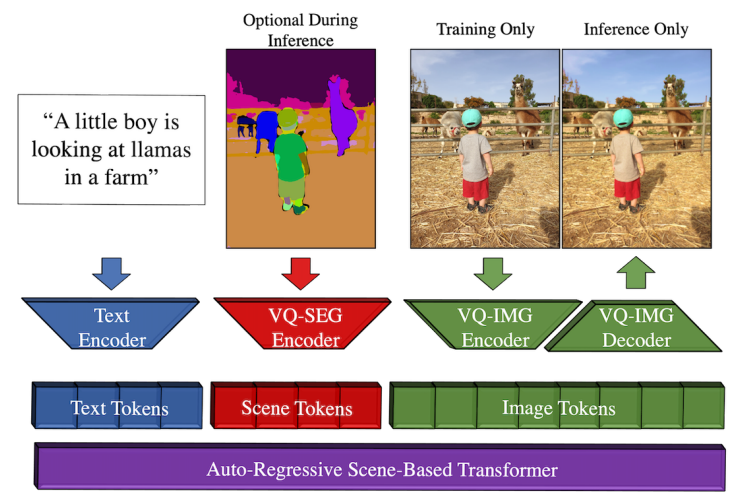
results Figure 6. from paper

What needs to be done?

Refer to the different folders to see details.

Citation

@misc{https://doi.org/10.48550/arxiv.2203.13131,
  doi = {10.48550/ARXIV.2203.13131},
  url = {https://arxiv.org/abs/2203.13131},
  author = {Gafni, Oran and Polyak, Adam and Ashual, Oron and Sheynin, Shelly and Parikh, Devi and Taigman, Yaniv},
  title = {Make-A-Scene: Scene-Based Text-to-Image Generation with Human Priors},
  publisher = {arXiv},
  year = {2022},
  copyright = {arXiv.org perpetual, non-exclusive license}
}
Owner
Casual GAN Papers
Generative AI community | Popular ML paper summaries | Generative Art | Paper Implementations
Casual GAN Papers
Meshed-Memory Transformer for Image Captioning. CVPR 2020

M²: Meshed-Memory Transformer This repository contains the reference code for the paper Meshed-Memory Transformer for Image Captioning (CVPR 2020). Pl

AImageLab 422 Dec 28, 2022
Includes PyTorch -> Keras model porting code for ConvNeXt family of models with fine-tuning and inference notebooks.

ConvNeXt-TF This repository provides TensorFlow / Keras implementations of different ConvNeXt [1] variants. It also provides the TensorFlow / Keras mo

Sayak Paul 87 Dec 06, 2022
PyTorch implementation of Convolutional Neural Fabrics http://arxiv.org/abs/1606.02492

PyTorch implementation of Convolutional Neural Fabrics arxiv:1606.02492 There are some minor differences: The raw image is first convolved, to obtain

Anuvabh Dutt 25 Dec 22, 2021
Deep Convolutional Generative Adversarial Networks

Unsupervised Representation Learning with Deep Convolutional Generative Adversarial Networks Alec Radford, Luke Metz, Soumith Chintala All images in t

Alec Radford 3.4k Dec 29, 2022
Benchmark tools for Compressive LiDAR-to-map registration

Benchmark tools for Compressive LiDAR-to-map registration This repo contains the released version of code and datasets used for our IROS 2021 paper: "

Allie 9 Nov 24, 2022
Implicit Deep Adaptive Design (iDAD)

Implicit Deep Adaptive Design (iDAD) This code supports the NeurIPS paper 'Implicit Deep Adaptive Design: Policy-Based Experimental Design without Lik

Desi 12 Aug 14, 2022
Hysterese plugin with two temperature offset areas

craftbeerpi4 plugin OffsetHysterese Temperatur-Steuerungs-Plugin mit zwei tempereaturbereich abhängigen Offsets. Installation sudo pip3 install https:

HappyHibo 1 Dec 21, 2021
High-Resolution 3D Human Digitization from A Single Image.

PIFuHD: Multi-Level Pixel-Aligned Implicit Function for High-Resolution 3D Human Digitization (CVPR 2020) News: [2020/06/15] Demo with Google Colab (i

Meta Research 8.4k Dec 29, 2022
Distributed Evolutionary Algorithms in Python

DEAP DEAP is a novel evolutionary computation framework for rapid prototyping and testing of ideas. It seeks to make algorithms explicit and data stru

Distributed Evolutionary Algorithms in Python 4.9k Jan 05, 2023
Chainer Implementation of Semantic Segmentation using Adversarial Networks

Semantic Segmentation using Adversarial Networks Requirements Chainer (1.23.0) Differences Use of FCN-VGG16 instead of Dilated8 as Segmentor. Caution

Taiki Oyama 99 Jun 28, 2022
Code for DeepXML: A Deep Extreme Multi-Label Learning Framework Applied to Short Text Documents

DeepXML Code for DeepXML: A Deep Extreme Multi-Label Learning Framework Applied to Short Text Documents Architectures and algorithms DeepXML supports

Extreme Classification 49 Nov 06, 2022
A python library for self-supervised learning on images.

Lightly is a computer vision framework for self-supervised learning. We, at Lightly, are passionate engineers who want to make deep learning more effi

Lightly 2k Jan 08, 2023
An image processing project uses Viola-jones technique to detect faces and then use SIFT algorithm for recognition.

Attendance_System An image processing project uses Viola-jones technique to detect faces and then use LPB algorithm for recognition. Face Detection Us

8 Jan 11, 2022
Tweesent-back - Tweesent backend uses fastAPI as the web framework

TweeSent Backend Tweesent backend. This repo uses fastAPI as the web framework.

0 Mar 26, 2022
PyTorch implementation of ENet

PyTorch-ENet PyTorch (v1.1.0) implementation of ENet: A Deep Neural Network Architecture for Real-Time Semantic Segmentation, ported from the lua-torc

David Silva 333 Dec 29, 2022
Decompose to Adapt: Cross-domain Object Detection via Feature Disentanglement

Decompose to Adapt: Cross-domain Object Detection via Feature Disentanglement In this project, we proposed a Domain Disentanglement Faster-RCNN (DDF)

19 Nov 24, 2022
Code release for NeurIPS 2020 paper "Co-Tuning for Transfer Learning"

CoTuning Official implementation for NeurIPS 2020 paper Co-Tuning for Transfer Learning. [News] 2021/01/13 The COCO 70 dataset used in the paper is av

THUML @ Tsinghua University 35 Sep 23, 2022
[CVPR 2022] CoTTA Code for our CVPR 2022 paper Continual Test-Time Domain Adaptation

CoTTA Code for our CVPR 2022 paper Continual Test-Time Domain Adaptation Prerequisite Please create and activate the following conda envrionment. To r

Qin Wang 87 Jan 08, 2023
A certifiable defense against adversarial examples by training neural networks to be provably robust

DiffAI v3 DiffAI is a system for training neural networks to be provably robust and for proving that they are robust. The system was developed for the

SRI Lab, ETH Zurich 202 Dec 13, 2022
[peer review] An Arbitrary Scale Super-Resolution Approach for 3D MR Images using Implicit Neural Representation

ArSSR This repository is the pytorch implementation of our manuscript "An Arbitrary Scale Super-Resolution Approach for 3-Dimensional Magnetic Resonan

Qing Wu 19 Dec 12, 2022