An image processing project uses Viola-jones technique to detect faces and then use SIFT algorithm for recognition.

Overview

Attendance_System

An image processing project uses Viola-jones technique to detect faces and then use LPB algorithm for recognition.

Face Detection Using Viola-Jones Algorithm

steps to implement:

  1. Calculating Integral Image
  2. integral images are used to simplify the calculations of haar like features and save time of iterating over all pixels
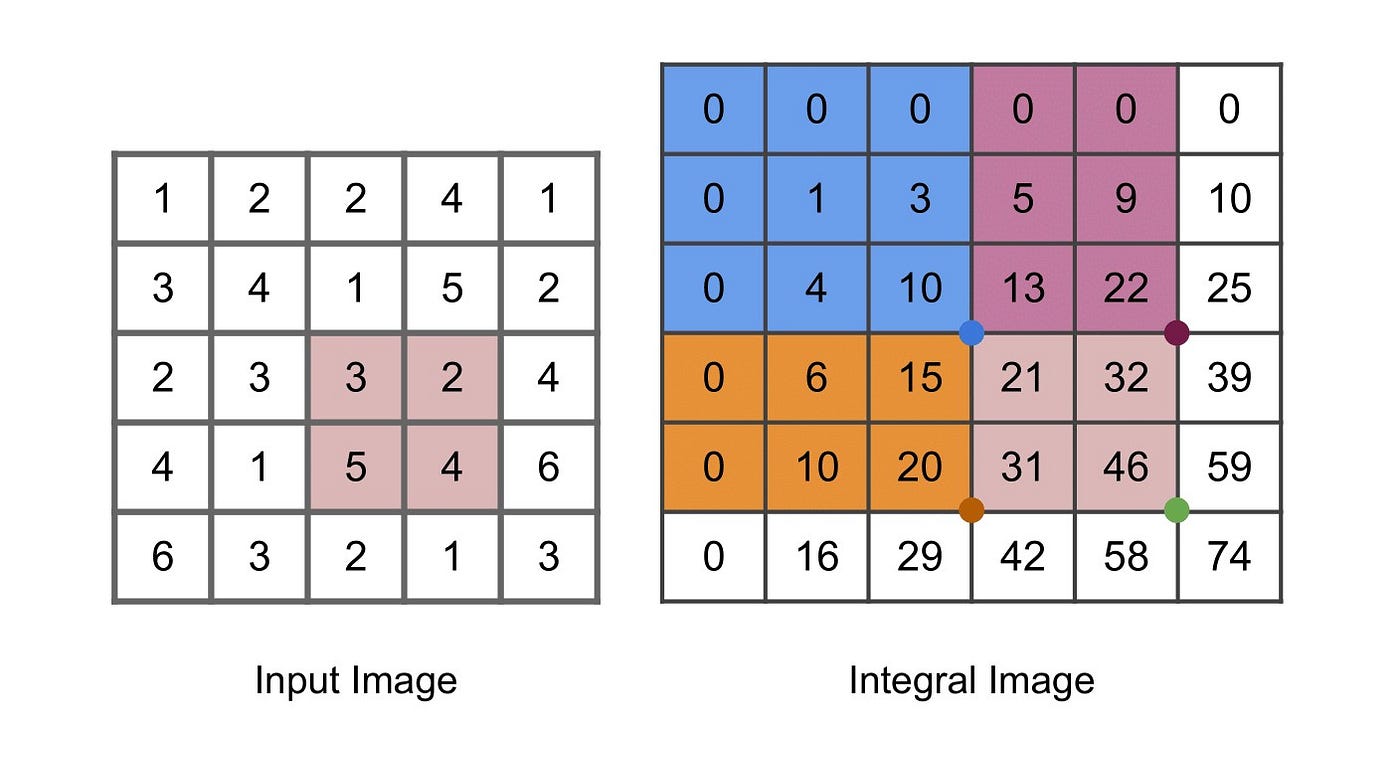

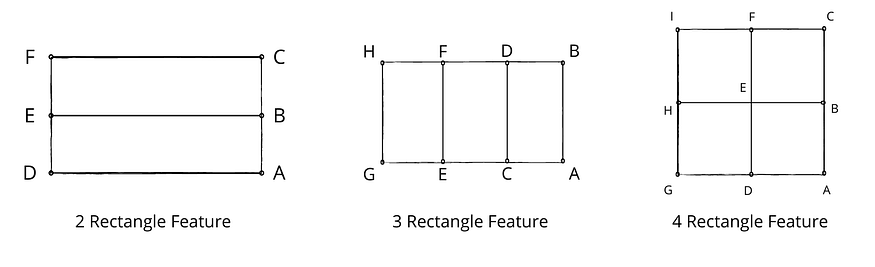
  3. Calculating Haar like features
  4. there are multiple types of haar feature windows, in our implementation, we used 5 types: (2 horizontal, 2 vertical, 3 horizontal, 3 vertical, 2*2 diagonal)
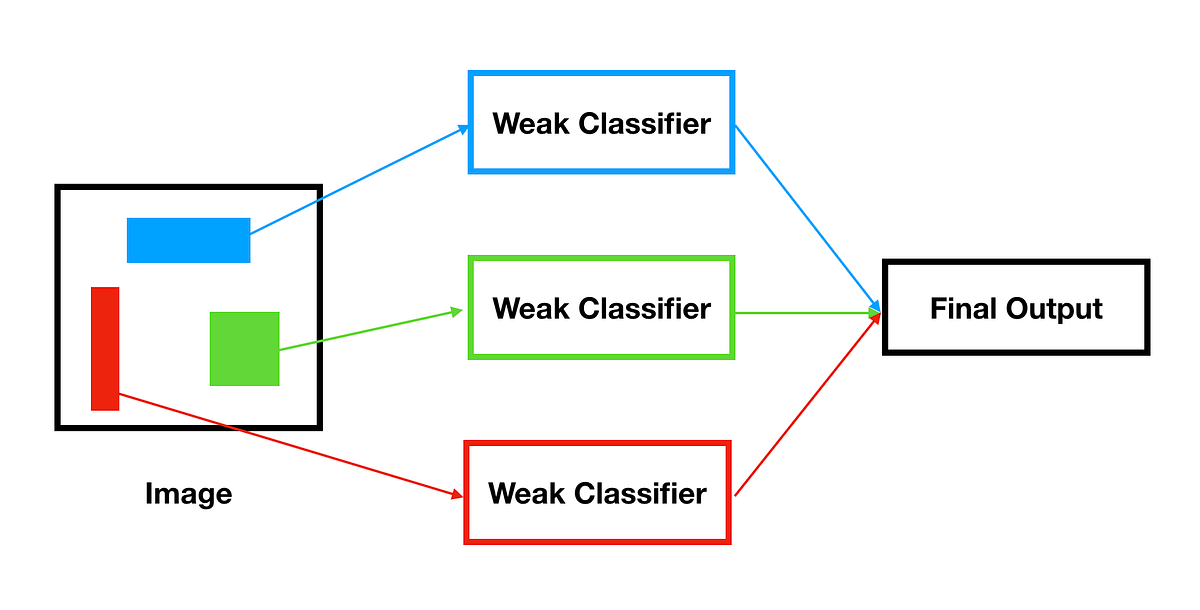
  5. AdaBoost Learning Algorithm
  6. Cascade Filter

Preprocessing Images

before preprocessing

output4

- image is cropped centered and resized to fit our window size(19,19)

- a gamma correction is applied to the image to enhance the detection

output3

Results ๐Ÿ“

Best Accuracy we got from a model trained by a training set of ( 2000 faces, 1500 non-faces) with 40 classifiers and only 1 layer of cascade classifier

test

results on image with multiple faces ๐Ÿ‘ฅ

output2

results on realtime with only one face ๐Ÿ‘ค

IMG-20220105-WA0024

How to use?

open ViolaJones/main.ipynb and run all cells

Recognition ๐Ÿ“

can detect most of input images

results on image ๐Ÿ‘ฅ

output2

How to use?

make new dataset in gray images and name it with your name

save your input photo in images folder

open recognize faces.ipynb and run all cells and just type your photo name and extention in test function

For Training

  1. In the fisrt cell slice the dataset as you want (the pkl file consist of 4000 faces and 7060 non-faces)
  2. Run the second cell and wait until the model finish the training (it might take a while depending on number of training samples)
  3. after that the model is stored in file called cvj_weights-..-...-...pkl

For Testing

  1. Run the remaining cells and change the image by the one you want
  2. For realtime run the last cell that opens camera for you
QA-GNN: Question Answering using Language Models and Knowledge Graphs

QA-GNN: Question Answering using Language Models and Knowledge Graphs This repo provides the source code & data of our paper: QA-GNN: Reasoning with L

Michihiro Yasunaga 434 Jan 04, 2023
Build fully-functioning computer vision models with PyTorch

Detecto is a Python package that allows you to build fully-functioning computer vision and object detection models with just 5 lines of code. Inferenc

Alan Bi 576 Dec 29, 2022
Codes for our IJCAI21 paper: Dialogue Discourse-Aware Graph Model and Data Augmentation for Meeting Summarization

DDAMS This is the pytorch code for our IJCAI 2021 paper Dialogue Discourse-Aware Graph Model and Data Augmentation for Meeting Summarization [Arxiv Pr

xcfeng 55 Dec 27, 2022
Dense Gaussian Processes for Few-Shot Segmentation

DGPNet - Dense Gaussian Processes for Few-Shot Segmentation Welcome to the public repository for DGPNet. The paper is available at arxiv: https://arxi

37 Jan 07, 2023
The official codes of our CVPR2022 paper: A Differentiable Two-stage Alignment Scheme for Burst Image Reconstruction with Large Shift

TwoStageAlign The official codes of our CVPR2022 paper: A Differentiable Two-stage Alignment Scheme for Burst Image Reconstruction with Large Shift Pa

Shi Guo 32 Dec 15, 2022
A note taker for NVDA. Allows the user to create, edit, view, manage and export notes to different formats.

Quick Notetaker add-on for NVDA The Quick Notetaker add-on is a wonderful tool which allows writing notes quickly and easily anytime and from any app

5 Dec 06, 2022
PyTorch code for our paper "Image Super-Resolution with Non-Local Sparse Attention" (CVPR2021).

Image Super-Resolution with Non-Local Sparse Attention This repository is for NLSN introduced in the following paper "Image Super-Resolution with Non-

143 Dec 28, 2022
Code for our paper "Sematic Representation for Dialogue Modeling" in ACL2021

AMR-Dialogue An implementation for paper "Semantic Representation for Dialogue Modeling". You may find our paper here. Requirements python 3.6 pytorch

xfbai 45 Dec 26, 2022
Official PyTorch Implementation of Hypercorrelation Squeeze for Few-Shot Segmentation, arXiv 2021

Hypercorrelation Squeeze for Few-Shot Segmentation This is the implementation of the paper "Hypercorrelation Squeeze for Few-Shot Segmentation" by Juh

Juhong Min 165 Dec 28, 2022
[ICCV 2021 Oral] Mining Latent Classes for Few-shot Segmentation

Mining Latent Classes for Few-shot Segmentation Lihe Yang, Wei Zhuo, Lei Qi, Yinghuan Shi, Yang Gao. This codebase contains baseline of our paper Mini

Lihe Yang 66 Nov 29, 2022
[CVPR 2022 Oral] MixFormer: End-to-End Tracking with Iterative Mixed Attention

MixFormer The official implementation of the CVPR 2022 paper MixFormer: End-to-End Tracking with Iterative Mixed Attention [Models and Raw results] (G

Multimedia Computing Group, Nanjing University 235 Jan 03, 2023
Pytorch implementation of XRD spectral identification from COD database

XRDidentifier Pytorch implementation of XRD spectral identification from COD database. Details will be explained in the paper to be submitted to NeurI

Masaki Adachi 4 Jan 07, 2023
Multi-atlas segmentation (MAS) is a promising framework for medical image segmentation

Multi-atlas segmentation (MAS) is a promising framework for medical image segmentation. Generally, MAS methods register multiple atlases, i.e., medical images with corresponding labels, to a target i

NanYoMy 13 Oct 09, 2022
Framework for estimating the structures and parameters of Bayesian networks (DAGs) at per-sample resolution

Sample-specific Bayesian Networks A framework for estimating the structures and parameters of Bayesian networks (DAGs) at per-sample or per-patient re

Caleb Ellington 1 Sep 23, 2022
for taichi voxel-challange event

Taichi Voxel Challenge Figure: result of python3 example6.py. Please replace the image above (demo.jpg) with yours, so that other people can immediate

Liming Xu 20 Nov 26, 2022
ICON: Implicit Clothed humans Obtained from Normals (CVPR 2022)

ICON: Implicit Clothed humans Obtained from Normals Yuliang Xiu ยท Jinlong Yang ยท Dimitrios Tzionas ยท Michael J. Black CVPR 2022 News ๐Ÿšฉ [2022/04/26] H

Yuliang Xiu 1.1k Jan 04, 2023
Official implementation for paper Knowledge Bridging for Empathetic Dialogue Generation (AAAI 2021).

Knowledge Bridging for Empathetic Dialogue Generation This is the official implementation for paper Knowledge Bridging for Empathetic Dialogue Generat

Qintong Li 50 Dec 20, 2022
StarGAN v2 - Official PyTorch Implementation (CVPR 2020)

StarGAN v2 - Official PyTorch Implementation StarGAN v2: Diverse Image Synthesis for Multiple Domains Yunjey Choi*, Youngjung Uh*, Jaejun Yoo*, Jung-W

Clova AI Research 3.1k Jan 09, 2023
DCGAN-tensorflow - A tensorflow implementation of Deep Convolutional Generative Adversarial Networks

DCGAN in Tensorflow Tensorflow implementation of Deep Convolutional Generative Adversarial Networks which is a stabilize Generative Adversarial Networ

Taehoon Kim 7.1k Dec 29, 2022
[NeurIPS 2021] A weak-shot object detection approach by transferring semantic similarity and mask prior.

TransMaS This repository is the official pytorch implementation of the following paper: NIPS2021 Mixed Supervised Object Detection by TransferringMask

BCMI 49 Jul 27, 2022