Denoising Diffusion Implicit Models

Related tags

Deep Learningddim
Overview

Denoising Diffusion Implicit Models (DDIM)

Jiaming Song, Chenlin Meng and Stefano Ermon, Stanford

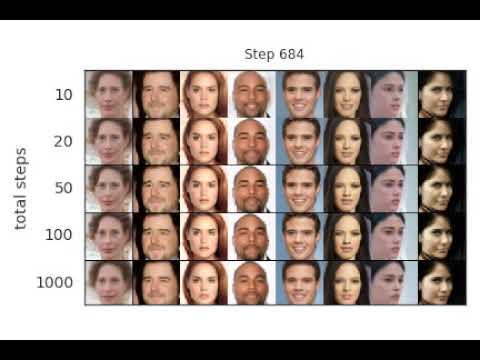
Implements sampling from an implicit model that is trained with the same procedure as Denoising Diffusion Probabilistic Model, but costs much less time and compute if you want to sample from it (click image below for a video demo):
Running the Experiments

The code has been tested on PyTorch 1.6.

Train a model

Training is exactly the same as DDPM with the following:

python main.py --config {DATASET}.yml --exp {PROJECT_PATH} --doc {MODEL_NAME} --ni

Sampling from the model

Sampling from the generalized model for FID evaluation

python main.py --config {DATASET}.yml --exp {PROJECT_PATH} --doc {MODEL_NAME} --sample --fid --timesteps {STEPS} --eta {ETA} --ni

where

  • ETA controls the scale of the variance (0 is DDIM, and 1 is one type of DDPM).
  • STEPS controls how many timesteps used in the process.
  • MODEL_NAME finds the pre-trained checkpoint according to its inferred path.

If you want to use the DDPM pretrained model:

python main.py --config {DATASET}.yml --exp {PROJECT_PATH} --use_pretrained --sample --fid --timesteps {STEPS} --eta {ETA} --ni

the --use_pretrained option will automatically load the model according to the dataset.

We provide a CelebA 64x64 model here, and use the DDPM version for CIFAR10 and LSUN.

If you want to use the version with the larger variance in DDPM: use the --sample_type ddpm_noisy option.

Sampling from the model for image inpainting

Use --interpolation option instead of --fid.

Sampling from the sequence of images that lead to the sample

Use --sequence option instead.

The above two cases contain some hard-coded lines specific to producing the image, so modify them according to your needs.

References and Acknowledgements

@article{song2020denoising,
  title={Denoising Diffusion Implicit Models},
  author={Song, Jiaming and Meng, Chenlin and Ermon, Stefano},
  journal={arXiv:2010.02502},
  year={2020},
  month={October},
  abbr={Preprint},
  url={https://arxiv.org/abs/2010.02502}
}

This implementation is based on / inspired by:

Colab notebook and additional materials for Python-driven analysis of redlining data in Philadelphia

RedliningExploration The Google Colaboratory file contained in this repository contains work inspired by a project on educational inequality in the Ph

Benjamin Warren 1 Jan 20, 2022
SPTAG: A library for fast approximate nearest neighbor search

SPTAG: A library for fast approximate nearest neighbor search SPTAG SPTAG (Space Partition Tree And Graph) is a library for large scale vector approxi

Microsoft 4.3k Jan 01, 2023
Supporting code for "Autoregressive neural-network wavefunctions for ab initio quantum chemistry".

naqs-for-quantum-chemistry This repository contains the codebase developed for the paper Autoregressive neural-network wavefunctions for ab initio qua

Tom Barrett 24 Dec 23, 2022
AttentionGAN for Unpaired Image-to-Image Translation & Multi-Domain Image-to-Image Translation

AttentionGAN-v2 for Unpaired Image-to-Image Translation AttentionGAN-v2 Framework The proposed generator learns both foreground and background attenti

Hao Tang 530 Dec 27, 2022
UA-GEC: Grammatical Error Correction and Fluency Corpus for the Ukrainian Language

UA-GEC: Grammatical Error Correction and Fluency Corpus for the Ukrainian Language This repository contains UA-GEC data and an accompanying Python lib

Grammarly 226 Dec 29, 2022
Code & Data for the Paper "Time Masking for Temporal Language Models", WSDM 2022

Time Masking for Temporal Language Models This repository provides a reference implementation of the paper: Time Masking for Temporal Language Models

Guy Rosin 12 Jan 06, 2023
Tensorflow implementation of "BEGAN: Boundary Equilibrium Generative Adversarial Networks"

BEGAN in Tensorflow Tensorflow implementation of BEGAN: Boundary Equilibrium Generative Adversarial Networks. Requirements Python 2.7 or 3.x Pillow tq

Taehoon Kim 922 Dec 21, 2022
Sentiment analysis translations of the Bhagavad Gita

Sentiment and Semantic Analysis of Bhagavad Gita Translations It is well known that translations of songs and poems not only breaks rhythm and rhyming

Machine learning and Bayesian inference @ UNSW Sydney 3 Aug 01, 2022
This is a clean and robust Pytorch implementation of DQN and Double DQN.

DQN/DDQN-Pytorch This is a clean and robust Pytorch implementation of DQN and Double DQN. Here is the training curve: All the experiments are trained

XinJingHao 15 Dec 27, 2022
git《Joint Entity and Relation Extraction with Set Prediction Networks》(2020) GitHub:

Joint Entity and Relation Extraction with Set Prediction Networks Source code for Joint Entity and Relation Extraction with Set Prediction Networks. W

130 Dec 13, 2022
PyTorch implementations of deep reinforcement learning algorithms and environments

Deep Reinforcement Learning Algorithms with PyTorch This repository contains PyTorch implementations of deep reinforcement learning algorithms and env

Petros Christodoulou 4.7k Jan 04, 2023
A deep learning tabular classification architecture inspired by TabTransformer with integrated gated multilayer perceptron.

The GatedTabTransformer. A deep learning tabular classification architecture inspired by TabTransformer with integrated gated multilayer perceptron. C

Radi Cho 60 Dec 15, 2022
This repository includes the code of the sequence-to-sequence model for discontinuous constituent parsing described in paper Discontinuous Grammar as a Foreign Language.

Discontinuous Grammar as a Foreign Language This repository includes the code of the sequence-to-sequence model for discontinuous constituent parsing

Daniel Fernández-González 2 Apr 07, 2022
Reporting and Visualization for Hazardous Events

Reporting and Visualization for Hazardous Events

Jv Kyle Eclarin 2 Oct 03, 2021
The official PyTorch code implementation of "Personalized Trajectory Prediction via Distribution Discrimination" in ICCV 2021.

Personalized Trajectory Prediction via Distribution Discrimination (DisDis) The official PyTorch code implementation of "Personalized Trajectory Predi

25 Dec 20, 2022
Resources for the "Evaluating the Factual Consistency of Abstractive Text Summarization" paper

Evaluating the Factual Consistency of Abstractive Text Summarization Authors: Wojciech Kryściński, Bryan McCann, Caiming Xiong, and Richard Socher Int

Salesforce 165 Dec 21, 2022
PyTorch implementation for MINE: Continuous-Depth MPI with Neural Radiance Fields

MINE: Continuous-Depth MPI with Neural Radiance Fields Project Page | Video PyTorch implementation for our ICCV 2021 paper. MINE: Towards Continuous D

Zijian Feng 325 Dec 29, 2022
Keyhole Imaging: Non-Line-of-Sight Imaging and Tracking of Moving Objects Along a Single Optical Path

Keyhole Imaging Code & Dataset Code associated with the paper "Keyhole Imaging: Non-Line-of-Sight Imaging and Tracking of Moving Objects Along a Singl

Stanford Computational Imaging Lab 20 Feb 03, 2022
Latte: Cross-framework Python Package for Evaluation of Latent-based Generative Models

Cross-framework Python Package for Evaluation of Latent-based Generative Models Latte Latte (for LATent Tensor Evaluation) is a cross-framework Python

Karn Watcharasupat 30 Sep 08, 2022
A graph adversarial learning toolbox based on PyTorch and DGL.

GraphWar: Arms Race in Graph Adversarial Learning NOTE: GraphWar is still in the early stages and the API will likely continue to change. 🚀 Installat

Jintang Li 54 Jan 05, 2023