PyTorch-Multi-Style-Transfer - Neural Style and MSG-Net

Overview

PyTorch-Style-Transfer

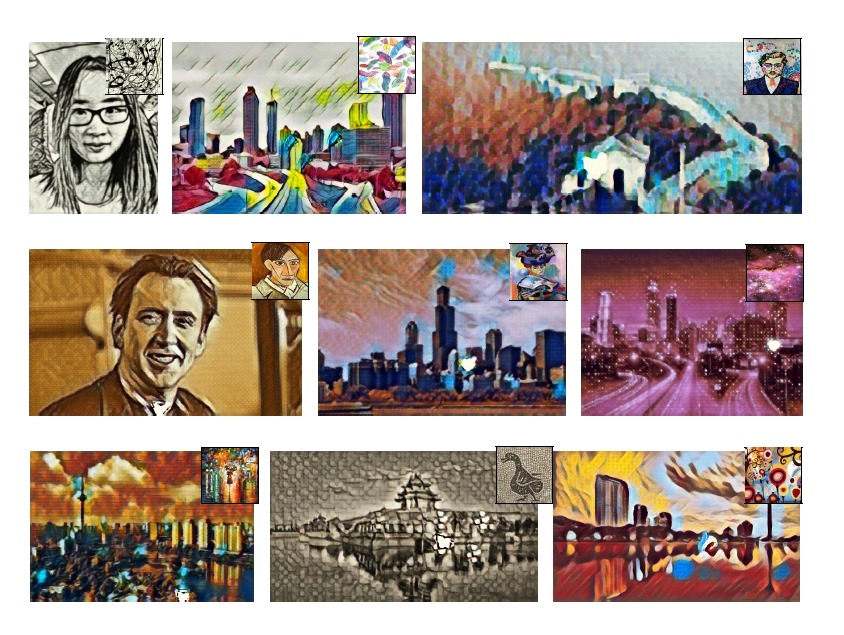
This repo provides PyTorch Implementation of MSG-Net (ours) and Neural Style (Gatys et al. CVPR 2016), which has been included by ModelDepot. We also provide Torch implementation and MXNet implementation.

Tabe of content

MSG-Net

Multi-style Generative Network for Real-time Transfer [arXiv] [project]
Hang Zhang, Kristin Dana
@article{zhang2017multistyle,
	title={Multi-style Generative Network for Real-time Transfer},
	author={Zhang, Hang and Dana, Kristin},
	journal={arXiv preprint arXiv:1703.06953},
	year={2017}
}

Stylize Images Using Pre-trained MSG-Net

  1. Download the pre-trained model
    git clone [email protected]:zhanghang1989/PyTorch-Style-Transfer.git
    cd PyTorch-Style-Transfer/experiments
    bash models/download_model.sh
  2. Camera Demo
    python camera_demo.py demo --model models/21styles.model
  3. Test the model
    python main.py eval --content-image images/content/venice-boat.jpg --style-image images/21styles/candy.jpg --model models/21styles.model --content-size 1024
  • If you don't have a GPU, simply set --cuda=0. For a different style, set --style-image path/to/style. If you would to stylize your own photo, change the --content-image path/to/your/photo. More options:

    • --content-image: path to content image you want to stylize.
    • --style-image: path to style image (typically covered during the training).
    • --model: path to the pre-trained model to be used for stylizing the image.
    • --output-image: path for saving the output image.
    • --content-size: the content image size to test on.
    • --cuda: set it to 1 for running on GPU, 0 for CPU.

Train Your Own MSG-Net Model

  1. Download the COCO dataset
    bash dataset/download_dataset.sh
  2. Train the model
    python main.py train --epochs 4
  • If you would like to customize styles, set --style-folder path/to/your/styles. More options:
    • --style-folder: path to the folder style images.
    • --vgg-model-dir: path to folder where the vgg model will be downloaded.
    • --save-model-dir: path to folder where trained model will be saved.
    • --cuda: set it to 1 for running on GPU, 0 for CPU.

Neural Style

Image Style Transfer Using Convolutional Neural Networks by Leon A. Gatys, Alexander S. Ecker, and Matthias Bethge.

python main.py optim --content-image images/content/venice-boat.jpg --style-image images/21styles/candy.jpg
  • --content-image: path to content image.
  • --style-image: path to style image.
  • --output-image: path for saving the output image.
  • --content-size: the content image size to test on.
  • --style-size: the style image size to test on.
  • --cuda: set it to 1 for running on GPU, 0 for CPU.

Acknowledgement

The code benefits from outstanding prior work and their implementations including:

Comments
  • training new model

    training new model

    @zhanghang1989 I trained a model with three style images. Now, I see eight .model files. Can you please tell me which .model file to use OR how to integrate them to single model file.

    Thanks Akash

    opened by akashdexati 7
  • Unable to resume training

    Unable to resume training

    Hey,

    So I started training a model, but seeing how long it was going to take I wanted to double check I could successfully resume training.

    I ran: python3 main.py train --epochs 4 --style-folder images/xmas-styles/ --save-model-dir trained_models/ until it generated the first checkpoint, then I ran python3 main.py train --epochs 4 --style-folder images/xmas-styles/ --save-model-dir trained_models/ --resume trained_models/Epoch_0iters_8000_Sat_Dec__9_18\:10\:43_2017_1.0_5.0.model and waiting for the first feedback report, which was Sat Dec 9 18:17:09 2017 Epoch 1: [2000/123287] content: 254020.831359 style: 1666218.549250 total: 1920239.380609 so it appeared to not have resumed at all.

    Also slight side question... Say I train with --epochs 4 til I get final model... If I were to use the last checkpoint before final to resume, but set --epochs 5 or higher, would that work correctly and just keep going through to 5 epochs before generating another final, and have no issues etc?

    opened by pingu2k4 6
  • Temporal coherence?

    Temporal coherence?

    Have you tried some technique for temporal coherence? If not, would you mind if I ask which one would you recommend or would like to try.

    Keep up the good work.

    opened by rraallvv 3
  • vgg16.t7 unhashable type: 'numpy.ndarray'

    vgg16.t7 unhashable type: 'numpy.ndarray'

    It's been a while since the last vgg16 issue i found on this "Issues".

    So i download the vgg16.t7 from the paper quoted in this github. And i run this command "python main.py train --epochs 4 --style-folder images/ownstyles --save-model-dir own_models --cuda 1" i have put the vgg16.t7 into models folder, it's been detected correctly. However, the following problem happened.

    Traceback (most recent call last):
      File "main.py", line 295, in <module>
        main()
      File "main.py", line 41, in main
        train(args)
      File "main.py", line 135, in train
        utils.init_vgg16(args.vgg_model_dir)
      File "C:\Users\user\Prepwork\Cap Project\PyTorch-Multi-Style-Transfer\experiments\utils.py", line 100, in init_vgg16
        vgglua = load_lua(os.path.join(model_folder, 'vgg16.t7'))
      File "C:\Users\user\anaconda3\envs\FTDS\lib\site-packages\torchfile.py", line 424, in load
        return reader.read_obj()
      File "C:\Users\user\anaconda3\envs\FTDS\lib\site-packages\torchfile.py", line 370, in read_obj
        obj._obj = self.read_obj()
      File "C:\Users\user\anaconda3\envs\FTDS\lib\site-packages\torchfile.py", line 385, in read_obj
        k = self.read_obj()
      File "C:\Users\user\anaconda3\envs\FTDS\lib\site-packages\torchfile.py", line 386, in read_obj
        v = self.read_obj()
      File "C:\Users\user\anaconda3\envs\FTDS\lib\site-packages\torchfile.py", line 370, in read_obj
        obj._obj = self.read_obj()
      File "C:\Users\user\anaconda3\envs\FTDS\lib\site-packages\torchfile.py", line 387, in read_obj
        obj[k] = v
    TypeError: unhashable type: 'numpy.ndarray'
    

    Is there anyway i can fix this? i found in other thread they said replace with another one, but i could not find another one other than from stanford.

    Thanks!

    opened by fuddyduddy 2
  • Fix colab notebook

    Fix colab notebook

    Hi. Made some changes to notebook:

    • fixed RuntimeError #21, #32, that was fixed in #31 and #37, but not for msgnet.ipynb;
    • removed unused import torch.nn.functional;
    • prettified according to pep8;
    • changed os.system('wget ...') to direct calling !wget ... without importing os module.

    Tested in colab (run all), the notebook works as expected without errors.

    opened by amrzv 1
  • Establish Docker directory

    Establish Docker directory

    What: Establishes a Docker directory with Dockerfile and run script

    Why: The original repo was written for an outdated version of PyTorch, which makes it hard to run on modern systems without conflicting with updated versions of the dependencies.

    Build the container with

    cd Docker
    docker build -t style-transfer .
    
    opened by ss32 1
  • Fix compatibility issues with torch==1.1.0

    Fix compatibility issues with torch==1.1.0

    RuntimeError: Error(s) in loading state_dict for Net:
    	Unexpected running stats buffer(s) "model1.1.running_mean" and "model1.1.running_var" for InstanceNorm2d with track_running_stats=False. If state_dict is a checkpoint saved before 0.4.0, this may be expected because InstanceNorm2d does not track running stats by default since 0.4.0. Please remove these keys from state_dict. If the running stats are actually needed, instead set track_running_stats=True in InstanceNorm2d to enable them. See the documentation of InstanceNorm2d for details.
    
    opened by jianchao-li 1
  • set default values

    set default values

    Hi,

    I try run the camera.py with the arguments discribed in the docs , but fail because inside the code dont have values for args.demo_size and img.copy too Whats the default values for set these variables?

    Thank you

    opened by gledsoul 1
  • Super Slow at optim on linux Mint

    Super Slow at optim on linux Mint

    Have this on a fresh install of linux Mint. I'm running the example, 'python main.py optim --content-image images/content/venice-boat.jpg --style-image images/21styles/candy.jpg' and its taking FOREVER to do anything. I used to have it working at a decent speed on Ubuntu on the same hardware.

    When inspecting GPU and CPU usage, I see it start off with minimal GPU usage, and huge CPU usage. it slowly increases GPU usage over time until it has enough and then completes the rest in around the same time as before. As an example, it takes around 8 minutes to figure out that there isn't enough VRAM for the selected image size, whereas previously on my Ubuntu installation that would take a matter of seconds. Any idea why it would take so much longer on Mint? And what I can do to remedy this?

    opened by pingu2k4 1
  • "TypeError: 'torch.FloatTensor' object is not callable" running demo on CPU

    Sorry if I'm missing something, I'm unfamiliar with PyTorch. I'm running the demo on CPU on a Mac and getting the following error:

      File "camera_demo.py", line 93, in <module>
        main()
      File "camera_demo.py", line 90, in main
        run_demo(args, mirror=True)
      File "camera_demo.py", line 60, in run_demo
        simg = style_v.data().numpy()
    TypeError: 'torch.FloatTensor' object is not callable
    

    Thanks.

    opened by Carmezim 1
  • optim with normal RAM?

    optim with normal RAM?

    Hi,

    So I spent around 24 hours so far training a model on my style images, got the results out by using the model on eval and so far they're not great. When I use the optim function with the styles however the results are pretty decent, however I am limited by my VRAM which is 6GB as to what size images I can output. Having a lot more RAM available, I was hoping I could do pretty decently sized images, but it seems that I can only get much larger images with eval. Does eval use normal RAM instead of VRAM?

    I will continue training my model so that I can use eval in the future, whether I can do larger images with optim or not, but no idea how much more training is required to make it anywhere near a respectable result.

    What sort of overall loss value should I be aiming for? Does the number of style images make a difference to what I should expect?

    opened by pingu2k4 1
  • Error Training TypeError: 'NoneType' object is not callable

    Error Training TypeError: 'NoneType' object is not callable

    I was able to get my environment setup successfully to run eval; however, now, trying train I'm running into an issue. Not sure if it's a syntax issues or if something else is going on? You help is greatly appreciated.

    
    #!/bin/bash
    #SBATCH --job-name=train-pytorch
    #SBATCH --mail-type=END,FAIL
    #SBATCH [email protected]
    #SBATCH --ntasks=1
    #SBATCH --time=00:10:00
    #SBATCH --mem=8000
    #SBATCH --gres=gpu:p100:2
    #SBATCH --cpus-per-task=6
    #SBATCH --output=%x_%j.log
    #SBATCH --error=%x_%j.err
    
    source ~/scratch/moldach/PyTorch-Style-Transfer/experiments/venv/bin/activate
    
    python main.py train \
      --epochs 4 \
      --style-folder /scratch/moldach/PyTorch-Style-Transfer/experiments/images/9styles \
      --vgg-model-dir vgg-model/ \
      --save-model-dir checkpoint/
    
    
    /scratch/moldach/first-order-model/venv/lib/python3.6/site-packages/torchvision/transforms/transforms.py:188: UserWarning: The use of the transforms.Scale transform is deprecated, please use transforms.Resize instead.
      "please use transforms.Resize instead.")
    Traceback (most recent call last):
      File "main.py", line 295, in <module>
        main()
      File "main.py", line 41, in main
        train(args)
      File "main.py", line 135, in train
        utils.init_vgg16(args.vgg_model_dir)
      File "/scratch/moldach/PyTorch-Style-Transfer/experiments/utils.py", line 102, in init_vgg16
        for (src, dst) in zip(vgglua.parameters()[0], vgg.parameters()):
    TypeError: 'NoneType' object is not callable


    pip freeze:

    $ pip freeze
    -f /cvmfs/soft.computecanada.ca/custom/python/wheelhouse/nix/avx2
    -f /cvmfs/soft.computecanada.ca/custom/python/wheelhouse/nix/generic
    -f /cvmfs/soft.computecanada.ca/custom/python/wheelhouse/generic
    cffi==1.11.5
    cloudpickle==0.5.3
    cycler==0.10.0
    dask==0.18.2
    dataclasses==0.8
    decorator==4.4.2
    future==0.18.2
    imageio==2.9.0
    imageio-ffmpeg==0.4.3
    kiwisolver==1.3.1
    matplotlib==3.3.4
    networkx==2.5
    numpy==1.19.1
    pandas==0.23.4
    Pillow==8.1.2
    pycparser==2.18
    pygit==0.1
    pyparsing==2.4.7
    python-dateutil==2.8.1
    pytz==2018.5
    PyWavelets==1.1.1
    PyYAML==5.1
    scikit-image==0.17.2
    scikit-learn==0.19.2
    scipy==1.4.1
    six==1.15.0
    tifffile==2020.9.3
    toolz==0.9.0
    torch==1.7.0
    torchfile==0.1.0
    torchvision==0.2.1
    tqdm==4.24.0
    typing-extensions==3.7.4.3
    
    opened by moldach 4
  • Color produced by eval doesn't match demo

    Color produced by eval doesn't match demo

    Hi ! Thanks for sharing the code. I've ran the eval program using the defaults provided and I noticed the color tends to be much dimmer than what is shown on the homepage here. Is there something that I am missing? The command I used was

    python main.py --style-image ./images/21styles/udnie.jpg --content-image ./images/content/venice-boat.jpg

    out

    opened by clarng 1
  • struct.error: unpack requires a buffer of 4 bytes

    struct.error: unpack requires a buffer of 4 bytes

    Dear author, Thank you so much for sharing a useful code. I able to run your evaluation code, but face the following error during runing of training code: File "main.py", line 41, in main train(args) File "main.py", line 135, in train utils.init_vgg16(args.vgg_model_dir) File "/home2/st118370/models/PyTorch-Multi-Style-Transfer/experiments/utils.py", line 100, in init_vgg16 vgglua = load_lua(os.path.join(model_folder, 'vgg16.t7')) File "/home2/st118370/anaconda3/envs/pytorch-py3/lib/python3.7/site-packages/torchfile.py", line 424, in load return reader.read_obj() File "/home2/st118370/anaconda3/envs/pytorch-py3/lib/python3.7/site-packages/torchfile.py", line 310, in read_obj typeidx = self.read_int() File "/home2/st118370/anaconda3/envs/pytorch-py3/lib/python3.7/site-packages/torchfile.py", line 277, in read_int return self._read('i')[0] File "/home2/st118370/anaconda3/envs/pytorch-py3/lib/python3.7/site-packages/torchfile.py", line 271, in _read return struct.unpack(fmt, self.f.read(sz)) struct.error: unpack requires a buffer of 4 bytes

    how can i resolve this problem? kindly guide. thanks

    opened by MFarooqAit 1
  • vgg16.t7  unhashable type: 'numpy.ndarray

    vgg16.t7 unhashable type: 'numpy.ndarray

    hi

    I have put the vgg16.t7 into models folder, it's been detected correctly. However, the following problem happened.

    Traceback (most recent call last): File "main.py", line 295, in main() File "main.py", line 41, in main train(args) File "main.py", line 135, in train utils.init_vgg16(args.vgg_model_dir) File "C:\Users\user\Prepwork\Cap Project\PyTorch-Multi-Style-Transfer\experiments\utils.py", line 100, in init_vgg16 vgglua = load_lua(os.path.join(model_folder, 'vgg16.t7')) File "C:\Users\user\anaconda3\envs\FTDS\lib\site-packages\torchfile.py", line 424, in load return reader.read_obj() File "C:\Users\user\anaconda3\envs\FTDS\lib\site-packages\torchfile.py", line 370, in read_obj obj._obj = self.read_obj() File "C:\Users\user\anaconda3\envs\FTDS\lib\site-packages\torchfile.py", line 385, in read_obj k = self.read_obj() File "C:\Users\user\anaconda3\envs\FTDS\lib\site-packages\torchfile.py", line 386, in read_obj v = self.read_obj() File "C:\Users\user\anaconda3\envs\FTDS\lib\site-packages\torchfile.py", line 370, in read_obj obj._obj = self.read_obj() File "C:\Users\user\anaconda3\envs\FTDS\lib\site-packages\torchfile.py", line 387, in read_obj obj[k] = v TypeError: unhashable type: 'numpy.ndarray'

    It does't work for pytorch-1.0.0 and 1.4.0, and giving the same error, how to deal with it? thanks !

    opened by Gavin-Evans 13
  • Different brush stroke size

    Different brush stroke size

    In your paper you wrote about the ability to train the model with different sizes of the style images to later get control over the brush stroke size. Did you implement this in either the pytorch or torch implementation? Greetings and keep up the great work

    opened by lpiribauer 0
Releases(v0.1)
(CVPR2021) ClassSR: A General Framework to Accelerate Super-Resolution Networks by Data Characteristic

ClassSR (CVPR2021) ClassSR: A General Framework to Accelerate Super-Resolution Networks by Data Characteristic Paper Authors: Xiangtao Kong, Hengyuan

Xiangtao Kong 308 Jan 05, 2023
Out-of-Town Recommendation with Travel Intention Modeling (AAAI2021)

TrainOR_AAAI21 This is the official implementation of our AAAI'21 paper: Haoran Xin, Xinjiang Lu, Tong Xu, Hao Liu, Jingjing Gu, Dejing Dou, Hui Xiong

Jack Xin 13 Oct 19, 2022
Pytorch implementation for the EMNLP 2020 (Findings) paper: Connecting the Dots: A Knowledgeable Path Generator for Commonsense Question Answering

Path-Generator-QA This is a Pytorch implementation for the EMNLP 2020 (Findings) paper: Connecting the Dots: A Knowledgeable Path Generator for Common

Peifeng Wang 33 Dec 05, 2022
A python module for scientific analysis of 3D objects based on VTK and Numpy

A lightweight and powerful python module for scientific analysis and visualization of 3d objects.

Marco Musy 1.5k Jan 06, 2023
Official implementation of "A Unified Objective for Novel Class Discovery", ICCV2021 (Oral)

A Unified Objective for Novel Class Discovery This is the official repository for the paper: A Unified Objective for Novel Class Discovery Enrico Fini

Enrico Fini 118 Dec 26, 2022
Learning from Synthetic Shadows for Shadow Detection and Removal [Inoue+, IEEE TCSVT 2020].

Learning from Synthetic Shadows for Shadow Detection and Removal (IEEE TCSVT 2020) Overview This repo is for the paper "Learning from Synthetic Shadow

Naoto Inoue 67 Dec 28, 2022
House_prices_kaggle - Predict sales prices and practice feature engineering, RFs, and gradient boosting

House Prices - Advanced Regression Techniques Predicting House Prices with Machine Learning This project is build to enhance my knowledge about machin

Gurpreet Singh 1 Jan 01, 2022
Robotics environments

Robotics environments Details and documentation on these robotics environments are available in OpenAI's blog post and the accompanying technical repo

Farama Foundation 121 Dec 28, 2022
The official implementation of NeurIPS 2021 paper: Finding Optimal Tangent Points for Reducing Distortions of Hard-label Attacks

Introduction This repository includes the source code for "Finding Optimal Tangent Points for Reducing Distortions of Hard-label Attacks", which is pu

machen 11 Nov 27, 2022
A library for uncertainty representation and training in neural networks.

Epistemic Neural Networks A library for uncertainty representation and training in neural networks. Introduction Many applications in deep learning re

DeepMind 211 Dec 12, 2022
Mask-invariant Face Recognition through Template-level Knowledge Distillation

Mask-invariant Face Recognition through Template-level Knowledge Distillation This is the official repository of "Mask-invariant Face Recognition thro

Fadi Boutros 35 Dec 06, 2022
Topic Modelling for Humans

gensim – Topic Modelling in Python Gensim is a Python library for topic modelling, document indexing and similarity retrieval with large corpora. Targ

RARE Technologies 13.8k Jan 03, 2023
code for our paper "Source Data-absent Unsupervised Domain Adaptation through Hypothesis Transfer and Labeling Transfer"

SHOT++ Code for our TPAMI submission "Source Data-absent Unsupervised Domain Adaptation through Hypothesis Transfer and Labeling Transfer" that is ext

75 Dec 16, 2022
A PyTorch implementation of DenseNet.

A PyTorch Implementation of DenseNet This is a PyTorch implementation of the DenseNet-BC architecture as described in the paper Densely Connected Conv

Brandon Amos 771 Dec 15, 2022
Bare bones use-case for deploying a containerized web app (built in streamlit) on AWS.

Containerized Streamlit web app This repository is featured in a 3-part series on Deploying web apps with Streamlit, Docker, and AWS. Checkout the blo

Collin Prather 62 Jan 02, 2023
A Python Package For System Identification Using NARMAX Models

SysIdentPy is a Python module for System Identification using NARMAX models built on top of numpy and is distributed under the 3-Clause BSD license. N

Wilson Rocha 175 Dec 25, 2022
HSC4D: Human-centered 4D Scene Capture in Large-scale Indoor-outdoor Space Using Wearable IMUs and LiDAR. CVPR 2022

HSC4D: Human-centered 4D Scene Capture in Large-scale Indoor-outdoor Space Using Wearable IMUs and LiDAR. CVPR 2022 [Project page | Video] Getting sta

51 Nov 29, 2022
Quantum-enhanced transformer neural network

Example of a Quantum-enhanced transformer neural network Get the code: git clone https://github.com/rdisipio/qtransformer.git cd qtransformer Create

Riccardo Di Sipio 61 Nov 08, 2022
My tensorflow implementation of "A neural conversational model", a Deep learning based chatbot

Deep Q&A Table of Contents Presentation Installation Running Chatbot Web interface Results Pretrained model Improvements Upgrade Presentation This wor

Conchylicultor 2.9k Dec 28, 2022
Self-Learning - Books Papers, Courses & more I have to learn soon

Self-Learning This repository is intended to be used for personal use, all rights reserved to respective owners, please cite original authors and ask

Achint Chaudhary 968 Jan 02, 2022