A PyTorch implementation of the architecture of Mask RCNN

Overview

EDIT (AS OF 4th NOVEMBER 2019):

  1. This implementation has multiple errors and as of the date 4th, November 2019 is insufficient to be utilized as a resource to understanding the architecture of Mask R-CNN. It has been pointed out to me through multiple emails and comments on HackerNews that such a faulty implementation is to the detriment of the research endeavors in the deep learning community. It was a project that I had put together quite early in my academic career and I did not realize the scale of my mistake

  2. I intend to take care of the issues (the issues filed in this repository are representative) and make this code more "readable" and embellish it with better documentation so that it fulfills the purpose for which it was made. Unfortunately, as of right now, I am busy with my academics and cannot attend to this project. I shall start working on bettering this repository by mid-January to early February 2020. Until then, I have provided links to other implementations of Mask R-CNN that I think could help serve your purpose

  3. PR's fixing any one of the issues listed are always welcome and will allow me to get a headstart on this particular task of making this repository more presentable.

Once again I would like to apologize for any inconvenience caused

LINKS

  1. https://github.com/facebookresearch/detectron2 (PyTorch implementation)
  2. https://github.com/matterport/Mask_RCNN (Tensorflow implementation). Much of this repository was built using this repository as a reference

Mask-RCNN

A PyTorch implementation of the architecture of Mask RCNN

Decription of folders

  1. model.py includes the models of ResNet and FPN which were already implemented by the authors of the papers and reproduced in this implementation
  2. nms and RoiAlign are taken from Robb Girshick's implementation of faster RCNN
  3. Focal loss has been added to this implementtaion on lieu of better results as evidenced by the paper on RetinaNets

Mask-RCNN model:
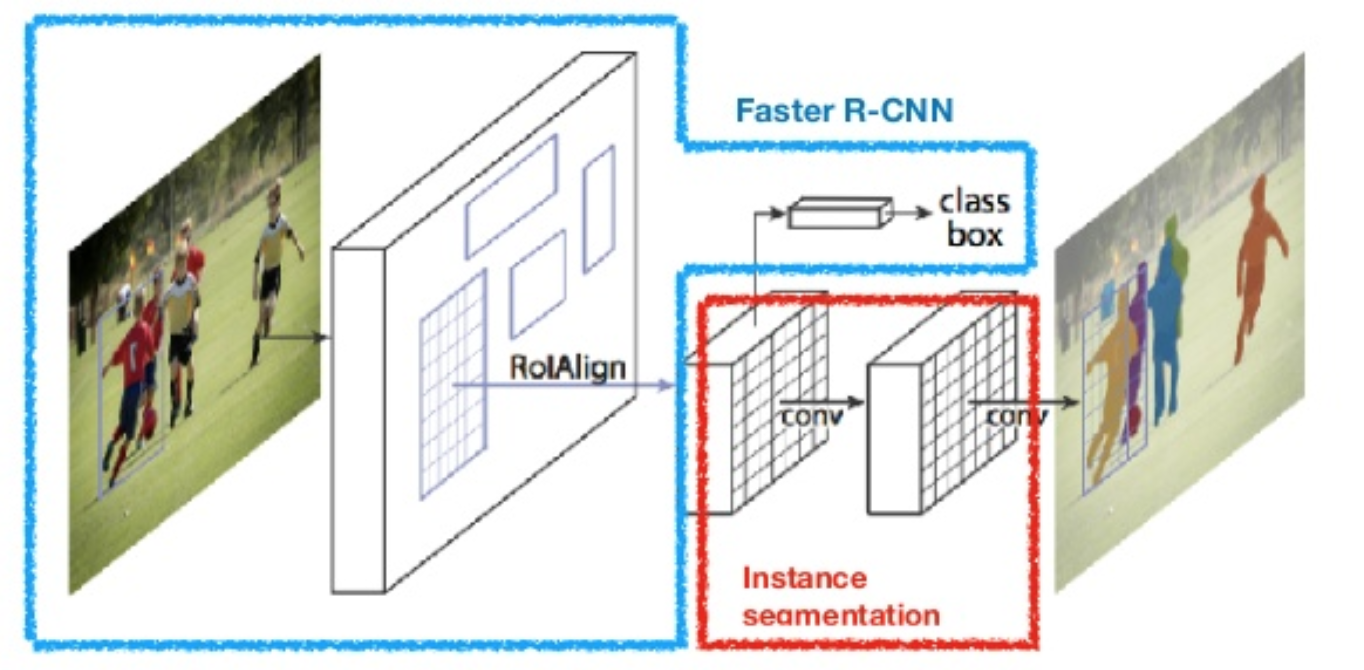
alt text

Features:

  1. The part of the network responsible for bounding box detection derives it's inspiration from the faster RCNN model having a RPN working in tandem with a ConvNet
  2. The pooling layers present in the ConvNet round down or round up to the nearest integer when the stride is not a divisor of the receptive field, which tends to either lose or assume "information" from the image respectively at the non integral points.
  3. ROI align was proposed to deal with this, wherein bilinear interpolation is used to detect the values at the non integral values of the pixels
  4. Using a more complex interpolation scheme( cubic interpolation -> 16 additional features) offers a slightly better result when this model was tested, however not enough to justify the additional complexity
  5. Cross entropy loss when summed over a huge number of proposals tends to take a huge value for proposals that have a high confidence metric thereby dwarfing the contribution from the proposals of interest. Focal Loss was proposed to do away with this problem
  6. However Focal loss gives much better results with single stage networks. This is because a two stage network has some discriminative policy to deal with this class imbalance something which the single stage networks don't enjoy.

If you find any issue in this repsoritory, feel free to fork this repository and submit a PR with the necessary changes

Owner
Sai Himal Allu
Research Assistant at CVIT-IIITH Ex: Undergrad at IIT Roorkee
Sai Himal Allu
A pure PyTorch batched computation implementation of "CIF: Continuous Integrate-and-Fire for End-to-End Speech Recognition"

A pure PyTorch batched computation implementation of "CIF: Continuous Integrate-and-Fire for End-to-End Speech Recognition"

張致強 14 Dec 02, 2022
BEAS: Blockchain Enabled Asynchronous & Secure Federated Machine Learning

BEAS Blockchain Enabled Asynchronous and Secure Federated Machine Learning Default Network Configuration: The default application uses the HyperLedger

Harpreet Virk 11 Nov 20, 2022
CVPR 2021: "The Spatially-Correlative Loss for Various Image Translation Tasks"

Spatially-Correlative Loss arXiv | website We provide the Pytorch implementation of "The Spatially-Correlative Loss for Various Image Translation Task

Chuanxia Zheng 89 Jan 04, 2023
Learning to Reconstruct 3D Manhattan Wireframes from a Single Image

Learning to Reconstruct 3D Manhattan Wireframes From a Single Image This repository contains the PyTorch implementation of the paper: Yichao Zhou, Hao

Yichao Zhou 50 Dec 27, 2022
A PyTorch implementation of the continual learning experiments with deep neural networks

Brain-Inspired Replay A PyTorch implementation of the continual learning experiments with deep neural networks described in the following paper: Brain

182 Dec 27, 2022
OMNIVORE is a single vision model for many different visual modalities

Omnivore: A Single Model for Many Visual Modalities [paper][website] OMNIVORE is a single vision model for many different visual modalities. It learns

Meta Research 451 Dec 27, 2022
We present a regularized self-labeling approach to improve the generalization and robustness properties of fine-tuning.

Overview This repository provides the implementation for the paper "Improved Regularization and Robustness for Fine-tuning in Neural Networks", which

NEU-StatsML-Research 21 Sep 08, 2022
Code for paper PairRE: Knowledge Graph Embeddings via Paired Relation Vectors.

PairRE Code for paper PairRE: Knowledge Graph Embeddings via Paired Relation Vectors. This implementation of PairRE for Open Graph Benchmak datasets (

Alipay 65 Dec 19, 2022
Code for Multiple Instance Active Learning for Object Detection, CVPR 2021

MI-AOD Language: 简体中文 | English Introduction This is the code for Multiple Instance Active Learning for Object Detection (The PDF is not available tem

Tianning Yuan 269 Dec 21, 2022
STARCH compuets regional extreme storm physical characteristics and moisture balance based on spatiotemporal precipitation data from reanalysis or climate model data.

STARCH (Storm Tracking And Regional CHaracterization) STARCH computes regional extreme storm physical and moisture balance characteristics based on sp

Onosama 7 Oct 20, 2022
A Streamlit component to render ECharts.

Streamlit - ECharts A Streamlit component to display ECharts. Install pip install streamlit-echarts Usage This library provides 2 functions to display

Fanilo Andrianasolo 290 Dec 30, 2022
Video2x - A lossless video/GIF/image upscaler achieved with waifu2x, Anime4K, SRMD and RealSR.

Official Discussion Group (Telegram): https://t.me/video2x A Discord server is also available. Please note that most developers are only on Telegram.

K4YT3X 5.9k Dec 31, 2022
This repository contains the code for the paper Neural RGB-D Surface Reconstruction

Neural RGB-D Surface Reconstruction Paper | Project Page | Video Neural RGB-D Surface Reconstruction Dejan Azinović, Ricardo Martin-Brualla, Dan B Gol

Dejan 406 Jan 04, 2023
Encode and decode text application

Text Encoder and Decoder Encode and decode text in many ways using this application! Encode in: ASCII85 Base85 Base64 Base32 Base16 Url MD5 Hash SHA-1

Alice 1 Feb 12, 2022
Resources related to our paper "CLIN-X: pre-trained language models and a study on cross-task transfer for concept extraction in the clinical domain"

CLIN-X (CLIN-X-ES) & (CLIN-X-EN) This repository holds the companion code for the system reported in the paper: "CLIN-X: pre-trained language models a

Bosch Research 4 Dec 05, 2022
Official PyTorch Implementation of Rank & Sort Loss [ICCV2021]

Rank & Sort Loss for Object Detection and Instance Segmentation The official implementation of Rank & Sort Loss. Our implementation is based on mmdete

Kemal Oksuz 229 Dec 20, 2022
PyTorch Implementation of Sparse DETR

Sparse DETR By Byungseok Roh*, Jaewoong Shin*, Wuhyun Shin*, and Saehoon Kim at Kakao Brain. (*: Equal contribution) This repository is an official im

Kakao Brain 113 Dec 28, 2022
On Uncertainty, Tempering, and Data Augmentation in Bayesian Classification

Understanding Bayesian Classification This repository hosts the code to reproduce the results presented in the paper On Uncertainty, Tempering, and Da

Sanyam Kapoor 18 Nov 17, 2022
A self-supervised 3D representation learning framework named viewpoint bottleneck.

Pointly-supervised 3D Scene Parsing with Viewpoint Bottleneck Paper Created by Liyi Luo, Beiwen Tian, Hao Zhao and Guyue Zhou from Institute for AI In

63 Aug 11, 2022