AquaTimer - Programmable Timer for Aquariums based on ATtiny414/814/1614

Overview

AquaTimer - Programmable Timer for Aquariums based on ATtiny414/814/1614

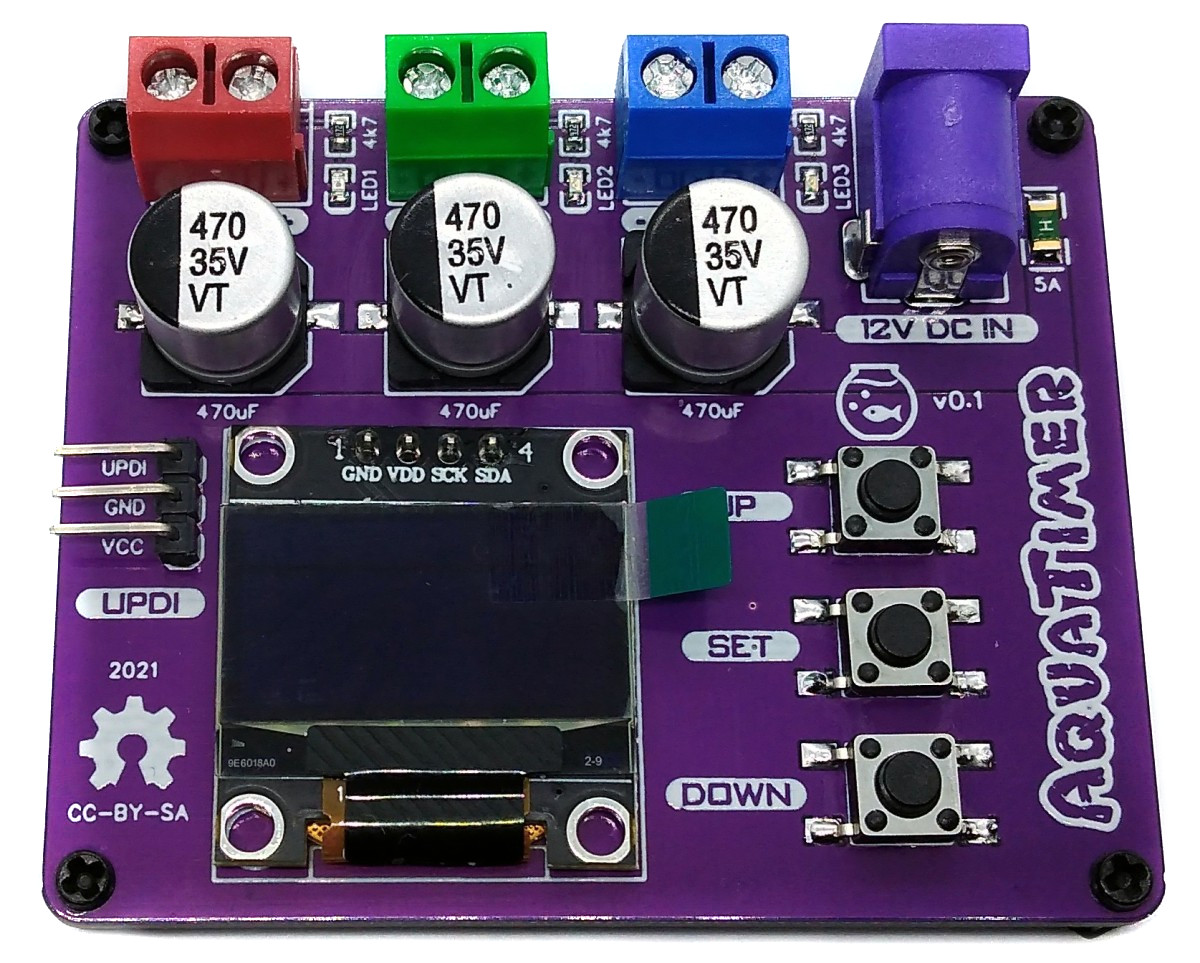
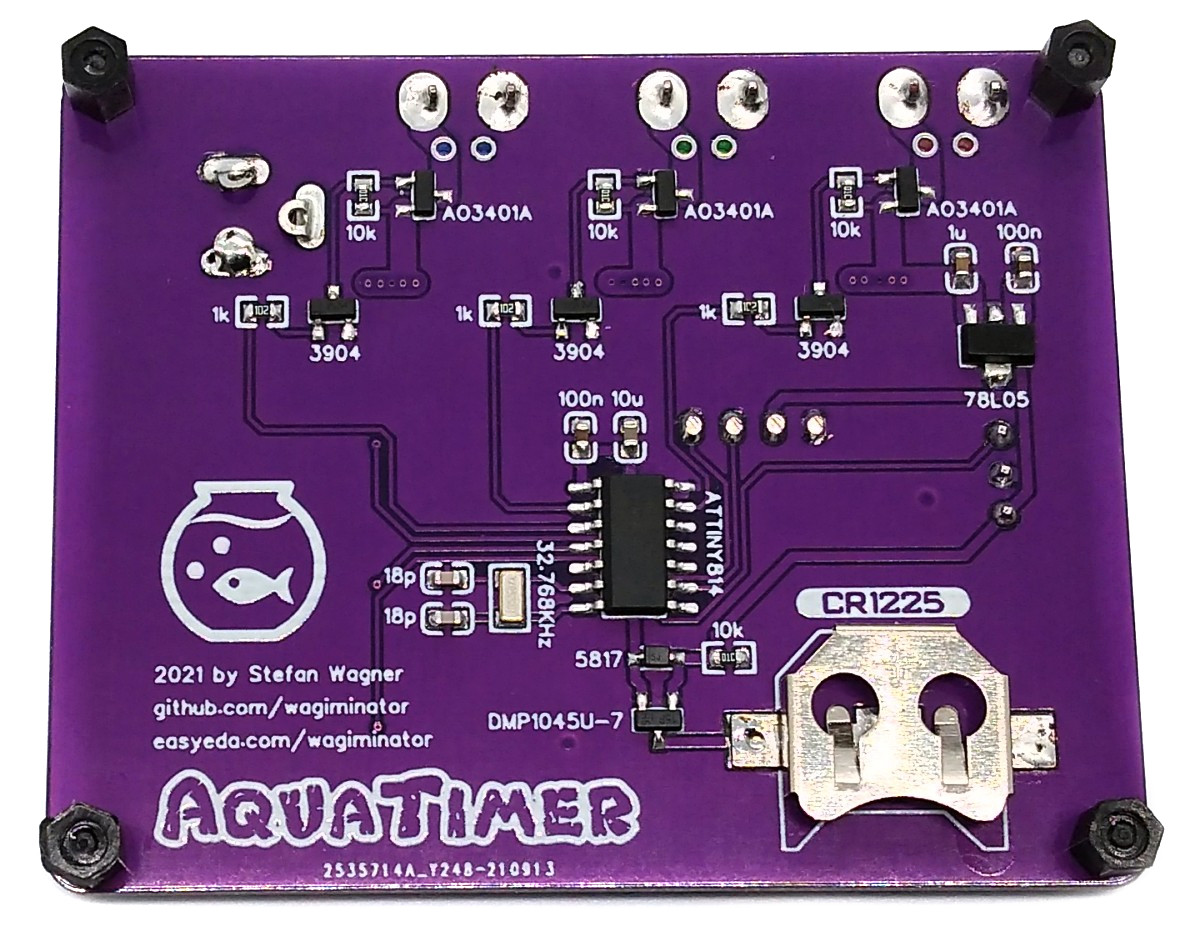
AquaTimer is a programmable timer for 12V devices such as lighting, solenoid valves or pumps not only for aquariums. It has three switchable channels for currents up to 2A each and up to 5A in total. Connected lighting can be dimmed if desired and slowly faded in and out to simulate sunrises and sunsets. The internal RTC of the ATtiny is used as a clockwork in conjunction with a 32.768kHz crystal. A backup battery keeps the clock running even if the external power supply is interrupted. Settings are made using three buttons and the OLED display.

pic1.jpg

Compiling and Uploading the Firmware

If using the Arduino IDE

  • Open your Arduino IDE.
  • Make sure you have installed megaTinyCore.
  • Go to Tools -> Board -> megaTinyCore and select ATtiny1614/1604/814/804/414/404/214/204.
  • Go to Tools and choose the following board options:
    • Chip: ATtiny1614 or ATtiny814 or ATtiny414
    • Clock: 5 MHz internal
    • Leave the rest at the default settings.
  • Connect your programmer to your PC and to the UPDI header on the board.
  • Go to Tools -> Programmer and select your UPDI programmer.
  • Go to Tools -> Burn Bootloader to burn the fuses.
  • Open the sketch and click Upload.

If using the makefile (Linux/Mac)

  • Connect your programmer (jtag2updi or SerialUPDI) to your PC and to the UPDI header on the board.
  • Download AVR 8-bit Toolchain and extract the sub-folders (avr, bin, include, ...) to /software/tools/avr-gcc. To do this, you have to register for free with Microchip on the download site.
  • Open the makefile and set the programmer and port (default is serialupdi on /dev/ttyUSB0).
  • Open a terminal.
  • Navigate to the folder with the makefile and the sketch.
  • Run "make install" to compile, burn the fuses and upload the firmware.

The device time is automatically set to the current time (compilation time) when the firmware is uploaded. Install the CR1220, CR1225 or LIR1220 (recommended) buffer battery before disconnecting the device.

Operating Instructions

  1. Connect the devices to be controlled to the AquaTimer using the screw terminals. Pay attention to the correct polarity!
  2. Connect the AquaTimer to a 12V power supply via the DC barrel connector.
  3. Press the "SET" button to get to the main menu. Adjust the values according to your wishes.

References, Links and Notes
  1. ATtiny814 Datasheet

pic2.jpg pic3.png pic4.jpg

License

license.png

This work is licensed under Creative Commons Attribution-ShareAlike 3.0 Unported License. (http://creativecommons.org/licenses/by-sa/3.0/)

Owner
Stefan Wagner
Stefan Wagner
Koopman operator identification library in Python

pykoop pykoop is a Koopman operator identification library written in Python. It allows the user to specify Koopman lifting functions and regressors i

DECAR Systems Group 34 Jan 04, 2023
Discretized Integrated Gradients for Explaining Language Models (EMNLP 2021)

Discretized Integrated Gradients for Explaining Language Models (EMNLP 2021) Overview of paths used in DIG and IG. w is the word being attributed. The

INK Lab @ USC 17 Oct 27, 2022
Hybrid CenterNet - Hybrid-supervised object detection / Weakly semi-supervised object detection

Hybrid-Supervised Object Detection System Object detection system trained by hybrid-supervision/weakly semi-supervision (HSOD/WSSOD): This project is

5 Dec 10, 2022
Self-Adaptable Point Processes with Nonparametric Time Decays

NPPDecay This is our implementation for the paper Self-Adaptable Point Processes with Nonparametric Time Decays, by Zhimeng Pan, Zheng Wang, Jeff M. P

zpan 2 Sep 24, 2022
基于Flask开发后端、VUE开发前端框架,在WEB端部署YOLOv5目标检测模型

基于Flask开发后端、VUE开发前端框架,在WEB端部署YOLOv5目标检测模型

37 Jan 01, 2023
Website which uses Deep Learning to generate horror stories.

Creepypasta - Text Generator Website which uses Deep Learning to generate horror stories. View Demo · View Website Repo · Report Bug · Request Feature

Dhairya Sharma 5 Oct 14, 2022
Code and Resources for the Transformer Encoder Reasoning Network (TERN)

Transformer Encoder Reasoning Network Code for the cross-modal visual-linguistic retrieval method from "Transformer Reasoning Network for Image-Text M

Nicola Messina 53 Dec 30, 2022
A naive ROS interface for visualDet3D.

YOLO3D ROS Node This repo contains a Monocular 3D detection Ros node. Base on https://github.com/Owen-Liuyuxuan/visualDet3D All parameters are exposed

Yuxuan Liu 19 Oct 08, 2022
hySLAM is a hybrid SLAM/SfM system designed for mapping

HySLAM Overview hySLAM is a hybrid SLAM/SfM system designed for mapping. The system is based on ORB-SLAM2 with some modifications and refactoring. Raú

Brian Hopkinson 15 Oct 10, 2022
People log into different sites every day to get information and browse through these sites one by one

HyperLink People log into different sites every day to get information and browse through these sites one by one. And they are exposed to advertisemen

0 Feb 17, 2022
🏎️ Accelerate training and inference of 🤗 Transformers with easy to use hardware optimization tools

Hugging Face Optimum 🤗 Optimum is an extension of 🤗 Transformers, providing a set of performance optimization tools enabling maximum efficiency to t

Hugging Face 842 Dec 30, 2022
Pytorch library for seismic data augmentation

Pytorch library for seismic data augmentation

Artemii Novoselov 27 Nov 22, 2022
Code for a seq2seq architecture with Bahdanau attention designed to map stereotactic EEG data from human brains to spectrograms, using the PyTorch Lightning.

stereoEEG2speech We provide code for a seq2seq architecture with Bahdanau attention designed to map stereotactic EEG data from human brains to spectro

15 Nov 11, 2022
RGBD-Net - This repository contains a pytorch lightning implementation for the 3DV 2021 RGBD-Net paper.

[3DV 2021] We propose a new cascaded architecture for novel view synthesis, called RGBD-Net, which consists of two core components: a hierarchical depth regression network and a depth-aware generator

Phong Nguyen Ha 4 May 26, 2022
Dense Deep Unfolding Network with 3D-CNN Prior for Snapshot Compressive Imaging, ICCV2021 [PyTorch Code]

Dense Deep Unfolding Network with 3D-CNN Prior for Snapshot Compressive Imaging, ICCV2021 [PyTorch Code]

Jian Zhang 20 Oct 24, 2022
PyTorch version of the paper 'Enhanced Deep Residual Networks for Single Image Super-Resolution' (CVPRW 2017)

About PyTorch 1.2.0 Now the master branch supports PyTorch 1.2.0 by default. Due to the serious version problem (especially torch.utils.data.dataloade

Sanghyun Son 2.1k Dec 27, 2022
Differentiable Simulation of Soft Multi-body Systems

Differentiable Simulation of Soft Multi-body Systems Yi-Ling Qiao, Junbang Liang, Vladlen Koltun, Ming C. Lin [Paper] [Code] Updates The C++ backend s

YilingQiao 26 Dec 23, 2022
DeepOBS: A Deep Learning Optimizer Benchmark Suite

DeepOBS - A Deep Learning Optimizer Benchmark Suite DeepOBS is a benchmarking suite that drastically simplifies, automates and improves the evaluation

Aaron Bahde 7 May 12, 2020
Official repository for "Orthogonal Projection Loss" (ICCV'21)

Orthogonal Projection Loss (ICCV'21) Kanchana Ranasinghe, Muzammal Naseer, Munawar Hayat, Salman Khan, & Fahad Shahbaz Khan Paper Link | Project Page

Kanchana Ranasinghe 83 Dec 26, 2022
MRI reconstruction (e.g., QSM) using deep learning methods

deepMRI: Deep learning methods for MRI Authors: Yang Gao, Hongfu Sun This repo is devloped based on Pytorch (1.8 or later) and matlab (R2019a or later

Hongfu Sun 17 Dec 18, 2022