A custom DeepStack model that has been trained detecting ONLY the USPS logo

Overview

DeepStack_USPS

This repository provides a custom DeepStack model that has been trained detecting ONLY the USPS logo. This was created after I discovered that the Deepstack OpenLogo custom model I was using did not contain USPS. The owner of that repo suggested that we create our own, so I decided to give it a shot!

In my use case, I have a Blue Iris clone of my main house cameras that is setup to NOT record. It's only set up to alert if it sees a car, truck, van or bus. The alert image is then sent over MQTT to node-red. It's then read in, and thrown against OpenLogo to see if it matches fedex, ups, amazon or dhl. If nothing is reported back, then I'll throw it against this USPS custom object end point. Essentially it's scanning each alert image multiple times, but its quick enough in processing that it should alert me when it sees the logo.

The main goal? My wife mails back her empty soda stream cannisters and then new ones are sent to us. Instead of having to head to a post office, its easier for us to catch our mail carrier and hand them the package when they're outside. Happy wife...

  • Create API and Detect Logos
  • Discover more Custom Models
  • Train your own Model

Create API and Detect Logos

The only logo in the model is "USPS". So this is a unique custom object endpoint that is only used for USPS detection. The way I understand it (which honestly, I just followed the directions), the AI training is based off of the images provided and the portion of the images that I tag with class names. So I could have done "truck" or "van" or "trailer" along with the USPS logo, but I wanted to keep things simple.

To start detecting, follow the steps below

  • Install DeepStack: Install DeepStack AI Server with instructions on DeepStack's documentation via https://docs.deepstack.cc

  • Download Custom Model: Download the trained custom model USPS.pt via this link. Create a folder on your machine and move the model to this folder.

    E.g A path on Windows Machine C\Users\MyUser\Documents\DeepStack-Models, which will make your model file path C\Users\MyUser\Documents\DeepStack-Models\USPS.pt

  • Run DeepStack: To run DeepStack AI Server with the custom USPS model, run the command that applies to your machine as detailed on DeepStack's documentation linked here.

    E.g

    For a Windows version, you run the command below

    deepstack --MODELSTORE-DETECTION "C\Users\MyUser\Documents\DeepStack-Models" --PORT 80

    For a Linux machine

    sudo docker run -v /home/MyUser/Documents/DeepStack-Models -p 80:5000 deepquestai/deepstack

    Once DeepStack runs, you will see a log like the one below in your Terminal/Console

    That means DeepStack is running your custom USPS model and now ready to start detecting logos in images via the API enpoint http://localhost:80/v1/vision/custom/USPS or http://your_machine_ip:80/v1/vision/custom/USPS

  • Detect Logo in image: You can detect logos in an image by sending a POST request to the url mentioned above with the paramater image set to an image using any proggramming language or with a tool like POSTMAN. For the purpose of this repository, we have provided a sample Python code below.

    • A sample image can be found in images/usps.jpg of this repository

    • Install Python and install the DeepStack Python SDK via the command below

      pip install deepstack_sdk
    • Run the Python file detect.py in this repository.

      python detect.py
    • After the code runs, you will find a new image in images/usps_new.jpg with the detection visualized, with the following results printed in the Terminal/Console.

      Name: USPS
      Confidence: 0.93151146
      x_min: 74
      x_max: 102
      y_min: 189
      y_max: 210
      -----------------------
      Name: USPS
      Confidence: 0.9639365
      x_min: 181
      x_max: 288
      y_min: 172
      y_max: 246
      -----------------------
      Name: USPS
      Confidence: 0.9687089
      x_min: 356
      x_max: 408
      y_min: 176
      y_max: 221
      -----------------------
      

Discover more Custom Models

Please visit the OpenLogo repository that started this whole thing. Almost all of this readme and code was copied from there. https://github.com/OlafenwaMoses/DeepStack_OpenLogo .

For more custom DeepStack models that has been trained and ready to use, visit the Custom Models sample page on DeepStack's documentation https://docs.deepstack.cc/custom-models-samples/ .

Train your own Model

If you will like to train a custom model yourself (this is what I did!), follow the instructions below.

  • Prepare and Annotate: Collect images on and annotate object(s) you plan to detect as detailed here
  • Train your Model: Train the model as detailed here
You might also like...
Example-custom-ml-block-keras - Custom Keras ML block example for Edge Impulse

Custom Keras ML block example for Edge Impulse This repository is an example on

Demonstrates how to divide a DL model into multiple IR model files (division) and introduce a simplest way to implement a custom layer works with OpenVINO IR models.

Demonstration of OpenVINO techniques - Model-division and a simplest-way to support custom layers Description: Model Optimizer in Intel(r) OpenVINO(tm

Only a Matter of Style: Age Transformation Using a Style-Based Regression Model

Only a Matter of Style: Age Transformation Using a Style-Based Regression Model The task of age transformation illustrates the change of an individual

naked is a Python tool which allows you to strip a model and only keep what matters for making predictions.

naked is a Python tool which allows you to strip a model and only keep what matters for making predictions. The result is a pure Python function with no third-party dependencies that you can simply copy/paste wherever you wish.

🍅🍅🍅YOLOv5-Lite: lighter, faster and easier to deploy. Evolved from yolov5 and the size of model is only 1.7M (int8) and 3.3M (fp16). It can reach 10+ FPS on the Raspberry Pi 4B when the input size is 320×320~

YOLOv5-Lite:lighter, faster and easier to deploy Perform a series of ablation experiments on yolov5 to make it lighter (smaller Flops, lower memory, a

Convert openmmlab (not only mmdetection) series model to tensorrt

MMDet to TensorRT This project aims to convert the mmdetection model to TensorRT model end2end. Focus on object detection for now. Mask support is exp

Repository to run object detection on a model trained on an autonomous driving dataset.

Autonomous Driving Object Detection on the Raspberry Pi 4 Description of Repository This repository contains code and instructions to configure the ne

Chinese clinical named entity recognition using pre-trained BERT model

Chinese clinical named entity recognition (CNER) using pre-trained BERT model Introduction Code for paper Chinese clinical named entity recognition wi

Pre-trained model, code, and materials from the paper
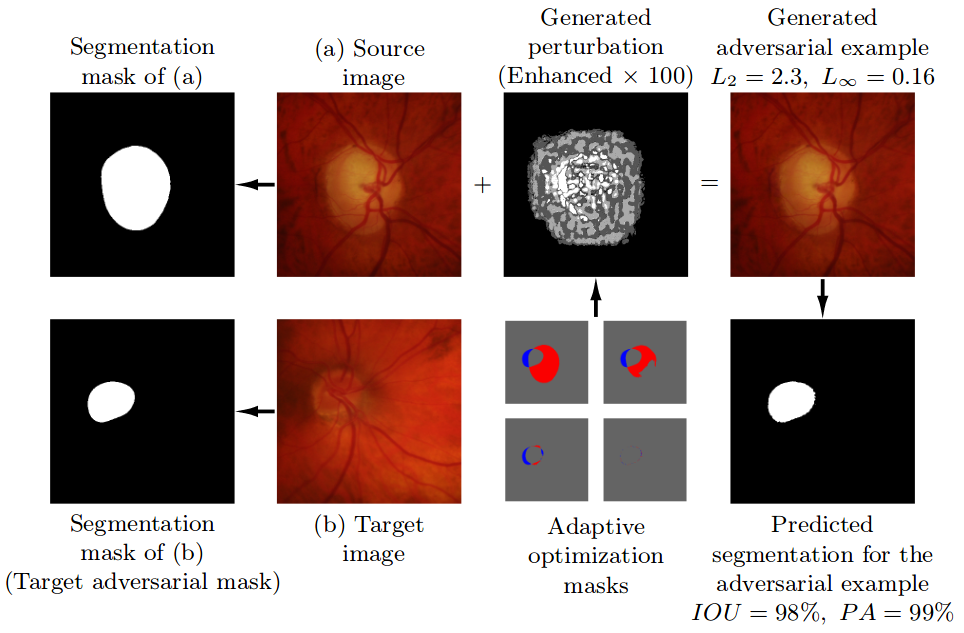
Pre-trained model, code, and materials from the paper "Impact of Adversarial Examples on Deep Learning Models for Biomedical Image Segmentation" (MICCAI 2019).

Adaptive Segmentation Mask Attack This repository contains the implementation of the Adaptive Segmentation Mask Attack (ASMA), a targeted adversarial

Comments
  • Question about image sources for training and image quality of camera

    Question about image sources for training and image quality of camera

    Hey man,

    hope you don't mind I open up an issue. I already opened an issue a couple of months ago at the @olafenwamoses, but never got an answer.

    I was able to set it up in the same way you did, using node red, an example image works just fine. All the images coming from my front camera (1920x1080) are not recognized though and therefore I'm wondering what your experience is.

    Also, how did you collect the USPS images for training and how many?

    Thanks in advance!

    opened by hillbicks 4
Releases(v1.1)
Owner
Stephen Stratoti
Stephen Stratoti
Graph-based community clustering approach to extract protein domains from a predicted aligned error matrix

Using a predicted aligned error matrix corresponding to an AlphaFold2 model , returns a series of lists of residue indices, where each list corresponds to a set of residues clustering together into a

Tristan Croll 24 Nov 23, 2022
Best practices for segmentation of the corporate network of any company

Best-practice-for-network-segmentation What is this? This project was created to publish the best practices for segmentation of the corporate network

2k Jan 07, 2023
Library to enable Bayesian active learning in your research or labeling work.

Bayesian Active Learning (BaaL) BaaL is an active learning library developed at ElementAI. This repository contains techniques and reusable components

ElementAI 687 Dec 25, 2022
Minimal PyTorch implementation of Generative Latent Optimization from the paper "Optimizing the Latent Space of Generative Networks"

Minimal PyTorch implementation of Generative Latent Optimization This is a reimplementation of the paper Piotr Bojanowski, Armand Joulin, David Lopez-

Thomas Neumann 117 Nov 27, 2022
Google-drive-to-sqlite - Create a SQLite database containing metadata from Google Drive

google-drive-to-sqlite Create a SQLite database containing metadata from Google

Simon Willison 140 Dec 04, 2022
Scalable Optical Flow-based Image Montaging and Alignment

SOFIMA SOFIMA (Scalable Optical Flow-based Image Montaging and Alignment) is a tool for stitching, aligning and warping large 2d, 3d and 4d microscopy

Google Research 16 Dec 21, 2022
Controlling a game using mediapipe hand tracking

These scripts use the Google mediapipe hand tracking solution in combination with a webcam in order to send game instructions to a racing game. It features 2 methods of control

3 May 17, 2022
[CVPRW 21] "BNN - BN = ? Training Binary Neural Networks without Batch Normalization", Tianlong Chen, Zhenyu Zhang, Xu Ouyang, Zechun Liu, Zhiqiang Shen, Zhangyang Wang

BNN - BN = ? Training Binary Neural Networks without Batch Normalization Codes for this paper BNN - BN = ? Training Binary Neural Networks without Bat

VITA 40 Dec 30, 2022
An onlinel learning to rank python codebase.

OLTR Online learning to rank python codebase. The code related to Pairwise Differentiable Gradient Descent (ranker/PDGDLinearRanker.py) is copied from

ielab 5 Jul 18, 2022
A Pytree Module system for Deep Learning in JAX

Treex A Pytree-based Module system for Deep Learning in JAX Intuitive: Modules are simple Python objects that respect Object-Oriented semantics and sh

Cristian Garcia 216 Dec 20, 2022
Open AI's Python library

OpenAI Python Library The OpenAI Python library provides convenient access to the OpenAI API from applications written in the Python language. It incl

Pavan Ananth Sharma 3 Jul 10, 2022
Robust Lane Detection via Expanded Self Attention (WACV 2022)

Robust Lane Detection via Expanded Self Attention (WACV 2022) Minhyeok Lee, Junhyeop Lee, Dogyoon Lee, Woojin Kim, Sangwon Hwang, Sangyoun Lee Overvie

Min Hyeok Lee 18 Nov 12, 2022
Reference implementation for Deep Unsupervised Learning using Nonequilibrium Thermodynamics

Diffusion Probabilistic Models This repository provides a reference implementation of the method described in the paper: Deep Unsupervised Learning us

Jascha Sohl-Dickstein 238 Jan 02, 2023
Medical Image Segmentation using Squeeze-and-Expansion Transformers

Medical Image Segmentation using Squeeze-and-Expansion Transformers Introduction This repository contains the code of the IJCAI'2021 paper 'Medical Im

askerlee 172 Dec 20, 2022
Code for ACL 21: Generating Query Focused Summaries from Query-Free Resources

marge This repository releases the code for Generating Query Focused Summaries from Query-Free Resources. Please cite the following paper [bib] if you

Yumo Xu 28 Nov 10, 2022
Fully Connected DenseNet for Image Segmentation

Fully Connected DenseNets for Semantic Segmentation Fully Connected DenseNet for Image Segmentation implementation of the paper The One Hundred Layers

Somshubra Majumdar 84 Oct 31, 2022
Captcha-tensorflow - Image Captcha Solving Using TensorFlow and CNN Model. Accuracy 90%+

Captcha Solving Using TensorFlow Introduction Solve captcha using TensorFlow. Learn CNN and TensorFlow by a practical project. Follow the steps, run t

Jackon Yang 869 Jan 06, 2023
Code and models used in "MUSS Multilingual Unsupervised Sentence Simplification by Mining Paraphrases".

Multilingual Unsupervised Sentence Simplification Code and pretrained models to reproduce experiments in "MUSS: Multilingual Unsupervised Sentence Sim

Facebook Research 81 Dec 29, 2022
Supporting code for the paper "Dangers of Bayesian Model Averaging under Covariate Shift"

Dangers of Bayesian Model Averaging under Covariate Shift This repository contains the code to reproduce the experiments in the paper Dangers of Bayes

Pavel Izmailov 25 Sep 21, 2022
deep learning for image processing including classification and object-detection etc.

深度学习在图像处理中的应用教程 前言 本教程是对本人研究生期间的研究内容进行整理总结,总结的同时也希望能够帮助更多的小伙伴。后期如果有学习到新的知识也会与大家一起分享。 本教程会以视频的方式进行分享,教学流程如下: 1)介绍网络的结构与创新点 2)使用Pytorch进行网络的搭建与训练 3)使用Te

WuZhe 13.6k Jan 04, 2023