Lbl2Vec learns jointly embedded label, document and word vectors to retrieve documents with predefined topics from an unlabeled document corpus.

Overview

Documentation Status

Lbl2Vec

Lbl2Vec is an algorithm for unsupervised document classification and unsupervised document retrieval. It automatically generates jointly embedded label, document and word vectors and returns documents of topics modeled by manually predefined keywords. Once you train the Lbl2Vec model you can:

  • Classify documents as related to one of the predefined topics.
  • Get similarity scores for documents to each predefined topic.
  • Get most similar predefined topic of documents.

See the paper for more details on how it works.

Corresponding Medium post describing the use of Lbl2Vec for unsupervised text classification can be found here.

Benefits

  1. No need to label the whole document dataset for classification.
  2. No stop word lists required.
  3. No need for stemming/lemmatization.
  4. Works on short text.
  5. Creates jointly embedded label, document, and word vectors.

How does it work?

The key idea of the algorithm is that many semantically similar keywords can represent a topic. In the first step, the algorithm creates a joint embedding of document and word vectors. Once documents and words are embedded in a vector space, the goal of the algorithm is to learn label vectors from previously manually defined keywords representing a topic. Finally, the algorithm can predict the affiliation of documents to topics from document vector <-> label vector similarities.

The Algorithm

0. Use the manually defined keywords for each topic of interest.

Domain knowledge is needed to define keywords that describe topics and are semantically similar to each other within the topics.

Basketball Soccer Baseball
NBA FIFA MLB
Basketball Soccer Baseball
LeBron Messi Ruth
... ... ...

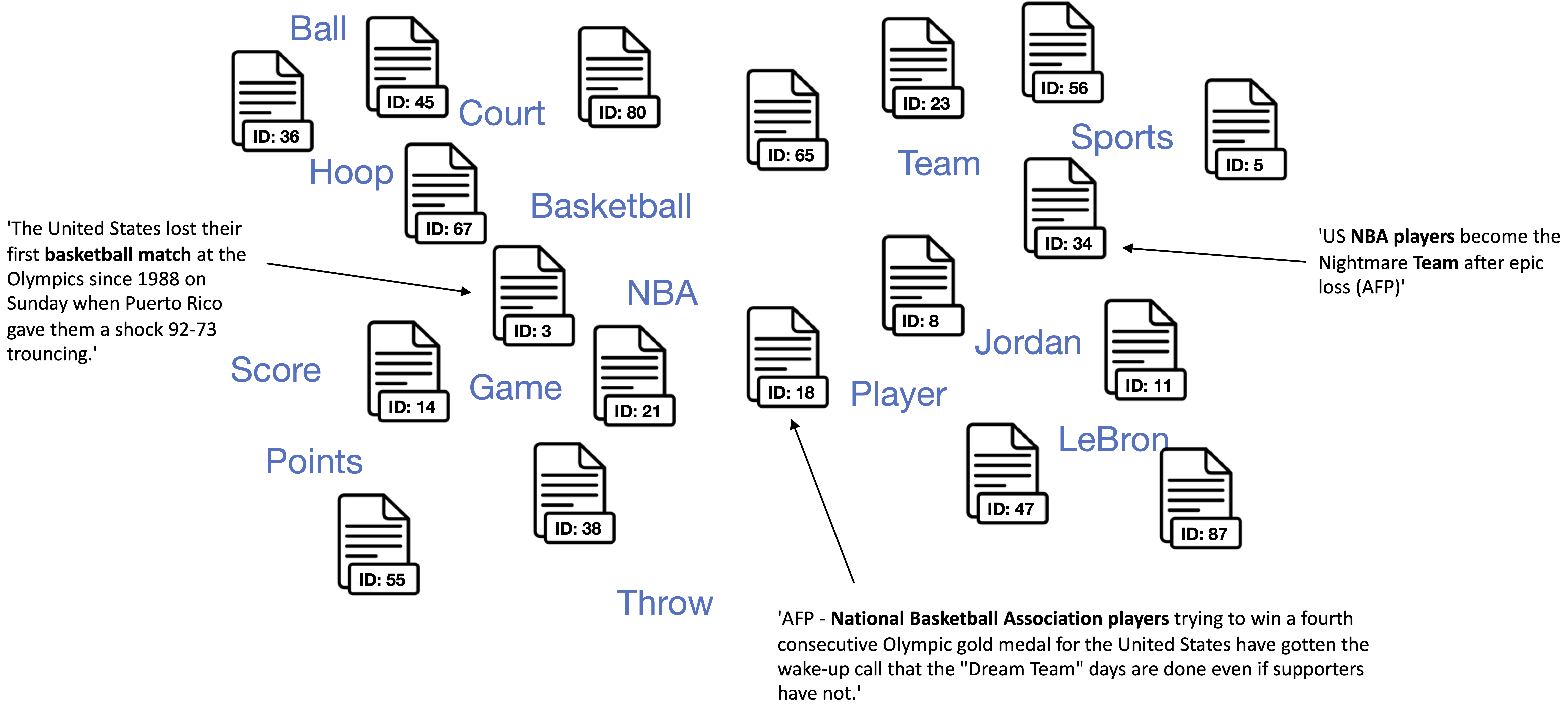
1. Create jointly embedded document and word vectors using Doc2Vec.

Documents will be placed close to other similar documents and close to the most distinguishing words.
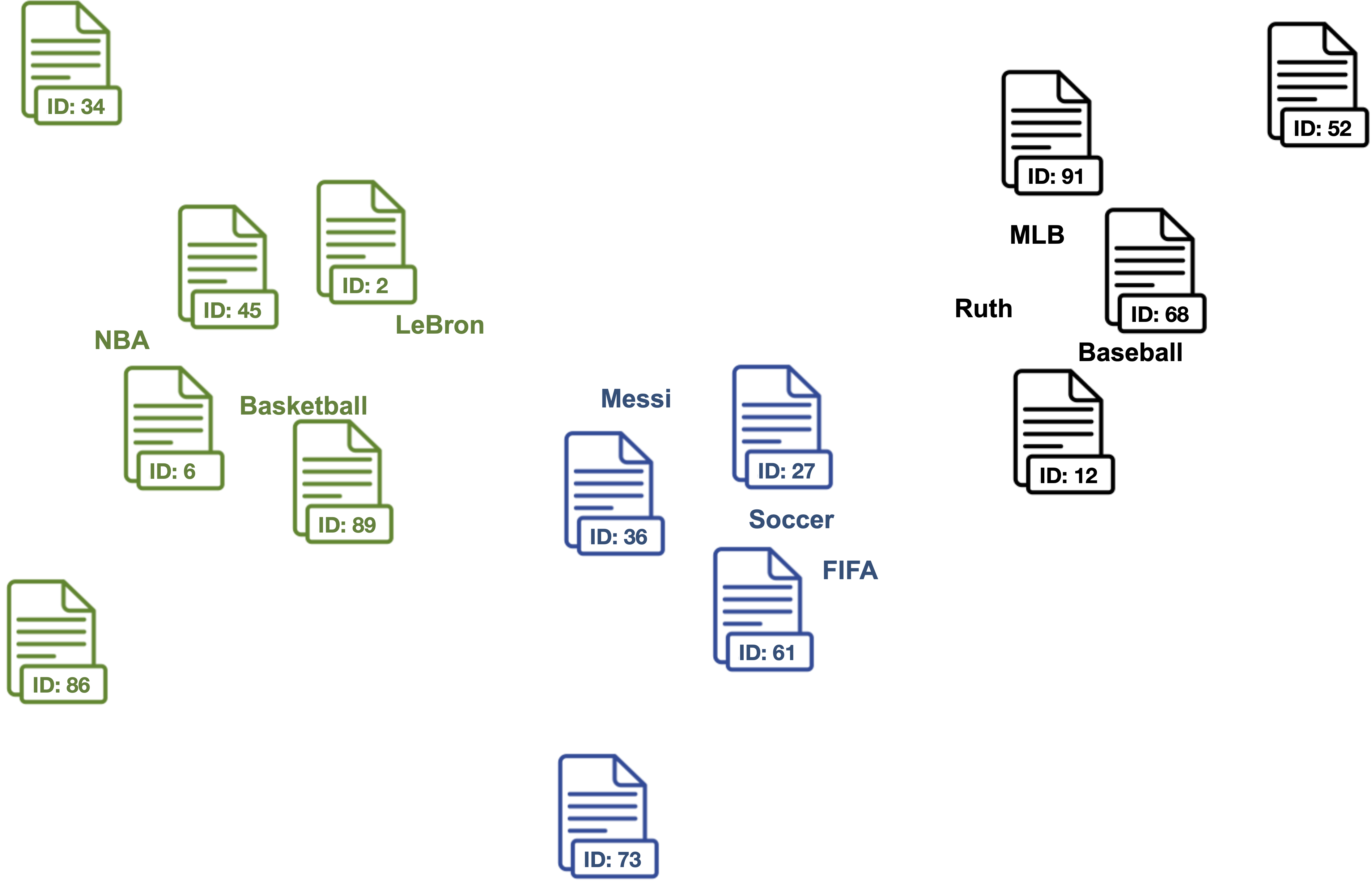
2. Find document vectors that are similar to the keyword vectors of each topic.

Each color represents a different topic described by the respective keywords.
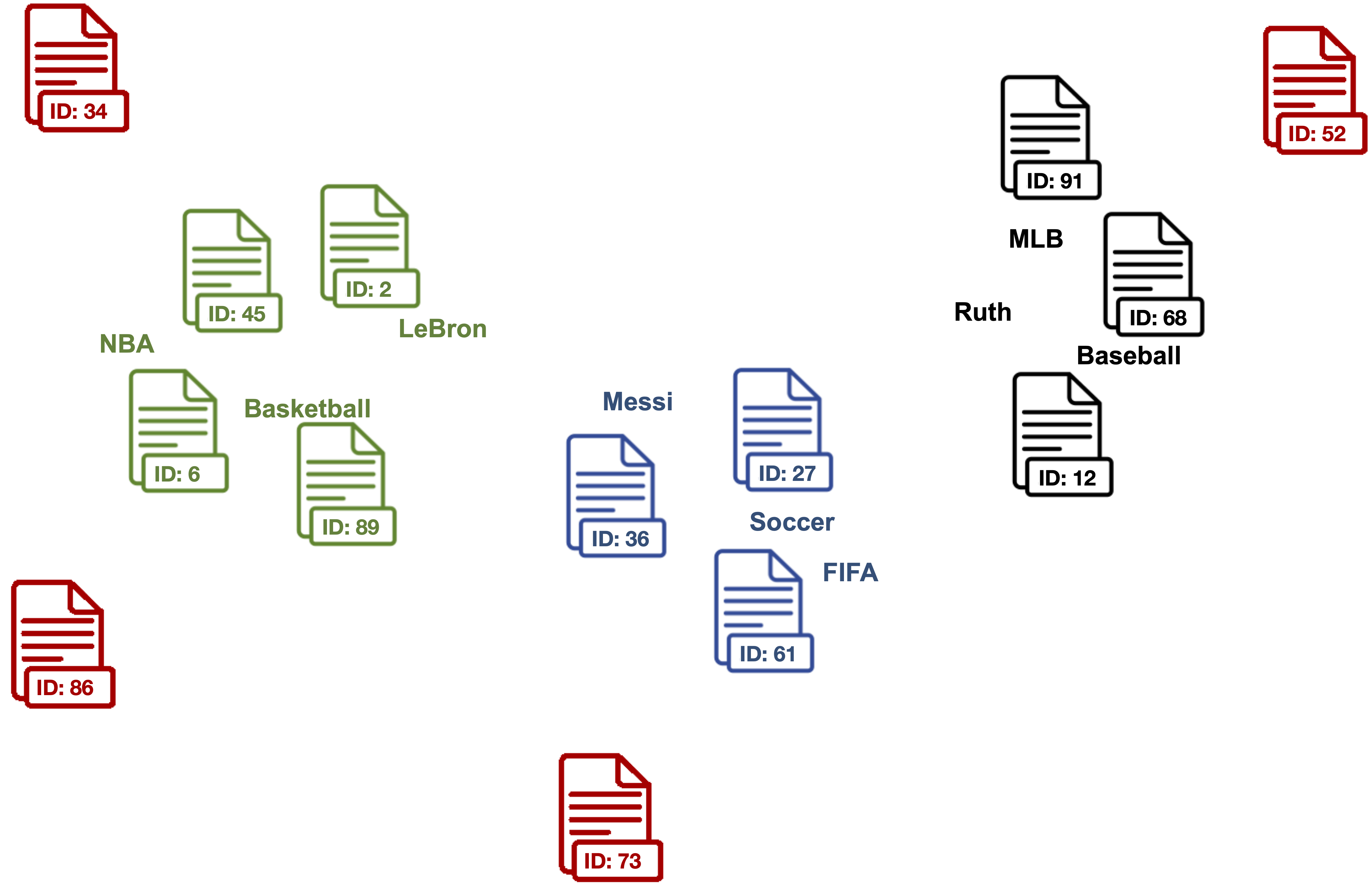
3. Clean outlier document vectors for each topic.

Red documents are outlier vectors that are removed and do not get used for calculating the label vector.
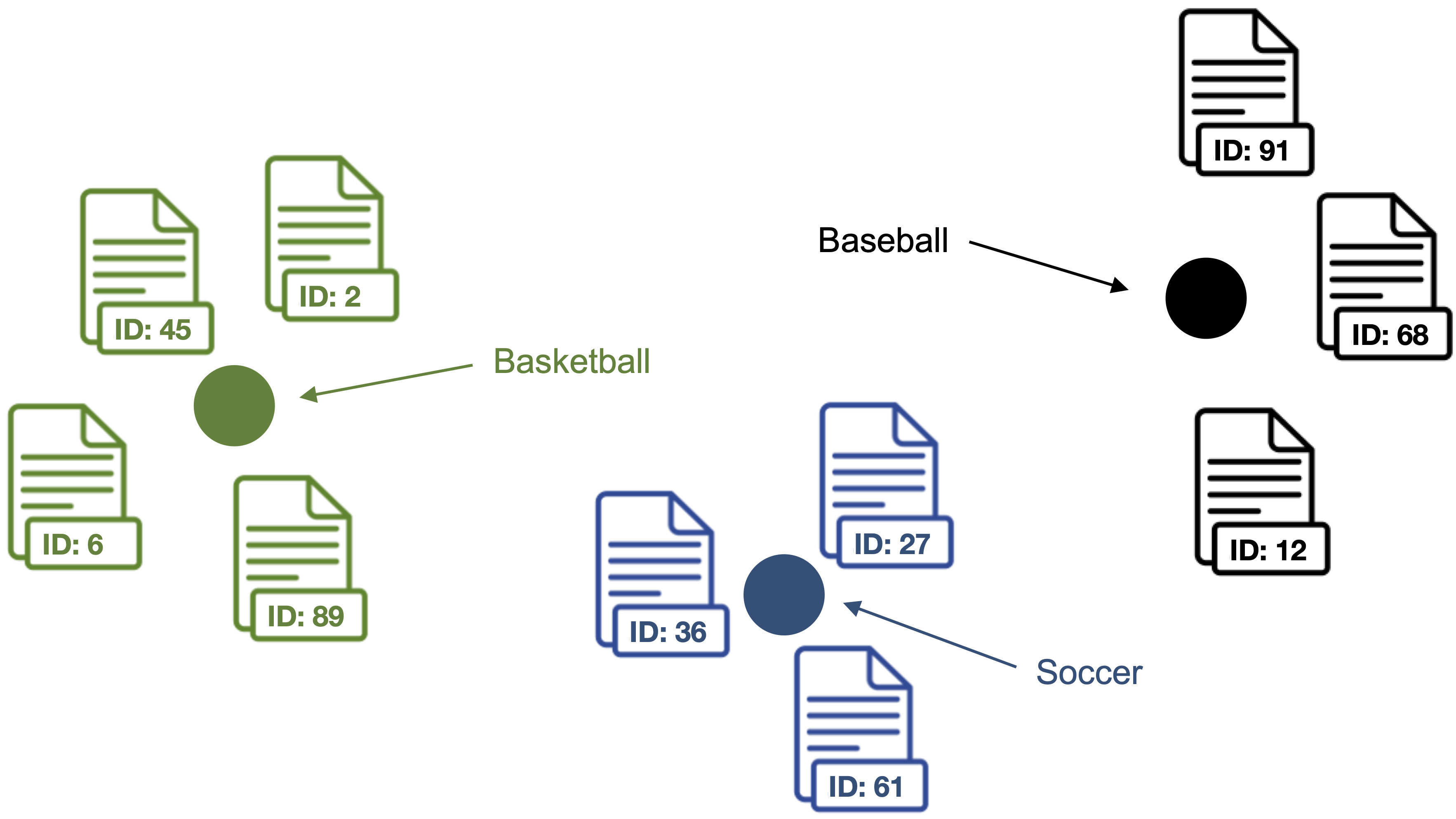
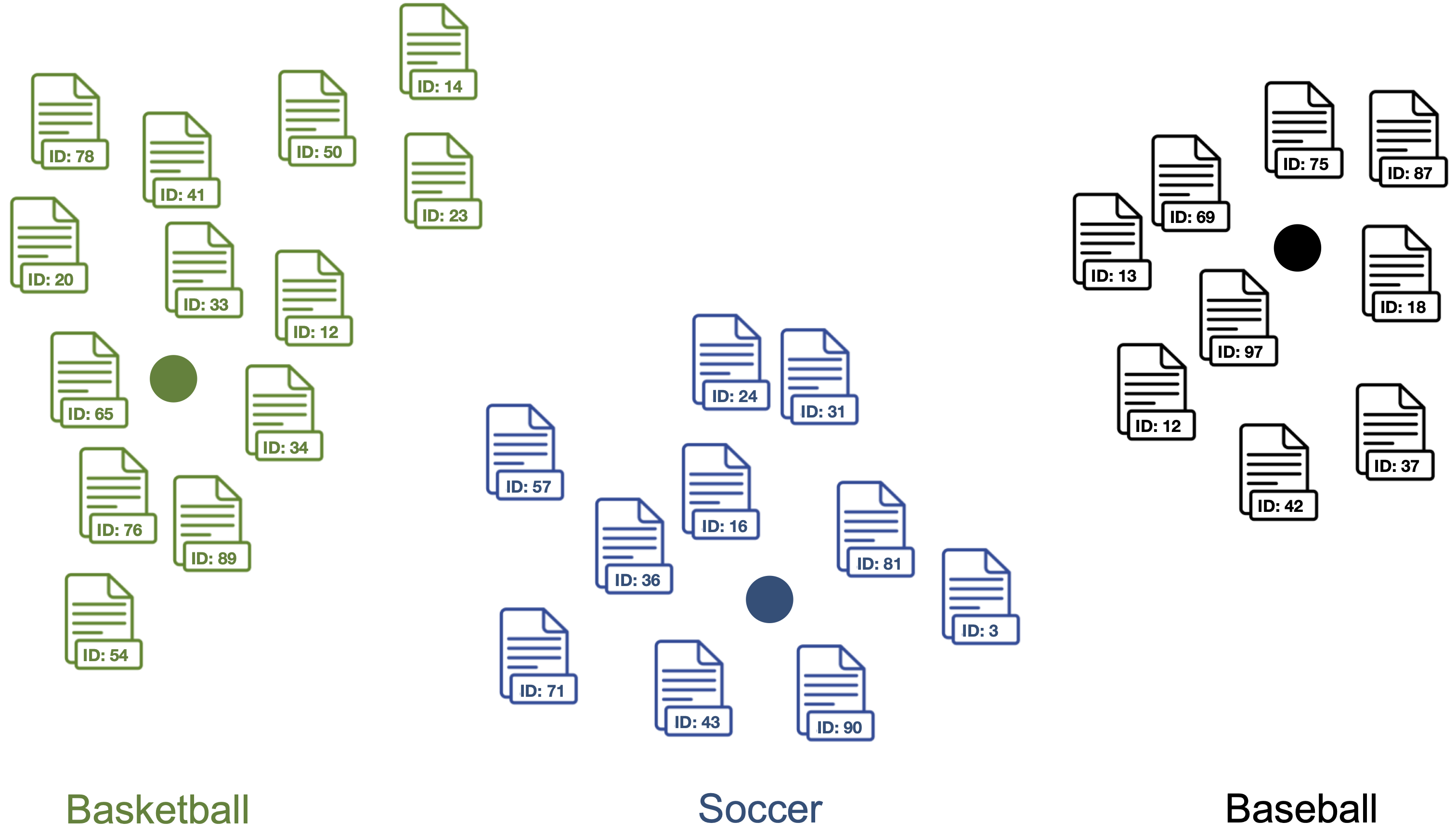
4. Compute the centroid of the outlier cleaned document vectors as label vector for each topic.

Points represent the label vectors of the respective topics.
5. Compute label vector <-> document vector similarities for each label vector and document vector in the dataset.

Documents are classified as topic with the highest label vector <-> document vector similarity.
Installation

pip install lbl2vec

Usage

For detailed information visit the Lbl2Vec API Guide and the examples.

from lbl2vec import Lbl2Vec

Learn new model from scratch

Learns word vectors, document vectors and label vectors from scratch during Lbl2Vec model training.

# init model
model = Lbl2Vec(keywords_list=descriptive_keywords, tagged_documents=tagged_docs)
# train model
model.fit()

Important parameters:

  • keywords_list: iterable list of lists with descriptive keywords of type str. For each label at least one descriptive keyword has to be added as list of str.
  • tagged_documents: iterable list of gensim.models.doc2vec.TaggedDocument elements. If you wish to train a new Doc2Vec model this parameter can not be None, whereas the doc2vec_model parameter must be None. If you use a pretrained Doc2Vec model this parameter has to be None. Input corpus, can be simply a list of elements, but for larger corpora, consider an iterable that streams the documents directly from disk/network.

Use word and document vectors from pretrained Doc2Vec model

Uses word vectors and document vectors from a pretrained Doc2Vec model to learn label vectors during Lbl2Vec model training.

# init model
model = Lbl2Vec(keywords_list=descriptive_keywords, doc2vec_model=pretrained_d2v_model)
# train model
model.fit()

Important parameters:

  • keywords_list: iterable list of lists with descriptive keywords of type str. For each label at least one descriptive keyword has to be added as list of str.
  • doc2vec_model: pretrained gensim.models.doc2vec.Doc2Vec model. If given a pretrained Doc2Vec model, Lbl2Vec uses the pre-trained Doc2Vec model from this parameter. If this parameter is defined, tagged_documents parameter has to be None. In order to get optimal Lbl2Vec results the given Doc2Vec model should be trained with the parameters "dbow_words=1" and "dm=0".

Predict label similarities for documents used for training

Computes the similarity scores for each document vector stored in the model to each of the label vectors.

# get similarity scores from trained model
model.predict_model_docs()

Important parameters:

  • doc_keys: list of document keys (optional). If None: return the similarity scores for all documents that are used to train the Lbl2Vec model. Else: only return the similarity scores of training documents with the given keys.

Predict label similarities for new documents that are not used for training

Computes the similarity scores for each given and previously unknown document vector to each of the label vectors from the model.

# get similarity scores for each new document from trained model
model.predict_new_docs(tagged_docs=tagged_docs)

Important parameters:

Save model to disk

model.save('model_name')

Load model from disk

model = Lbl2Vec.load('model_name')

Citing Lbl2Vec

When citing Lbl2Vec in academic papers and theses, please use this BibTeX entry:

@conference{webist21,
author={Tim Schopf. and Daniel Braun. and Florian Matthes.},
title={Lbl2Vec: An Embedding-based Approach for Unsupervised Document Retrieval on Predefined Topics},
booktitle={Proceedings of the 17th International Conference on Web Information Systems and Technologies - WEBIST,},
year={2021},
pages={124-132},
publisher={SciTePress},
organization={INSTICC},
doi={10.5220/0010710300003058},
isbn={978-989-758-536-4},
issn={2184-3252},
}
You might also like...
Torch-based tool for quantizing high-dimensional vectors using additive codebooks

Trainable multi-codebook quantization This repository implements a utility for use with PyTorch, and ideally GPUs, for training an efficient quantizer

UA-GEC: Grammatical Error Correction and Fluency Corpus for the Ukrainian Language

UA-GEC: Grammatical Error Correction and Fluency Corpus for the Ukrainian Language This repository contains UA-GEC data and an accompanying Python lib

This repository contains the code for "Self-Diagnosis and Self-Debiasing: A Proposal for Reducing Corpus-Based Bias in NLP".

Self-Diagnosis and Self-Debiasing This repository contains the source code for Self-Diagnosis and Self-Debiasing: A Proposal for Reducing Corpus-Based

Ever felt tired after preprocessing the dataset, and not wanting to write any code further to train your model? Ever encountered a situation where you wanted to record the hyperparameters of the trained model and able to retrieve it afterward? Models Playground is here to help you do that. Models playground allows you to train your models right from the browser. ERISHA is a mulitilingual multispeaker expressive speech synthesis framework. It can transfer the expressivity to the speaker's voice for which no expressive speech corpus is available.
ERISHA is a mulitilingual multispeaker expressive speech synthesis framework. It can transfer the expressivity to the speaker's voice for which no expressive speech corpus is available.

ERISHA: Multilingual Multispeaker Expressive Text-to-Speech Library ERISHA is a multilingual multispeaker expressive speech synthesis framework. It ca

Official repository for
Official repository for "Action-Based Conversations Dataset: A Corpus for Building More In-Depth Task-Oriented Dialogue Systems"

Action-Based Conversations Dataset (ABCD) This respository contains the code and data for ABCD (Chen et al., 2021) Introduction Whereas existing goal-

Official code of our work, AVATAR: A Parallel Corpus for Java-Python Program Translation.

AVATAR Official code of our work, AVATAR: A Parallel Corpus for Java-Python Program Translation. AVATAR stands for jAVA-pyThon progrAm tRanslation. AV

[2021 MultiMedia] CONQUER: Contextual Query-aware Ranking for Video Corpus Moment Retrieval
[2021 MultiMedia] CONQUER: Contextual Query-aware Ranking for Video Corpus Moment Retrieval

CONQUER: Contexutal Query-aware Ranking for Video Corpus Moment Retreival PyTorch implementation of CONQUER: Contexutal Query-aware Ranking for Video

Designing a Minimal Retrieve-and-Read System for Open-Domain Question Answering (NAACL 2021)

Designing a Minimal Retrieve-and-Read System for Open-Domain Question Answering Abstract In open-domain question answering (QA), retrieve-and-read mec

Comments
  • ValueError: cannot compute similarity with no input

    ValueError: cannot compute similarity with no input

    Hi Team,

    I am getting following error while running model fit:

    2022-04-08 14:19:04,344 - Lbl2Vec - INFO - Train document and word embeddings 2022-04-08 14:19:09,992 - Lbl2Vec - INFO - Train label embeddings

    ValueError Traceback (most recent call last) in

    ~/SageMaker/lbl2vec/lbl2vec.py in fit(self) 248 # get doc keys and similarity scores of documents that are similar to 249 # the description keywords --> 250 self.labels[['doc_keys', 'doc_similarity_scores']] = self.labels['description_keywords'].apply(lambda row: self._get_similar_documents( 251 self.doc2vec_model, row, num_docs=self.num_docs, similarity_threshold=self.similarity_threshold, min_num_docs=self.min_num_docs)) 252

    ~/anaconda3/envs/python3/lib/python3.6/site-packages/pandas/core/series.py in apply(self, func, convert_dtype, args, **kwds) 4211 else: 4212 values = self.astype(object)._values -> 4213 mapped = lib.map_infer(values, f, convert=convert_dtype) 4214 4215 if len(mapped) and isinstance(mapped[0], Series):

    pandas/_libs/lib.pyx in pandas._libs.lib.map_infer()

    ~/SageMaker/lbl2vec/lbl2vec.py in (row) 249 # the description keywords 250 self.labels[['doc_keys', 'doc_similarity_scores']] = self.labels['description_keywords'].apply(lambda row: self._get_similar_documents( --> 251 self.doc2vec_model, row, num_docs=self.num_docs, similarity_threshold=self.similarity_threshold, min_num_docs=self.min_num_docs)) 252 253 # validate that documents to calculate label embeddings from are found

    ~/SageMaker/lbl2vec/lbl2vec.py in _get_similar_documents(self, doc2vec_model, keywords, num_docs, similarity_threshold, min_num_docs) 625 for word in cleaned_keywords_list] 626 similar_docs = doc2vec_model.dv.most_similar( --> 627 positive=keywordword_vectors, topn=num_docs) 628 except KeyError as error: 629 error.args = (

    ~/anaconda3/envs/python3/lib/python3.6/site-packages/gensim/models/keyedvectors.py in most_similar(self, positive, negative, topn, clip_start, clip_end, restrict_vocab, indexer) 775 all_keys.add(self.get_index(key)) 776 if not mean: --> 777 raise ValueError("cannot compute similarity with no input") 778 mean = matutils.unitvec(array(mean).mean(axis=0)).astype(REAL) 779

    ValueError: cannot compute similarity with no input

    help wanted 
    opened by TechyNilesh 3
  • pip install doesnt work

    pip install doesnt work

    Hello I'm trying to install the package but I get an error.

    pip install lbl2vec

    Collecting lbl2vec ERROR: Could not find a version that satisfies the requirement lbl2vec (from versions: none) ERROR: No matching distribution found for lbl2vec

    I searched a bit on google and couldn't find a solution.

    Python 3.7.4 pip 19.2.3

    help wanted 
    opened by veiro 2
  • Is paragraph classification possible?

    Is paragraph classification possible?

    Hello and thanks for sharing this. A question: can Lbl2Vec perform well when the "documents" are paragraph-sized? For example 3-5 sentences? Would we need to change Doc2Vec that Lbl2Vec currently uses into Sent2Vec or some other equivalent? Your thoughts?

    Thanks!

    opened by stelmath 0
Releases(v1.0.2)
Owner
sebis - TUM - Germany
Official account of sebis chair
sebis - TUM - Germany
Spatial Attentive Single-Image Deraining with a High Quality Real Rain Dataset (CVPR'19)

Spatial Attentive Single-Image Deraining with a High Quality Real Rain Dataset (CVPR'19) Tianyu Wang*, Xin Yang*, Ke Xu, Shaozhe Chen, Qiang Zhang, Ry

Steve Wong 177 Dec 01, 2022
Language Models Can See: Plugging Visual Controls in Text Generation

Language Models Can See: Plugging Visual Controls in Text Generation Authors: Yixuan Su, Tian Lan, Yahui Liu, Fangyu Liu, Dani Yogatama, Yan Wang, Lin

Yixuan Su 195 Dec 22, 2022
YOLTv5 rapidly detects objects in arbitrarily large aerial or satellite images that far exceed the ~600×600 pixel size typically ingested by deep learning object detection frameworks

YOLTv5 rapidly detects objects in arbitrarily large aerial or satellite images that far exceed the ~600×600 pixel size typically ingested by deep learning object detection frameworks.

Adam Van Etten 145 Jan 01, 2023
Tensorflow implementation for "Improved Transformer for High-Resolution GANs" (NeurIPS 2021).

HiT-GAN Official TensorFlow Implementation HiT-GAN presents a Transformer-based generator that is trained based on Generative Adversarial Networks (GA

Google Research 78 Oct 31, 2022
This repo contains the official implementations of EigenDamage: Structured Pruning in the Kronecker-Factored Eigenbasis

EigenDamage: Structured Pruning in the Kronecker-Factored Eigenbasis This repo contains the official implementations of EigenDamage: Structured Prunin

Chaoqi Wang 107 Apr 20, 2022
Implementation of the Chamfer Distance as a module for pyTorch

Chamfer Distance for pyTorch This is an implementation of the Chamfer Distance as a module for pyTorch. It is written as a custom C++/CUDA extension.

Christian Diller 205 Jan 05, 2023
List of all dependencies affected by node-ipc malicious commit

node-ipc-dependencies-list List of all dependencies affected by node-ipc malicious commit as of 17/3/2022 - 19/3/2022 (timestamp) Please improve upon

99 Oct 15, 2022
This repository contains several jupyter notebooks to help users learn to use neon, our deep learning framework

neon_course This repository contains several jupyter notebooks to help users learn to use neon, our deep learning framework. For more information, see

Nervana 92 Jan 03, 2023
SVG Icon processing tool for C++

BAWR This is a tool to automate the icons generation from sets of svg files into fonts and atlases. The main purpose of this tool is to add it to the

Frank David Martínez M 66 Dec 14, 2022
Single-Stage Instance Shadow Detection with Bidirectional Relation Learning (CVPR 2021 Oral)

Single-Stage Instance Shadow Detection with Bidirectional Relation Learning (CVPR 2021 Oral) Tianyu Wang*, Xiaowei Hu*, Chi-Wing Fu, and Pheng-Ann Hen

Steve Wong 51 Oct 20, 2022
Leveraging Two Types of Global Graph for Sequential Fashion Recommendation, ICMR 2021

This is the repo for the paper: Leveraging Two Types of Global Graph for Sequential Fashion Recommendation Requirements OS: Ubuntu 16.04 or higher ver

Yujuan Ding 10 Oct 10, 2022
ATOMIC 2020: On Symbolic and Neural Commonsense Knowledge Graphs

(Comet-) ATOMIC 2020: On Symbolic and Neural Commonsense Knowledge Graphs Paper Jena D. Hwang, Chandra Bhagavatula, Ronan Le Bras, Jeff Da, Keisuke Sa

AI2 152 Dec 27, 2022
A dataset for online Arabic calligraphy

Calliar Calliar is a dataset for Arabic calligraphy. The dataset consists of 2500 json files that contain strokes manually annotated for Arabic callig

ARBML 114 Dec 28, 2022
Mask R-CNN for object detection and instance segmentation on Keras and TensorFlow

Mask R-CNN for Object Detection and Segmentation This is an implementation of Mask R-CNN on Python 3, Keras, and TensorFlow. The model generates bound

Matterport, Inc 22.5k Jan 04, 2023
Neural machine translation between the writings of Shakespeare and modern English using TensorFlow

Shakespeare translations using TensorFlow This is an example of using the new Google's TensorFlow library on monolingual translation going from modern

Motoki Wu 245 Dec 28, 2022
PyTorch implementation of the paper The Lottery Ticket Hypothesis for Object Recognition

LTH-ObjectRecognition The Lottery Ticket Hypothesis for Object Recognition Sharath Girish*, Shishira R Maiya*, Kamal Gupta, Hao Chen, Larry Davis, Abh

16 Feb 06, 2022
This is a computer vision based implementation of the popular childhood game 'Hand Cricket/Odd or Even' in python

Hand Cricket Table of Content Overview Installation Game rules Project Details Future scope Overview This is a computer vision based implementation of

Abhinav R Nayak 6 Jan 12, 2022
Embracing Single Stride 3D Object Detector with Sparse Transformer

SST: Single-stride Sparse Transformer This is the official implementation of paper: Embracing Single Stride 3D Object Detector with Sparse Transformer

TuSimple 385 Dec 28, 2022
A PaddlePaddle implementation of Time Interval Aware Self-Attentive Sequential Recommendation.

TiSASRec.paddle A PaddlePaddle implementation of Time Interval Aware Self-Attentive Sequential Recommendation. Introduction 论文:Time Interval Aware Sel

Paddorch 2 Nov 28, 2021
Taking A Closer Look at Domain Shift: Category-level Adversaries for Semantics Consistent Domain Adaptation

Taking A Closer Look at Domain Shift: Category-level Adversaries for Semantics Consistent Domain Adaptation (CVPR2019) This is a pytorch implementatio

Yawei Luo 280 Jan 01, 2023