Automatic 2D-to-3D Video Conversion with CNNs

Related tags

Deep Learningdeep3d
Overview

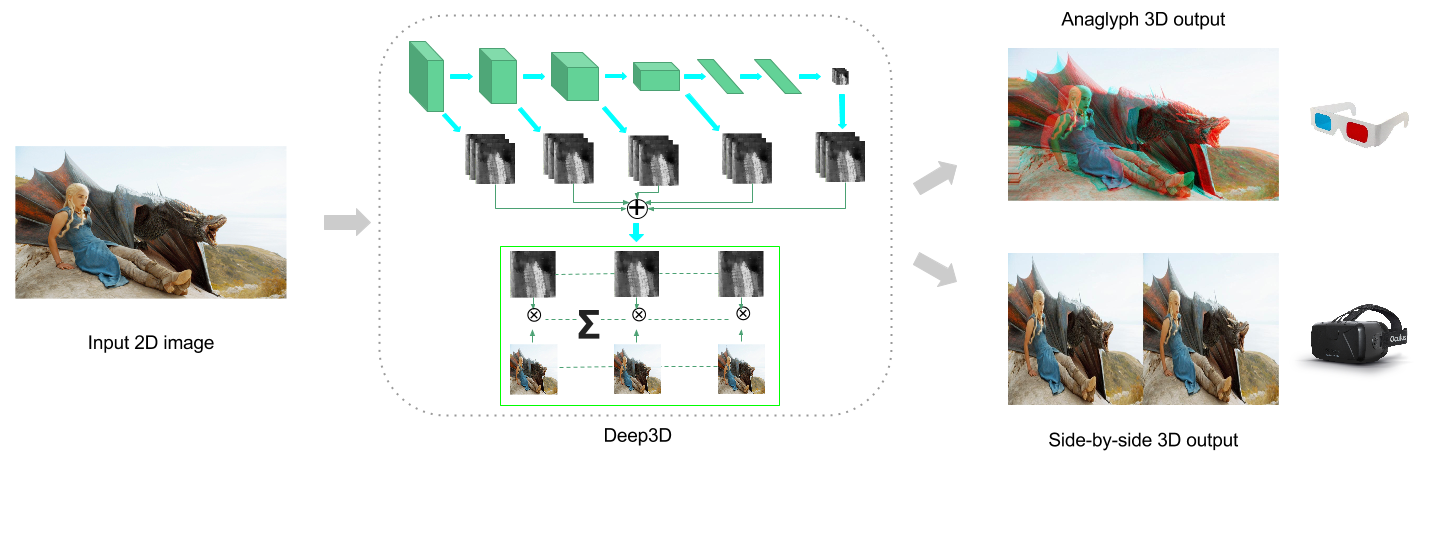
Deep3D: Automatic 2D-to-3D Video Conversion with CNNs

How To Run

To run this code. Please install MXNet following the official document. Deep3D requires MXNet to be built with Cuda 7.0 and Cudnn 4 or above. Please open mxnet/config.mk and set USE_CUDA and USE_CUDNN to 1. Then, append EXTRA_OPERATORS=path/to/deep3d/operators to path/to/mxnet/config.mk and recompile MXNet.
alt text

Motivation

Since the debut of Avatar in 2008, 3D movies has rapidly developed into mainstream technology. Roughly 10 to 20 3D movies are produced each year and the launch of Oculus Rift and other VR head set is only going to drive up the demand.

Producing 3D movies, however, is still hard. There are two ways of doing this and in practice they are about equally popular: shooting with a special 3D camera or shooting in 2D and manually convert to 3D. But 3D cameras are expensive and unwieldy while manual conversion involves an army of "depth artists" who sit there and draw depth maps for each frame.

Wouldn't it be cool if 2D-to-3D conversion can be done automatically, if you can take a 3D selfie with an ordinary phone?

Teaser

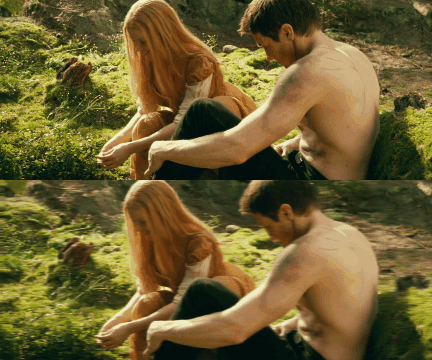
In case you are already getting sleepy, here are some cool 3D images converted from 2D ones by Deep3D. Normally you need 3D glasses or VR display to watch 3D images, but since most readers won't have these we show the 3D images as GIFs.

alt text alt text alt text alt text alt text alt text alt text alt text

Method

3D imagery has two views, one for the left eye and the other for the right. To convert an 2D image to 3D, you need to first estimate the distance from camera for each pixel (a.k.a depth map) and then wrap the image based on its depth map to create two views.

The difficult step is estimating the depth map. For automatic conversion, we would like to learn a model for it. There are several works on depth estimation from single 2D image with DNNs. However, they need to be trained on image-depth pairs which are hard to collect. As a result they can only use small datasets with a few hundred examples like NYU Depth and KITTI. Moreover, these datasets only has static scenes and it's hard to imagine they will generalize to photos with people in them.

In Contrast, Deep3D can be trained directly on 3D movies that have tens of millions frames in total. We do this by making the depth map an internal representation instead of the end prediction. Thus, instead of predicting an depth map and then use it to recreate the missing view with a separate algorithm, we train depth estimation and recreate end-to-end in the same neural network.

Here are some visualizations of our internal depth representation to help you understand how it works:


alt text alt text alt text alt text alt text alt text alt text alt text alt text

Following each image, there are 4-by-3 maps of depth layers, ordered from near to far. You can see that objects that are near to you appear in the first depth maps and objects that are far away appear in the last ones. This shows that the internal depth representation is learning to infer depth from 2D images without been directly trained on it.

Code

This work is done with MXNet, a flexible and efficient deep learning package. The trained model and a prediction script is in deep3d.ipynb. We will release the code for training shortly.

Owner
Eric Junyuan Xie
Software Engineer @ Bytedance
Eric Junyuan Xie
Code of 3D Shape Variational Autoencoder Latent Disentanglement via Mini-Batch Feature Swapping for Bodies and Faces

3D Shape Variational Autoencoder Latent Disentanglement via Mini-Batch Feature Swapping for Bodies and Faces Installation After cloning the repo open

37 Dec 03, 2022
Segmentation Training Pipeline

Segmentation Training Pipeline This package is a part of Musket ML framework. Reasons to use Segmentation Pipeline Segmentation Pipeline was developed

Musket ML 52 Dec 12, 2022
Differentiable Prompt Makes Pre-trained Language Models Better Few-shot Learners

DART Implementation for ICLR2022 paper Differentiable Prompt Makes Pre-trained Language Models Better Few-shot Learners. Environment

ZJUNLP 83 Dec 27, 2022
A benchmark dataset for emulating atmospheric radiative transfer in weather and climate models with machine learning (NeurIPS 2021 Datasets and Benchmarks Track)

ClimART - A Benchmark Dataset for Emulating Atmospheric Radiative Transfer in Weather and Climate Models Official PyTorch Implementation Using deep le

21 Dec 31, 2022
Revisiting Oxford and Paris: Large-Scale Image Retrieval Benchmarking

Revisiting Oxford and Paris: Large-Scale Image Retrieval Benchmarking We revisit and address issues with Oxford 5k and Paris 6k image retrieval benchm

Filip Radenovic 188 Dec 17, 2022
Website for D2C paper

D2C This is the repository that contains source code for the D2C Website. If you find D2C useful for your work please cite: @article{sinha2021d2c au

1 Oct 21, 2021
Tensorflow implementation and notebooks for Implicit Maximum Likelihood Estimation

tf-imle Tensorflow 2 and PyTorch implementation and Jupyter notebooks for Implicit Maximum Likelihood Estimation (I-MLE) proposed in the NeurIPS 2021

NEC Laboratories Europe 69 Dec 13, 2022
Reinforcement Learning for the Blackjack

Reinforcement Learning for Blackjack Author: ZHA Mengyue Math Department of HKUST Problem Statement We study playing Blackjack by reinforcement learni

Dolores 3 Jan 24, 2022
Proceedings of the IEEE Conference on Computer Vision and Pattern Recognition

Proceedings of the IEEE Conference on Computer Vision and Pattern Recognition

107 Dec 02, 2022
PyTorch Implementation of [1611.06440] Pruning Convolutional Neural Networks for Resource Efficient Inference

PyTorch implementation of [1611.06440 Pruning Convolutional Neural Networks for Resource Efficient Inference] This demonstrates pruning a VGG16 based

Jacob Gildenblat 836 Dec 26, 2022
sense-py-AnishaBaishya created by GitHub Classroom

Compute Statistics Here we compute statistics for a bunch of numbers. This project uses the unittest framework to test functionality. Pass the tests T

1 Oct 21, 2021
RL Algorithms with examples in Python / Pytorch / Unity ML agents

Reinforcement Learning Project This project was created to make it easier to get started with Reinforcement Learning. It now contains: An implementati

Rogier Wachters 3 Aug 19, 2022
PaddleRobotics is an open-source algorithm library for robots based on Paddle, including open-source parts such as human-robot interaction, complex motion control, environment perception, SLAM positioning, and navigation.

简体中文 | English PaddleRobotics paddleRobotics是基于paddle的机器人开源算法库集,包括人机交互、复杂运动控制、环境感知、slam定位导航等开源算法部分。 人机交互 主动多模交互技术TFVT-HRI 主动多模交互技术是通过视觉、语音、触摸传感器等输入机器人

185 Dec 26, 2022
Open source annotation tool for machine learning practitioners.

doccano doccano is an open source text annotation tool for humans. It provides annotation features for text classification, sequence labeling and sequ

7.1k Jan 01, 2023
An official source code for "Augmentation-Free Self-Supervised Learning on Graphs"

Augmentation-Free Self-Supervised Learning on Graphs An official source code for Augmentation-Free Self-Supervised Learning on Graphs paper, accepted

Namkyeong Lee 59 Dec 01, 2022
Official PyTorch implementation of DD3D: Is Pseudo-Lidar needed for Monocular 3D Object detection? (ICCV 2021), Dennis Park*, Rares Ambrus*, Vitor Guizilini, Jie Li, and Adrien Gaidon.

DD3D: "Is Pseudo-Lidar needed for Monocular 3D Object detection?" Install // Datasets // Experiments // Models // License // Reference Full video Offi

Toyota Research Institute - Machine Learning 364 Dec 27, 2022
PAthological QUpath Obsession - QuPath and Python conversations

PAQUO: PAthological QUpath Obsession Welcome to paquo 👋 , a library for interacting with QuPath from Python. paquo's goal is to provide a pythonic in

Bayer AG 60 Dec 31, 2022
The official implementation of A Unified Game-Theoretic Interpretation of Adversarial Robustness.

This repository is the official implementation of A Unified Game-Theoretic Interpretation of Adversarial Robustness. Requirements pip install -r requi

Jie Ren 17 Dec 12, 2022
Python版OpenCVのTracking APIのサンプルです。DaSiamRPNアルゴリズムまで対応しています。

OpenCV-Object-Tracker-Sample Python版OpenCVのTracking APIのサンプルです。   Requirement opencv-contrib-python 4.5.3.56 or later Algorithm 2021/07/16時点でOpenCVには以

KazuhitoTakahashi 36 Jan 01, 2023
PyTorch implementation of spectral graph ConvNets, NIPS’16

Graph ConvNets in PyTorch October 15, 2017 Xavier Bresson http://www.ntu.edu.sg/home/xbresson https://github.com/xbresson https://twitter.com/xbresson

Xavier Bresson 287 Jan 04, 2023