Implementation of Memory-Compressed Attention, from the paper "Generating Wikipedia By Summarizing Long Sequences"

Overview

Memory Compressed Attention

Implementation of the Self-Attention layer of the proposed Memory-Compressed Attention, in Pytorch. This repository offers both the causal and non-causal variant, and will take care of the padding if the sequence length is not divisible by the compression ratio.

The code also resolves an edge-case where the very first query have no keys to attend to in the auto-regressive scenario. The solution is to use null key/values, appended to the final compressed set, so that there is always at least 1 key for all queries to attend to.

Install

$ pip install memory_compressed_attention

Usage

import torch
from memory_compressed_attention import MemoryCompressedAttention

attn = MemoryCompressedAttention(
    dim = 512,
    heads = 8,                 # number of heads
    causal = False,            # auto-regressive or not
    compression_factor = 3,    # compression ratio
    dropout = 0.1              # dropout post-attention
)

x = torch.randn(1, 1024, 512)
mask = torch.ones(1, 1024).bool()

attn(x, input_mask = mask) # (1, 1024, 512)

Citations

@misc{liu2018generating,
    title={Generating Wikipedia by Summarizing Long Sequences},
    author={Peter J. Liu and Mohammad Saleh and Etienne Pot and Ben Goodrich and Ryan Sepassi and Lukasz Kaiser and Noam Shazeer},
    year={2018},
    eprint={1801.10198},
    archivePrefix={arXiv},
    primaryClass={cs.CL}
}
You might also like...
Memory Efficient Attention (O(sqrt(n)) for Jax and PyTorch

Memory Efficient Attention This is unofficial implementation of Self-attention Does Not Need O(n^2) Memory for Jax and PyTorch. Implementation is almo

 Attention for PyTorch with Linear Memory Footprint
Attention for PyTorch with Linear Memory Footprint

Attention for PyTorch with Linear Memory Footprint Unofficially implements https://arxiv.org/abs/2112.05682 to get Linear Memory Cost on Attention (+

PyTorch code for our paper "Attention in Attention Network for Image Super-Resolution"

Under construction... Attention in Attention Network for Image Super-Resolution (A2N) This repository is an PyTorch implementation of the paper "Atten

Implementation of Transformer in Transformer, pixel level attention paired with patch level attention for image classification, in Pytorch

Transformer in Transformer Implementation of Transformer in Transformer, pixel level attention paired with patch level attention for image c

Implementation of STAM (Space Time Attention Model), a pure and simple attention model that reaches SOTA for video classification

STAM - Pytorch Implementation of STAM (Space Time Attention Model), yet another pure and simple SOTA attention model that bests all previous models in

Official Pytorch Implementation of Relational Self-Attention: What's Missing in Attention for Video Understanding

Relational Self-Attention: What's Missing in Attention for Video Understanding This repository is the official implementation of "Relational Self-Atte

Official implementation of cosformer-attention in cosFormer: Rethinking Softmax in Attention

cosFormer Official implementation of cosformer-attention in cosFormer: Rethinking Softmax in Attention Update log 2022/2/28 Add core code License This

This is a pytorch implementation of the NeurIPS paper GAN Memory with No Forgetting.

GAN Memory for Lifelong learning This is a pytorch implementation of the NeurIPS paper GAN Memory with No Forgetting. Please consider citing our paper

Official and maintained implementation of the paper
Official and maintained implementation of the paper "OSS-Net: Memory Efficient High Resolution Semantic Segmentation of 3D Medical Data" [BMVC 2021].

OSS-Net: Memory Efficient High Resolution Semantic Segmentation of 3D Medical Data Christoph Reich, Tim Prangemeier, Özdemir Cetin & Heinz Koeppl | Pr

Comments
  • The order of masking and softmax operation

    The order of masking and softmax operation

    Hi,

    In memory_compressed_attention.py, I'm wondering if we need to do softmax operation after masking? Btw, if the entry in the mask should be float('-inf') instead of -float('-inf')? If I make something wrong, please correct me.

    image

    Thanks!

    opened by cfeng16 3
  • mask error in attention

    mask error in attention

    Very grateful for your pioneering work! I want to use it in Standard Transformer released in http://nlp.seas.harvard.edu/2018/04/03/attention.html. but it mat a mask error in training. more detail information shown as follow, the code i use: image class ConvCompress(nn.Module): def init(self, dim, ratio = 2, groups = 1): super(ConvCompress, self).init() self.conv = nn.Conv1d(dim, dim, ratio, stride = ratio, groups = groups) #self.linear = nn.Linear(dim, dim)

    def forward(self, mem):
        mem = mem.transpose(1, 2)
        compressed_mem = self.conv(mem)
        return compressed_mem.transpose(1, 2)
    

    class MemoryCompressedAttention(nn.Module): def init(self, h, d_model, compression_factor = 2, dropout = 0.1): super(MemoryCompressedAttention, self).init() assert (d_model % h) == 0, 'dimension must be divisible by number of heads' self.h = h self.d_model = d_model self.d_k = d_model // h

        self.compression_factor = compression_factor
        self.compress_fn = ConvCompress(d_model, compression_factor, groups = h)
    
        #self.to_qkv = nn.Linear(dim, dim * 3, bias = False)
        self.wq = nn.Linear(d_model, d_model, bias = False)
        self.wk = nn.Linear(d_model, d_model, bias = False)
        self.wv = nn.Linear(d_model, d_model, bias = False)
    
        self.wo = nn.Linear(d_model, d_model)
    
        self.dropout = nn.Dropout(dropout)
    
        #self.null_k = nn.Parameter(torch.zeros(1, 1, d_model))
        #self.null_v = nn.Parameter(torch.zeros(1, 1, d_model))
    
    def forward(self, query, key, value, mask = None):
        
        if mask is not None:
            # Same mask applied to all h heads.
            mask = mask.unsqueeze(1)
        nbatches = query.size(0)
        t = query.size(1)
        cf = self.compression_factor
    
        query = self.wq(query)
        key = self.wk(key)
        value = self.wv(value)
    
        # make sure keys and values sequence lengths
        # are divisible by the compression factor
        padding = cf - (t % cf)
        if padding != 0:
            key, value = map(lambda t: F.pad(t, (0, 0, padding, 0)), (key, value))
    
    
        # compress keys and values
        key, value = map(self.compress_fn, (key, value))
    
        # attach a null key and value, in the case that the first query has no keys to pay attention to
        null_k = nn.Parameter(torch.zeros(key.size(0), 1, self.d_model)).cuda()
        null_v = nn.Parameter(torch.zeros(value.size(0), 1, self.d_model)).cuda()
    
        key = torch.cat((null_k, key), dim=1)
        value = torch.cat((null_v, value), dim=1)
        
        # merge heads
        #query, key, value = map(lambda t: t.reshape(*t.shape[:2], h, -1).transpose(1, 2), (query, key, value))
        # 1) Do all the linear projections in batch from d_model => h x d_k
        query = query.view(nbatches, -1, self.h, self.d_k).transpose(1, 2)
        key = key.view(nbatches, -1, self.h, self.d_k).transpose(1, 2)
        value = value.view(nbatches, -1, self.h, self.d_k).transpose(1, 2)
    
      
        # 2) Apply attention on all the projected vectors in batch.
        x, self.attn = attention(query, key, value, mask=mask,
                                 dropout=self.dropout)
    
        # 3) "Concat" using a view and apply a final linear.   # split heads and combine
        x = x.contiguous().view(nbatches, -1, self.d_model)
        out = self.wo(x)
    
        return out
    

    The error was show that image
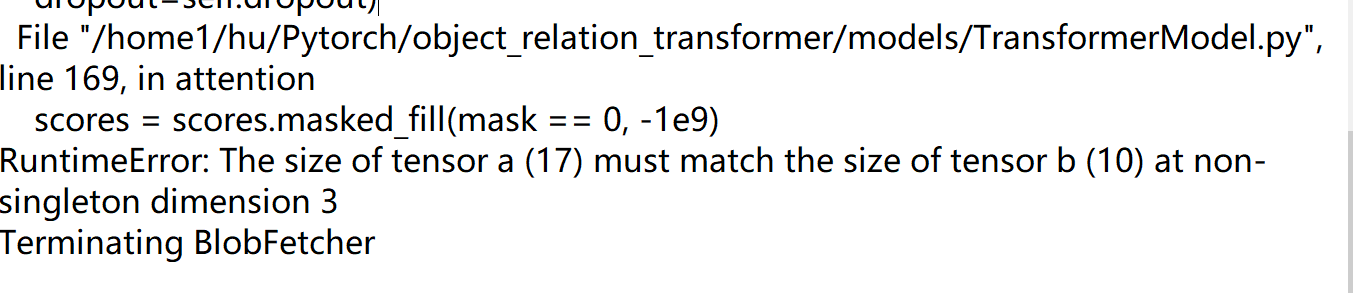
    I want to know how to fix it, and how to do mask for N*M matrix??

    opened by HN123-123 0
Releases(0.0.5)
Owner
Phil Wang
Working with Attention. It's all we need
Phil Wang
This implementation contains the application of GPlearn's symbolic transformer on a commodity futures sector of the financial market.

GPlearn_finiance_stock_futures_extension This implementation contains the application of GPlearn's symbolic transformer on a commodity futures sector

Chengwei <a href=[email protected]"> 189 Dec 25, 2022
Official implementation of "CrossPoint: Self-Supervised Cross-Modal Contrastive Learning for 3D Point Cloud Understanding" (CVPR, 2022)

CrossPoint: Self-Supervised Cross-Modal Contrastive Learning for 3D Point Cloud Understanding (CVPR'22) Paper Link | Project Page Abstract : Manual an

Mohamed Afham 152 Dec 23, 2022
Toontown House CT Edition

Toontown House: Classic Toontown House Classic source that should just work. ❓ W

Open Source Toontown Servers 5 Jan 09, 2022
Microsoft Cognitive Toolkit (CNTK), an open source deep-learning toolkit

CNTK Chat Windows build status Linux build status The Microsoft Cognitive Toolkit (https://cntk.ai) is a unified deep learning toolkit that describes

Microsoft 17.3k Dec 29, 2022
The code of NeurIPS 2021 paper "Scalable Rule-Based Representation Learning for Interpretable Classification".

Rule-based Representation Learner This is a PyTorch implementation of Rule-based Representation Learner (RRL) as described in NeurIPS 2021 paper: Scal

Zhuo Wang 53 Dec 17, 2022
Python scripts to detect faces in Python with the BlazeFace Tensorflow Lite models

Python scripts to detect faces using Python with the BlazeFace Tensorflow Lite models. Tested on Windows 10, Tensorflow 2.4.0 (Python 3.8).

Ibai Gorordo 46 Nov 17, 2022
Car Parking Tracker Using OpenCv

Car Parking Vacancy Tracker Using OpenCv I used basic image processing methods i

Adwait Kelkar 30 Dec 03, 2022
ETMO: Evolutionary Transfer Multiobjective Optimization

ETMO: Evolutionary Transfer Multiobjective Optimization To promote the research on ETMO, benchmark problems are of great importance to ETMO algorithm

Songbai Liu 0 Mar 16, 2021
This is the code of "Multi-view Contrastive Graph Clustering" in NeurlPS 2021.

MCGC Description This is the code of "Multi-view Contrastive Graph Clustering" in NeurlPS 2021. Datasets Results ACM DBLP IMDB Amazon photos Amazon co

31 Nov 14, 2022
(CVPR 2021) PAConv: Position Adaptive Convolution with Dynamic Kernel Assembling on Point Clouds

PAConv: Position Adaptive Convolution with Dynamic Kernel Assembling on Point Clouds by Mutian Xu*, Runyu Ding*, Hengshuang Zhao, and Xiaojuan Qi. Int

CVMI Lab 228 Dec 25, 2022
Pytorch and Keras Implementations of Hyperspectral Image Classification -- Traditional to Deep Models: A Survey for Future Prospects.

The repository contains the implementations for Hyperspectral Image Classification -- Traditional to Deep Models: A Survey for Future Prospects. Model

Ankur Deria 115 Jan 06, 2023
An example project demonstrating how the Autonomous Learning Library can be used to build new reinforcement learning agents.

About This repository shows how Autonomous Learning Library can be used to build new reinforcement learning agents. In particular, it contains a model

Chris Nota 5 Aug 30, 2022
Codes for our paper "SentiLARE: Sentiment-Aware Language Representation Learning with Linguistic Knowledge" (EMNLP 2020)

SentiLARE: Sentiment-Aware Language Representation Learning with Linguistic Knowledge Introduction SentiLARE is a sentiment-aware pre-trained language

74 Dec 30, 2022
A simple python module to generate anchor (aka default/prior) boxes for object detection tasks.

PyBx WIP A simple python module to generate anchor (aka default/prior) boxes for object detection tasks. Calculated anchor boxes are returned as ndarr

thatgeeman 4 Dec 15, 2022
Largest list of models for Core ML (for iOS 11+)

Since iOS 11, Apple released Core ML framework to help developers integrate machine learning models into applications. The official documentation We'v

Kedan Li 5.6k Jan 08, 2023
CTC segmentation python package

CTC segmentation CTC segmentation can be used to find utterances alignments within large audio files. This repository contains the ctc-segmentation py

Ludwig Kürzinger 217 Jan 04, 2023
Annotated notes and summaries of the TensorFlow white paper, along with SVG figures and links to documentation

TensorFlow White Paper Notes Features Notes broken down section by section, as well as subsection by subsection Relevant links to documentation, resou

Sam Abrahams 437 Oct 09, 2022
An interpreter for RASP as described in the ICML 2021 paper "Thinking Like Transformers"

RASP Setup Mac or Linux Run ./setup.sh . It will create a python3 virtual environment and install the dependencies for RASP. It will also try to insta

141 Jan 03, 2023
Voxel Set Transformer: A Set-to-Set Approach to 3D Object Detection from Point Clouds (CVPR 2022)

Voxel Set Transformer: A Set-to-Set Approach to 3D Object Detection from Point Clouds (CVPR2022)[paper] Authors: Chenhang He, Ruihuang Li, Shuai Li, L

Billy HE 141 Dec 30, 2022
The pure and clear PyTorch Distributed Training Framework.

The pure and clear PyTorch Distributed Training Framework. Introduction Requirements and Usage Dependency Dataset Basic Usage Slurm Cluster Usage Base

WILL LEE 208 Dec 20, 2022