A PyTorch implementation of a Factorization Machine module in cython.

Overview

fmpytorch

A library for factorization machines in pytorch. A factorization machine is like a linear model, except multiplicative interaction terms between the variables are modeled as well.

The input to a factorization machine layer is a vector, and the output is a scalar. Batching is fully supported.

This is a work in progress. Feedback and bugfixes welcome! Hopefully you find the code useful.

Usage

The factorization machine layers in fmpytorch can be used just like any other built-in module. Here's a simple feed-forward model using a factorization machine that takes in a 50-D input, and models interactions using k=5 factors.

import torch
from fmpytorch.second_order.fm import FactorizationMachine

class MyModel(torch.nn.Module):
    def __init__(self):
        super(MyModel, self).__init__()
        self.linear = torch.nn.Linear(100, 50)
        self.dropout = torch.nn.Dropout(.5)
	# This makes a fm layer mapping from 50-D to 1-D.
	# The number of factors is 5.
        self.fm = FactorizationMachine(50, 5)

    def forward(self, x):
        x = self.linear(x)
        x = self.dropout(x)
        x = self.fm(x)
        return x

See examples/toy.py or examples/regression.py for fuller examples.

Installation

This package requires pytorch, numpy, and cython.

To install, you can run:

cd fmpytorch
sudo python setup.py install

Factorization Machine brief intro

A linear model, given a vector x models its output y as
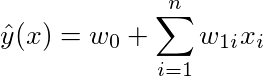
where w are the learnable weights of the model.

However, the interactions between the input variables x_i are purely additive. In some cases, it might be useful to model the interactions between your variables, e.g., x_i * x_j. You could add terms into your model like

However, this introduces a large number of w2 variables. Specifically, there are O(n^2) parameters introduced in this formulation, one for each interaction pair. A factorization machine approximates w2 using low dimensional factors, i.e.,

where each v_i is a low-dimensional vector. This is the forward pass of a second order factorization machine. This low-rank re-formulation has reduced the number of additional parameters for the factorization machine to O(k*n). Magically, the forward (and backward) pass can be reformulated so that it can be computed in O(k*n), rather than the naive O(k*n^2) formulation above.

Currently supported features

Currently, only a second order factorization machine is supported. The forward and backward passes are implemented in cython. Compared to the autodiff solution, the cython passes run several orders of magnitude faster. I've only tested it with python 2 at the moment.

TODOs

  1. Support for sparse tensors.
  2. More interesting useage examples
  3. More testing, e.g., with python 3, etc.
  4. Make sure all of the code plays nice with torch-specific stuff, e.g., GPUs
  5. Arbitrary order factorization machine support
  6. Better organization/code cleaning

Thanks to

Vlad Niculae (@vene) for his sage wisdom.

The original factorization machine citation, which this layer is based off of, is

@inproceedings{rendle2010factorization,
	       title={Factorization machines},
    	       author={Rendle, Steffen},
      	       booktitle={ICDM},
               pages={995--1000},
	       year={2010},
	       organization={IEEE}
}
Owner
Jack Hessel
Research Scientist @ AI2: PhD in CS previously from Cornell
Jack Hessel
Implementations of paper Controlling Directions Orthogonal to a Classifier

Classifier Orthogonalization Implementations of paper Controlling Directions Orthogonal to a Classifier , ICLR 2022, Yilun Xu, Hao He, Tianxiao Shen,

Yilun Xu 33 Dec 01, 2022
a Lightweight library for sequential learning agents, including reinforcement learning

SaLinA: SaLinA - A Flexible and Simple Library for Learning Sequential Agents (including Reinforcement Learning) TL;DR salina is a lightweight library

Facebook Research 405 Dec 17, 2022
Code base for reproducing results of I.Schubert, D.Driess, O.Oguz, and M.Toussaint: Learning to Execute: Efficient Learning of Universal Plan-Conditioned Policies in Robotics. NeurIPS (2021)

Learning to Execute (L2E) Official code base for completely reproducing all results reported in I.Schubert, D.Driess, O.Oguz, and M.Toussaint: Learnin

3 May 18, 2022
Cobalt Strike teamserver detection.

Cobalt-Strike-det Cobalt Strike teamserver detection. usage: cobaltstrike_verify.py [-l TARGETS] [-t THREADS] optional arguments: -h, --help show this

TimWhite 17 Sep 27, 2022
Image-retrieval-baseline - MUGE Multimodal Retrieval Baseline

MUGE Multimodal Retrieval Baseline This repo is implemented based on the open_cl

47 Dec 16, 2022
Uncertain natural language inference

Uncertain Natural Language Inference This repository hosts the code for the following paper: Tongfei Chen*, Zhengping Jiang*, Adam Poliak, Keisuke Sak

Tongfei Chen 14 Sep 01, 2022
🧑‍🔬 verify your TEAL program by experiment and observation

Graviton - Testing TEAL with Dry Runs Tutorial Local Installation The following instructions assume that you have make available in your local environ

Algorand 18 Jan 03, 2023
Contrastive Learning with Non-Semantic Negatives

Contrastive Learning with Non-Semantic Negatives This repository is the official implementation of Robust Contrastive Learning Using Negative Samples

39 Jul 31, 2022
Pytorch implementation of One-Shot Affordance Detection

One-shot Affordance Detection PyTorch implementation of our one-shot affordance detection models. This repository contains PyTorch evaluation code, tr

46 Dec 12, 2022
Implementing Vision Transformer (ViT) in PyTorch

Lightning-Hydra-Template A clean and scalable template to kickstart your deep learning project 🚀 ⚡ 🔥 Click on Use this template to initialize new re

2 Dec 24, 2021
Riemannian Geometry for Molecular Surface Approximation (RGMolSA)

Riemannian Geometry for Molecular Surface Approximation (RGMolSA) Introduction Ligand-based virtual screening aims to reduce the cost and duration of

11 Nov 15, 2022
Mae segmentation - Reproduction of semantic segmentation using masked autoencoder (mae)

ADE20k Semantic segmentation with MAE Getting started Install the mmsegmentation

97 Dec 17, 2022
Use of Attention Gates in a Convolutional Neural Network / Medical Image Classification and Segmentation

Attention Gated Networks (Image Classification & Segmentation) Pytorch implementation of attention gates used in U-Net and VGG-16 models. The framewor

Ozan Oktay 1.6k Dec 30, 2022
Patch2Pix: Epipolar-Guided Pixel-Level Correspondences [CVPR2021]

Patch2Pix for Accurate Image Correspondence Estimation This repository contains the Pytorch implementation of our paper accepted at CVPR2021: Patch2Pi

Qunjie Zhou 199 Nov 29, 2022
Mask-invariant Face Recognition through Template-level Knowledge Distillation

Mask-invariant Face Recognition through Template-level Knowledge Distillation This is the official repository of "Mask-invariant Face Recognition thro

Fadi Boutros 35 Dec 06, 2022
Language-Driven Semantic Segmentation

Language-driven Semantic Segmentation (LSeg) The repo contains official PyTorch Implementation of paper Language-driven Semantic Segmentation. Authors

Intelligent Systems Lab Org 416 Jan 03, 2023
Computer-Vision-Paper-Reviews - Computer Vision Paper Reviews with Key Summary along Papers & Codes

Computer-Vision-Paper-Reviews Computer Vision Paper Reviews with Key Summary along Papers & Codes. Jonathan Choi 2021 50+ Papers across Computer Visio

Jonathan Choi 2 Mar 17, 2022
ML powered analytics engine for outlier detection and root cause analysis.

Website • Docs • Blog • LinkedIn • Community Slack ML powered analytics engine for outlier detection and root cause analysis ✨ What is Chaos Genius? C

Chaos Genius 523 Jan 04, 2023
OBBDetection: an oriented object detection toolbox modified from MMdetection

OBBDetection note: If you have questions or good suggestions, feel free to propose issues and contact me. introduction OBBDetection is an oriented obj

MIXIAOXIN_HO 3 Nov 11, 2022
Generate text captions for images from their CLIP embeddings. Includes PyTorch model code and example training script.

clip-text-decoder Generate text captions for images from their CLIP embeddings. Includes PyTorch model code and example training script. Example Predi

Frank Odom 36 Dec 21, 2022