
Source code for the GPT-2 story generation models in the EMNLP 2020 paper "STORIUM: A Dataset and Evaluation Platform for Human-in-the-Loop Story Generation"

Overview

Storium GPT-2 Models

This is the official repository for the GPT-2 models described in the EMNLP 2020 paper [STORIUM: A Dataset and Evaluation Platform for Machine-in-the-Loop Story Generation]. It has all the code necessary to reproduce the models and analysis from the paper.

Overview
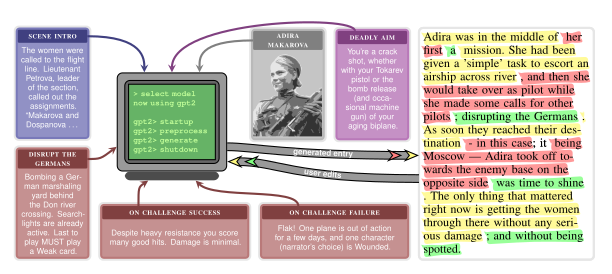
A high-level outline of our dataset and platform. In this example from a real STORIUM game, the character ADIRA MAKAROVA uses the strength card DEADLY AIM to DISRUPT THE GERMANS, a challenge card. Our model conditions on the natural language annotations in the scene intro, challenge card, strength card, and character, along with the text of the previous scene entry (not shown) to generate a suggested story continuation. Players may then edit the model output, by adding or deleting text, before publishing the entry. We collect these edits, using the matched text as the basis of our USER metric. New models can be added to the platform by simply implementing four methods: startup, shutdown, preprocess, and generate.

Deployment

This repository contains the code that makes our GPT-2 story generation models deployable on our evaluation platform, so it serves as a great template for how to structure your code. Please see the file figmentate.py for the simple API required for making your model deployable on our platform. You will also need to provide a json file with any properties needed to pass to your startup method. See for example the properties below:

{
  "scene_entry":
  {
    "properties": {
      "checkpoint_path": "/var/lib/figmentator/checkpoint",
      "sample": {
	"top_p": 0.9,
	"temperature": 0.9,
	"repetition_penalty": 1.2
      }
    },
    "requires": ["torch==1.3.0", "transformers==2.2.0", "kiwisolver==1.1.0"],
    "cls": "model=figmentate:GPT2Figmentator"
  }
}

The key scene_entry defines the type of model being created. Currently, we only support models that generate the text of a scene entry, though we might support other types of prediction models in the future, like suggesting cards or narrator actions.

The properties object will be passed to your startup method. It allows for defining any parameters needed for sampling from your model.

The requires list, is simply a list of python packages that need to be installed for your model to run. These will be automatically installed when your model is deployed. If you notice, we specify the deep learning package torch as a requirement. That's because our code is agnostic to the underlying deep learning framework being used by your model. That means it should support models using other frameworks like tensorflow or jax.

Finally, the cls string is the class that wraps your model. It is specified using Python's entry points syntax.

Cite

@inproceedings{akoury2020storium,
  Author = {Nader Akoury, Shufan Wang, Josh Whiting, Stephen Hood, Nanyun Peng and Mohit Iyyer},
  Booktitle = {Empirical Methods for Natural Language Processing},
  Year = "2020",
  Title = {{STORIUM}: {A} {D}ataset and {E}valuation {P}latform for {S}tory {G}eneration}
}
Owner
Nader Akoury
CS PhD Student
Nader Akoury
Pervasive Attention: 2D Convolutional Networks for Sequence-to-Sequence Prediction

This is a fork of Fairseq(-py) with implementations of the following models: Pervasive Attention - 2D Convolutional Neural Networks for Sequence-to-Se

Maha 490 Dec 15, 2022
Implements MLP-Mixer: An all-MLP Architecture for Vision.

MLP-Mixer-CIFAR10 This repository implements MLP-Mixer as proposed in MLP-Mixer: An all-MLP Architecture for Vision. The paper introduces an all MLP (

Sayak Paul 51 Jan 04, 2023
Simple tutorials using Google's TensorFlow Framework

TensorFlow-Tutorials Introduction to deep learning based on Google's TensorFlow framework. These tutorials are direct ports of Newmu's Theano Tutorial

Nathan Lintz 6k Jan 06, 2023
EDCNN: Edge enhancement-based Densely Connected Network with Compound Loss for Low-Dose CT Denoising

EDCNN: Edge enhancement-based Densely Connected Network with Compound Loss for Low-Dose CT Denoising By Tengfei Liang, Yi Jin, Yidong Li, Tao Wang. Th

workingcoder 115 Jan 05, 2023
Learning Spatio-Temporal Transformer for Visual Tracking

STARK The official implementation of the paper Learning Spatio-Temporal Transformer for Visual Tracking Hiring research interns for visual transformer

Multimedia Research 484 Dec 29, 2022
Generalized Proximal Policy Optimization with Sample Reuse (GePPO)

Generalized Proximal Policy Optimization with Sample Reuse This repository is the official implementation of the reinforcement learning algorithm Gene

Jimmy Queeney 9 Nov 28, 2022
a spacial-temporal pattern detection system for home automation

Argos a spacial-temporal pattern detection system for home automation. Based on OpenCV and Tensorflow, can run on raspberry pi and notify HomeAssistan

Angad Singh 133 Jan 05, 2023
Pydantic models for pywttr and aiopywttr.

Pydantic models for pywttr and aiopywttr.

Almaz 2 Dec 08, 2022
Official repository of the paper Learning to Regress 3D Face Shape and Expression from an Image without 3D Supervision

Official repository of the paper Learning to Regress 3D Face Shape and Expression from an Image without 3D Supervision

Soubhik Sanyal 689 Dec 25, 2022
A facial recognition doorbell system using a Raspberry Pi

Facial Recognition Doorbell This project expands on the person-detecting doorbell system to allow it to identify faces, and announce names accordingly

rydercalmdown 22 Apr 15, 2022
DP-CL(Continual Learning with Differential Privacy)

DP-CL(Continual Learning with Differential Privacy) This is the official implementation of the Continual Learning with Differential Privacy. If you us

Phung Lai 3 Nov 04, 2022
RepVGG: Making VGG-style ConvNets Great Again

RepVGG: Making VGG-style ConvNets Great Again (PyTorch) This is a super simple ConvNet architecture that achieves over 80% top-1 accuracy on ImageNet

2.8k Jan 04, 2023
atmaCup #11 の Public 4th / Pricvate 5th Solution のリポジトリです。

#11 atmaCup 2021-07-09 ~ 2020-07-21 に行われた #11 [初心者歓迎! / 画像編] atmaCup のリポジトリです。結果は Public 4th / Private 5th でした。 フレームワークは PyTorch で、実装は pytorch-image-m

Tawara 12 Apr 07, 2022
Scikit-event-correlation - Event Correlation and Forecasting over High Dimensional Streaming Sensor Data algorithms

scikit-event-correlation Event Correlation and Changing Detection Algorithm Theo

Intellia ICT 5 Oct 30, 2022
Fine-grained Post-training for Improving Retrieval-based Dialogue Systems - NAACL 2021

Fine-grained Post-training for Multi-turn Response Selection Implements the model described in the following paper Fine-grained Post-training for Impr

Janghoon Han 83 Dec 20, 2022
Pytorch implementation of forward and inverse Haar Wavelets 2D

Pytorch implementation of forward and inverse Haar Wavelets 2D

Sergei Belousov 9 Oct 30, 2022
Source code for CVPR 2020 paper "Learning to Forget for Meta-Learning"

L2F - Learning to Forget for Meta-Learning Sungyong Baik, Seokil Hong, Kyoung Mu Lee Source code for CVPR 2020 paper "Learning to Forget for Meta-Lear

Sungyong Baik 29 May 22, 2022
Code of U2Fusion: a unified unsupervised image fusion network for multiple image fusion tasks, including multi-modal, multi-exposure and multi-focus image fusion.

U2Fusion Code of U2Fusion: a unified unsupervised image fusion network for multiple image fusion tasks, including multi-modal (VIS-IR, medical), multi

Han Xu 129 Dec 11, 2022
Checking fibonacci - Generating the Fibonacci sequence is a classic recursive problem

Fibonaaci Series Generating the Fibonacci sequence is a classic recursive proble

Moureen Caroline O 1 Feb 15, 2022
Source code and Dataset creation for the paper "Neural Symbolic Regression That Scales"

NeuralSymbolicRegressionThatScales Pytorch implementation and pretrained models for the paper "Neural Symbolic Regression That Scales", presented at I

35 Nov 25, 2022