A PyTorch port of the Neural 3D Mesh Renderer

Overview

Neural 3D Mesh Renderer (CVPR 2018)

This repo contains a PyTorch implementation of the paper Neural 3D Mesh Renderer by Hiroharu Kato, Yoshitaka Ushiku, and Tatsuya Harada. It is a port of the original Chainer implementation released by the authors. Currently the API is the same as in the original implementation with some smalls additions (e.g. render using a general 3x4 camera matrix, lens distortion coefficients etc.). However it is possible that it will change in the future.

The library is fully functional and it passes all the test cases supplied by the authors of the original library. Detailed documentation will be added in the near future.

Requirements

Python 2.7+ and PyTorch 0.4.0.

The code has been tested only with PyTorch 0.4.0, there are no guarantees that it is compatible with older versions. Currently the library has both Python 3 and Python 2 support.

Note: In some newer PyTorch versions you might see some compilation errors involving AT_ASSERT. In these cases you can use the version of the code that is in the branch at_assert_fix. These changes will be merged into master in the near future.

Installation

You can install the package by running

pip install neural_renderer_pytorch

Since running install.py requires PyTorch, make sure to install PyTorch before running the above command.

Running examples

python ./examples/example1.py
python ./examples/example2.py
python ./examples/example3.py
python ./examples/example4.py

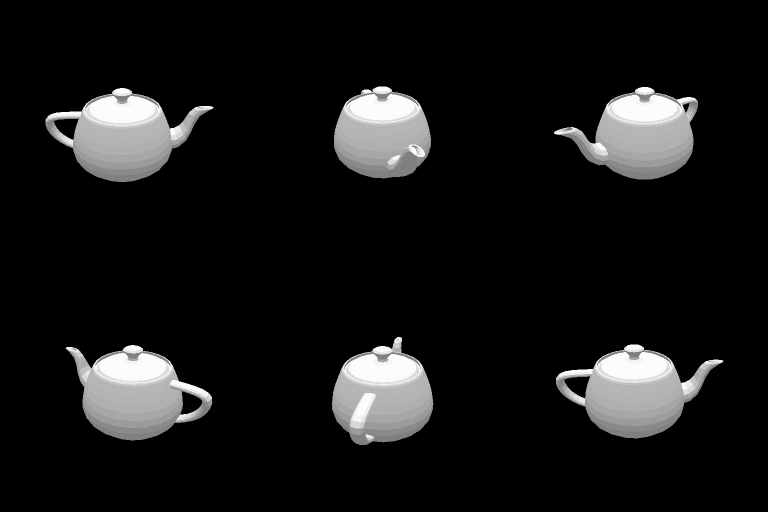
Example 1: Drawing an object from multiple viewpoints
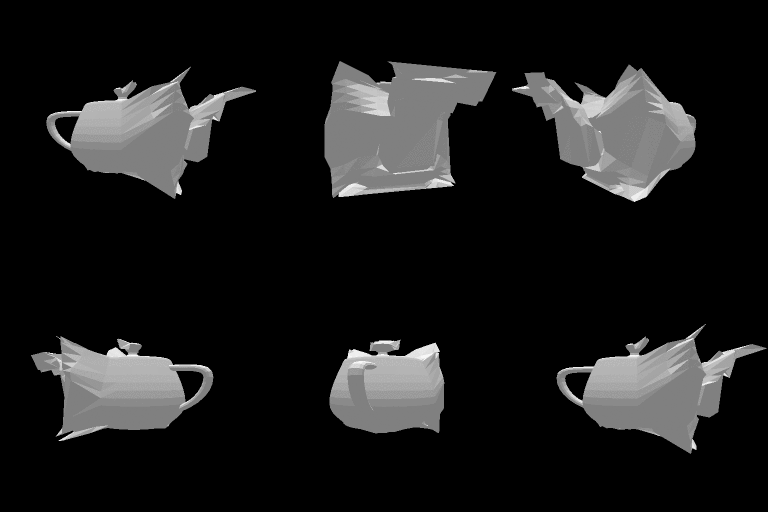
Example 2: Optimizing vertices

Transforming the silhouette of a teapot into a rectangle. The loss function is the difference between the rendered image and the reference image.

Reference image, optimization, and the result.

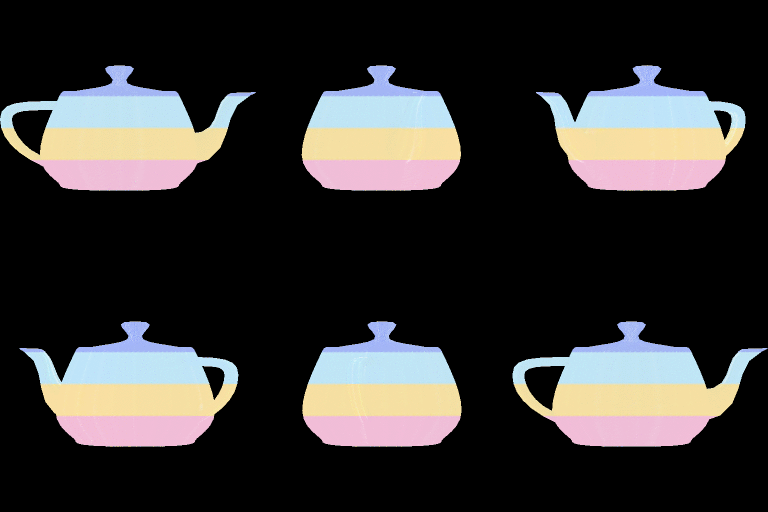
Example 3: Optimizing textures

Matching the color of a teapot with a reference image.

Reference image, result.

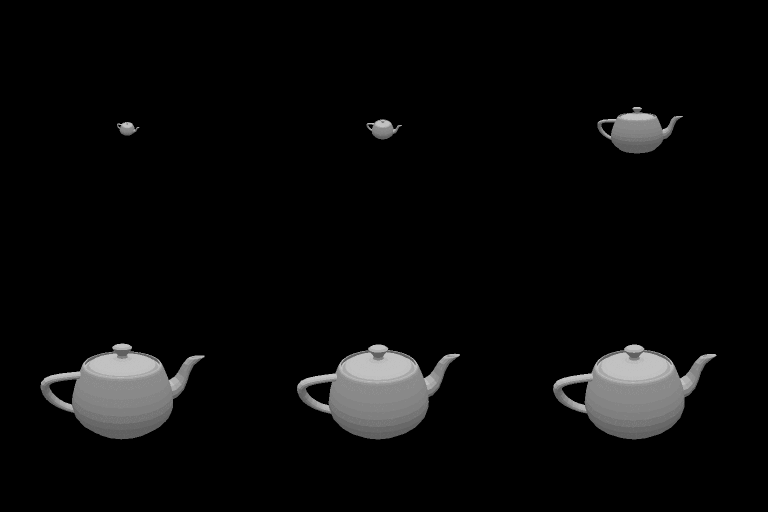
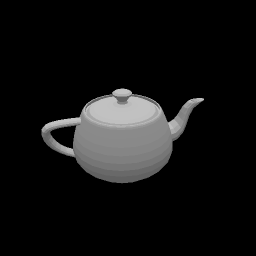
Example 4: Finding camera parameters

The derivative of images with respect to camera pose can be computed through this renderer. In this example the position of the camera is optimized by gradient descent.

From left to right: reference image, initial state, and optimization process.
Citation

@InProceedings{kato2018renderer
    title={Neural 3D Mesh Renderer},
    author={Kato, Hiroharu and Ushiku, Yoshitaka and Harada, Tatsuya},
    booktitle={The IEEE Conference on Computer Vision and Pattern Recognition (CVPR)},
    year={2018}
}
Owner
Daniilidis Group University of Pennsylvania
Research group of Prof. Kostas Daniilidis
Daniilidis Group University of Pennsylvania
Source code for our Paper "Learning in High-Dimensional Feature Spaces Using ANOVA-Based Matrix-Vector Multiplication"

NFFT4ANOVA Source code for our Paper "Learning in High-Dimensional Feature Spaces Using ANOVA-Based Matrix-Vector Multiplication" This package uses th

Theresa Wagner 1 Aug 10, 2022
Isaac Gym Reinforcement Learning Environments

Isaac Gym Reinforcement Learning Environments

NVIDIA Omniverse 714 Jan 08, 2023
This repository consists of Blender python scripts and corresponding assets to generate variants of the CANDLE dataset

candle-simulator This repository consists of Blender python scripts and corresponding assets to generate variants of the IITH-CANDLE dataset. The rend

1 Dec 15, 2021
Code For TDEER: An Efficient Translating Decoding Schema for Joint Extraction of Entities and Relations (EMNLP2021)

TDEER (WIP) Code For TDEER: An Efficient Translating Decoding Schema for Joint Extraction of Entities and Relations (EMNLP2021) Overview TDEER is an e

Alipay 6 Dec 17, 2022
Automatic tool focused on deriving metallicities of open clusters

metalcode Automatic tool focused on deriving metallicities of open clusters. Based on the method described in Pöhnl & Paunzen (2010, https://ui.adsabs

2 Dec 13, 2021
Colossal-AI: A Unified Deep Learning System for Large-Scale Parallel Training

ColossalAI An integrated large-scale model training system with efficient parallelization techniques. arXiv: Colossal-AI: A Unified Deep Learning Syst

HPC-AI Tech 7.9k Jan 08, 2023
Code for Dual Contrastive Learning for Unsupervised Image-to-Image Translation, NTIRE, CVPRW 2021.

arXiv Dual Contrastive Learning Adversarial Generative Networks (DCLGAN) We provide our PyTorch implementation of DCLGAN, which is a simple yet powerf

119 Dec 04, 2022
BTC-Generator - BTC Generator With Python

Что такое BTC-Generator? Это генератор чеков всеми любимого @BTC_BANKER_BOT Для

DoomGod 3 Aug 24, 2022
Labels4Free: Unsupervised Segmentation using StyleGAN

Labels4Free: Unsupervised Segmentation using StyleGAN ICCV 2021 Figure: Some segmentation masks predicted by Labels4Free Framework on real and synthet

70 Dec 23, 2022
Towards Interpretable Deep Metric Learning with Structural Matching

DIML Created by Wenliang Zhao*, Yongming Rao*, Ziyi Wang, Jiwen Lu, Jie Zhou This repository contains PyTorch implementation for paper Towards Interpr

Wenliang Zhao 75 Nov 11, 2022
Sound and Cost-effective Fuzzing of Stripped Binaries by Incremental and Stochastic Rewriting

StochFuzz: A New Solution for Binary-only Fuzzing StochFuzz is a (probabilistically) sound and cost-effective fuzzing technique for stripped binaries.

Zhuo Zhang 164 Dec 05, 2022
Source codes for the paper "Local Additivity Based Data Augmentation for Semi-supervised NER"

LADA This repo contains codes for the following paper: Jiaao Chen*, Zhenghui Wang*, Ran Tian, Zichao Yang, Diyi Yang: Local Additivity Based Data Augm

GT-SALT 36 Dec 02, 2022
This is a Tensorflow implementation of Learning to See in the Dark in CVPR 2018

Learning-to-See-in-the-Dark This is a Tensorflow implementation of Learning to See in the Dark in CVPR 2018, by Chen Chen, Qifeng Chen, Jia Xu, and Vl

5.3k Jan 01, 2023
[ICCV21] Self-Calibrating Neural Radiance Fields

Self-Calibrating Neural Radiance Fields, ICCV, 2021 Project Page | Paper | Video Author Information Yoonwoo Jeong [Google Scholar] Seokjun Ahn [Google

381 Dec 30, 2022
Audio Source Separation is the process of separating a mixture into isolated sounds from individual sources

Audio Source Separation is the process of separating a mixture into isolated sounds from individual sources (e.g. just the lead vocals).

Victor Basu 14 Nov 07, 2022
The source code of the ICCV2021 paper "PIRenderer: Controllable Portrait Image Generation via Semantic Neural Rendering"

The source code of the ICCV2021 paper "PIRenderer: Controllable Portrait Image Generation via Semantic Neural Rendering"

Ren Yurui 261 Jan 09, 2023
Decision Transformer: A brand new Offline RL Pattern

DecisionTransformer_StepbyStep Intro Decision Transformer: A brand new Offline RL Pattern. 这是关于NeurIPS 2021 热门论文Decision Transformer的复现。 👍 原文地址: Deci

Irving 14 Nov 22, 2022
PocketNet: Extreme Lightweight Face Recognition Network using Neural Architecture Search and Multi-Step Knowledge Distillation

PocketNet This is the official repository of the paper: PocketNet: Extreme Lightweight Face Recognition Network using Neural Architecture Search and M

Fadi Boutros 40 Dec 22, 2022
Deep Learning Emotion decoding using EEG data from Autism individuals

Deep Learning Emotion decoding using EEG data from Autism individuals This repository includes the python and matlab codes using for processing EEG 2D

Juan Manuel Mayor Torres 12 Dec 08, 2022
Arbitrary Distribution Modeling with Censorship in Real Time 59 2 60 3 Bidding Advertising for KDD'21

Arbitrary_Distribution_Modeling This repo implements the Neighborhood Likelihood Loss (NLL) and Arbitrary Distribution Modeling (ADM, with Interacting

7 Jan 03, 2023