8QueensGenetic
A Python project for optimizing the 8 Queens Puzzle using the Genetic Algorithm implemented in PyGAD.
The project uses the Kivy cross-platform Python framework for building the GUI of the 8 queens puzzle. The GUI helps to visualize the solutions reached while the genetic algorithm (GA) is optimizing the problem to find the best solution.
For implementing the genetic algorithm, the PyGAD library is used. Check its documentation here: https://pygad.readthedocs.io
IMPORTANT If you are coming for the code of the tutorial 8 Queen Puzzle Optimization Using a Genetic Algorithm in Python, then it has been moved to the TutorialProject directory on 17 June 2020.
PyGAD Installation
To install PyGAD, simply use pip to download and install the library from PyPI (Python Package Index). The library lives a PyPI at this page https://pypi.org/project/pygad.
For Windows, issue the following command:
pip install pygad
For Linux and Mac, replace pip by use pip3 because the library only supports Python 3.
pip3 install pygad
PyGAD is developed in Python 3.7.3 and depends on NumPy for creating and manipulating arrays and Matplotlib for creating figures. The exact NumPy version used in developing PyGAD is 1.16.4. For Matplotlib, the version is 3.1.0.
Project GUI
The project comes with a GUI built in Kivy, a cross-platform Python framework for building natural user interfaces. Before using the project, install Kivy:
pip install kivy
Because the project is built using Python 3, use pip3 instead of pip for Mac/Linux:
pip3 install kivy
Check this Stackoverflow answer to install other libraries that are essential to run Kivy: https://stackoverflow.com/a/44220712
The main file for this project is called main.py which holds the code for building the GUI and instantiating PyGAD for running the genetic algorithm.
After running the main.py file successfully, the window will appear as given in the figure below. The GUI uses a GridLayout for creating an 8x8 grid. This grid represents the board of the 8 queen puzzle.
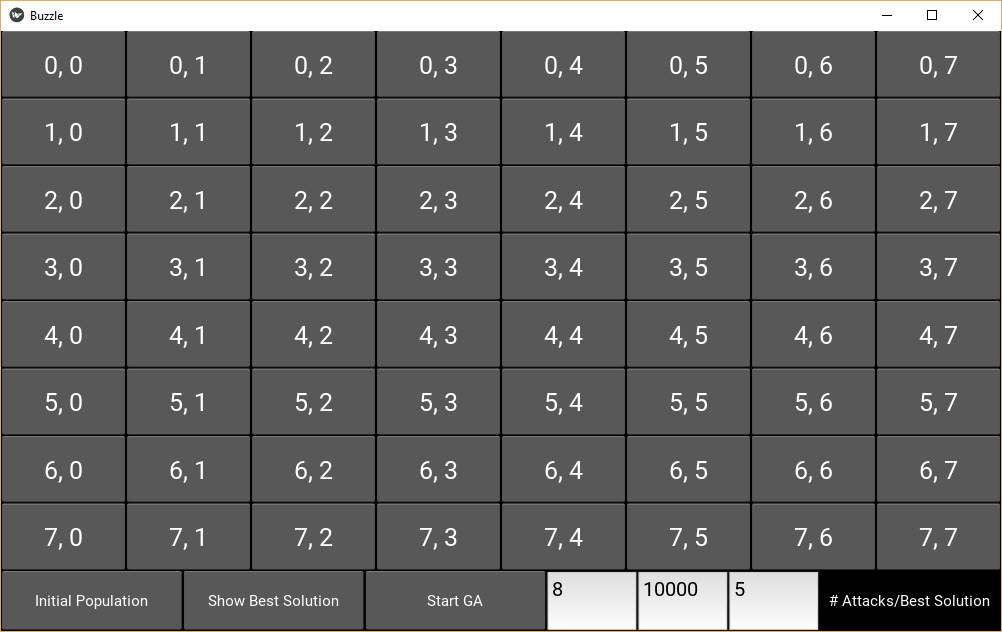
The objective of the GA is to find the best locations for the 8 queens so that no queen is attacking another horizontally, vertically, or diagonally. This project assumes that no 2 queens are in the same row. As a result, we are sure that no 2 queens will attack each other horizontally. This leaves us to the 2 other types of attacks (vertically and diagonally).
The bottom part of the window has 3 Button widgets and 1 Label widget. From left to right, the description of the 3 Button widgets is as follows:
- The Initial Population button creates the initial population of the GA.
- The Show Best Solution button shows the best solution in the last generation the GA stopped at.
- The Start GA button starts the GA iterations/generations.
The Label widget just prints some informational messages to the user. For example, it prints the fitness value of the best solution when the user presses the Show Best Solution button.
Steps to Use the Project
Follow these steps to use the project:
- Run the main.py file.
- Press the Initial Population Button.
- Press the Start GA Button.
After pressing the Start GA button, the GA uses the initial population and evolves its solutions until reaching the best possible solution.
Behind the scenes, some important stuff was built that includes building the Kivy GUI, instantiating PyGAD, preparing the the fitness function, preparing the callback function, and more. For more information, please check the tutorial titled 8 Queen Puzzle Optimization Using a Genetic Algorithm in Python.
6 Attacks
After running the main.py file and pressing the Initial Population button, the next figure shows one possible initial population in which 6 out of 8 queens are attacking each other.
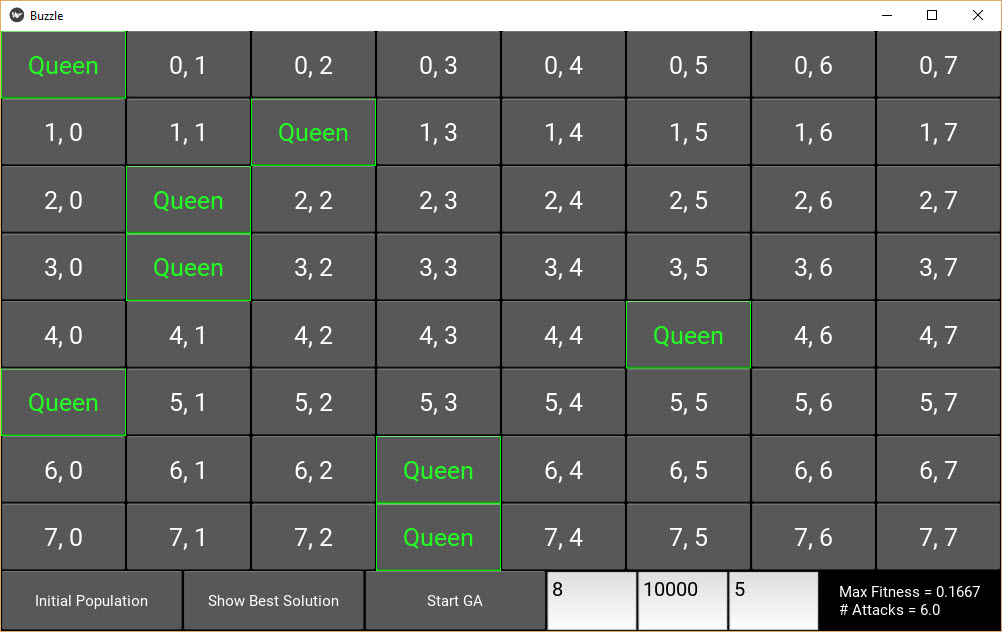
In the Label, the fitness value is calculated as 1.0/number of attacks. In this case, the fitness value is equal to 1.0/6.0 which is 0.1667.
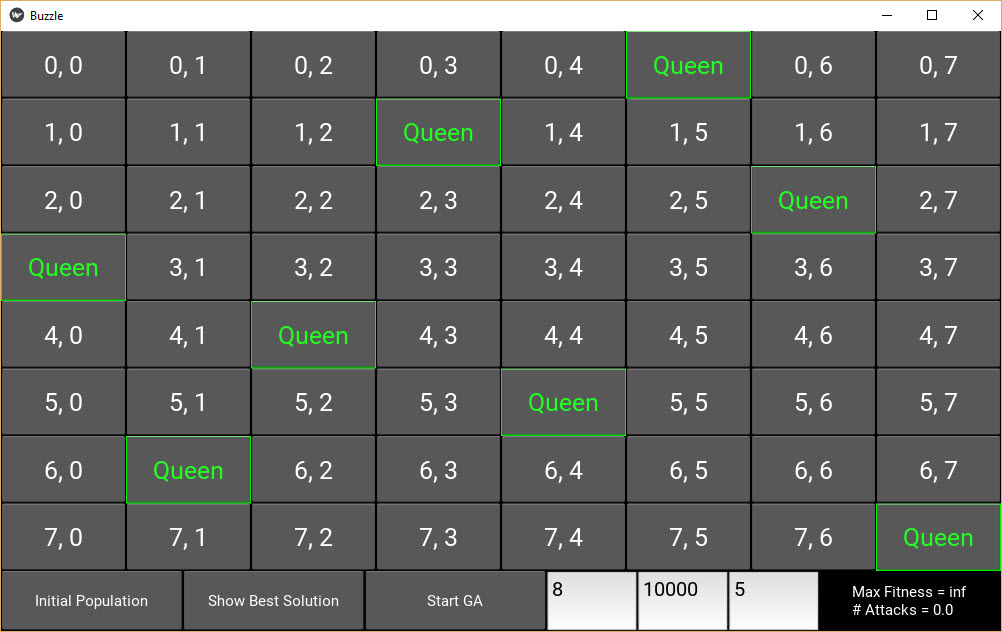
The next figures shows how the GA evolves the solutions until reaching the best solution in which 0 attacks exists.
5 Attacks

4 Attacks

3 Attacks
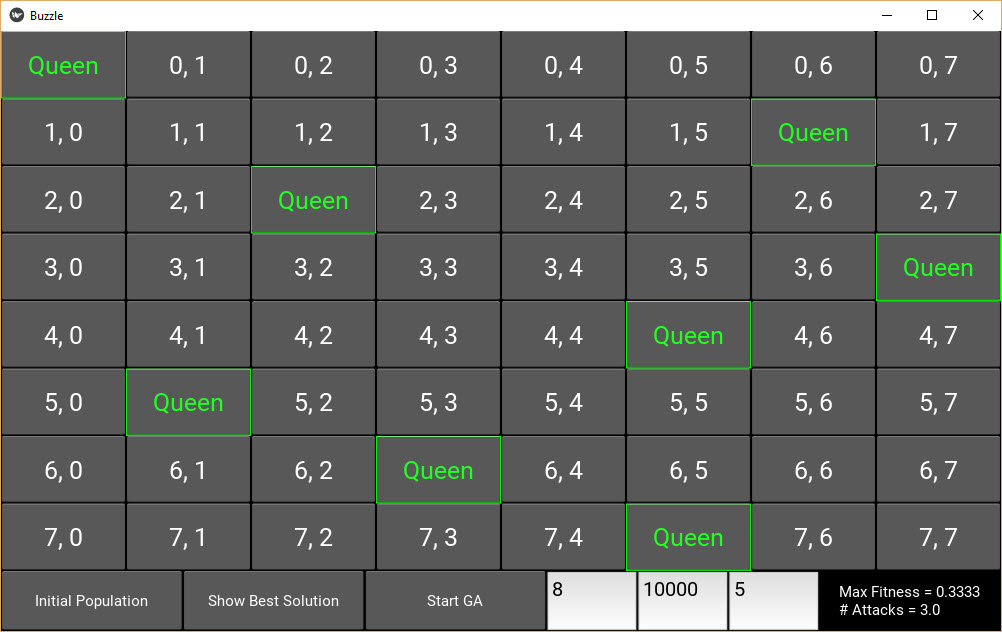
2 Attacks
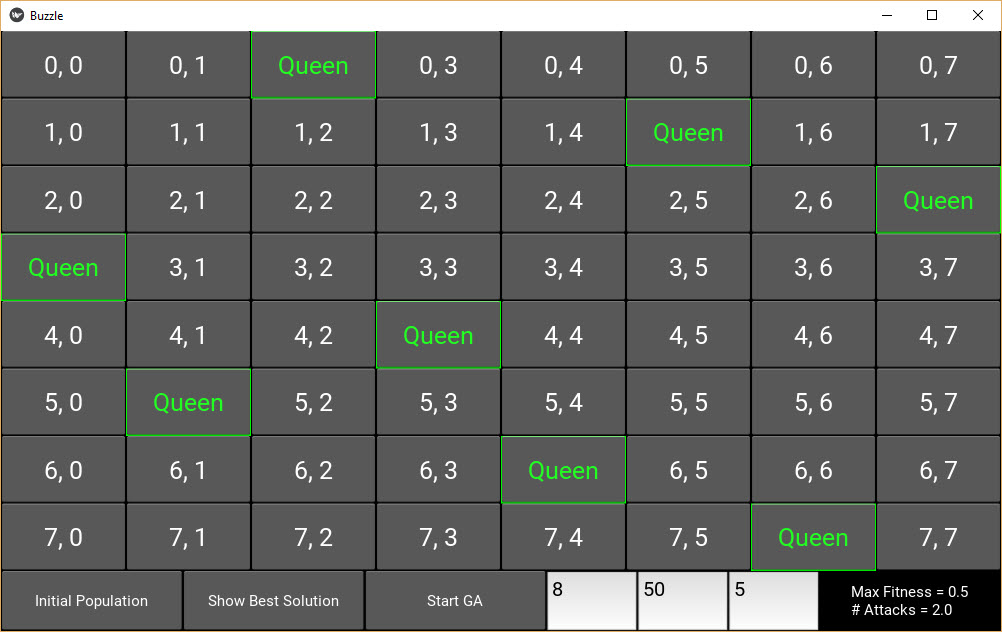
1 Attack
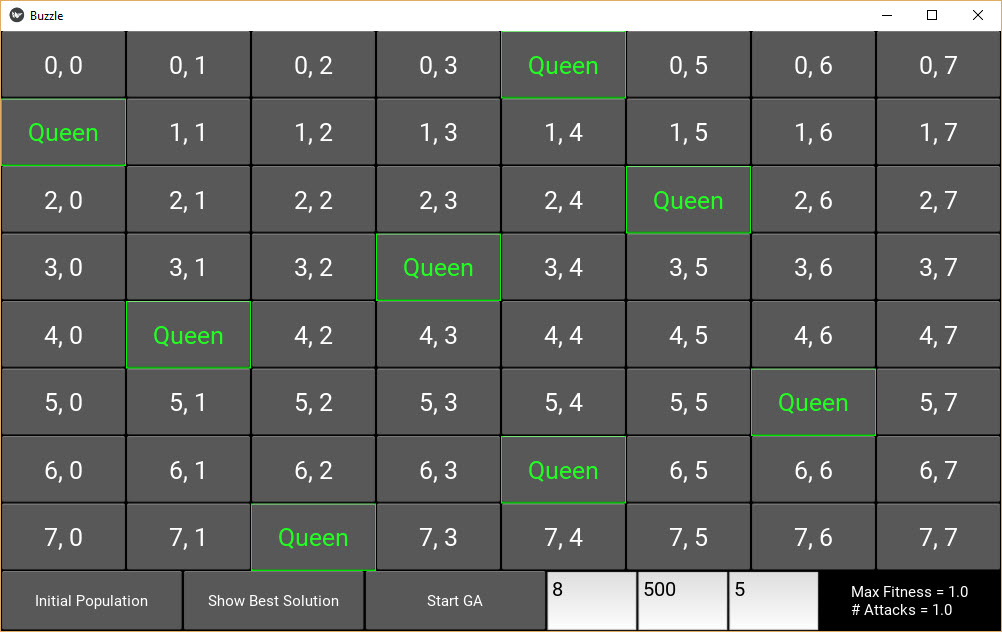
0 Attacks (Optimal Solution)
IMPORTANT
It is very important to note that the GA does not guarantee reaching the optimal solution each time it works. You can make changes in the number of solutions per population, the number of generations, or the number of mutations. Other than doing that, the initial population might also be another factor for not reaching the optimal solution for a given trial.
For More Information
There are different resources that can be used to get started with the building CNN and its Python implementation.
Tutorial: 8 Queen Puzzle Optimization Using a Genetic Algorithm in Python
In 1 May 2019, I wrote a tutorial discussing this project. The tutorial is titled 8 Queen Puzzle Optimization Using a Genetic Algorithm in Python which is published at Heartbeat. Check it at these links:
- Heartbeat: https://heartbeat.fritz.ai/8-queen-puzzle-optimization-using-a-genetic-algorithm-in-python-1d9ca769ede8

Book: Practical Computer Vision Applications Using Deep Learning with CNNs
You can also check my book cited as Ahmed Fawzy Gad 'Practical Computer Vision Applications Using Deep Learning with CNNs'. Dec. 2018, Apress, 978-1-4842-4167-7 which discusses neural networks, convolutional neural networks, deep learning, genetic algorithm, and more.
Find the book at these links:

Citing PyGAD - Bibtex Formatted Citation
If you used PyGAD, please consider adding a citation to the following paper about PyGAD:
@misc{gad2021pygad,
      title={PyGAD: An Intuitive Genetic Algorithm Python Library},
      author={Ahmed Fawzy Gad},
      year={2021},
      eprint={2106.06158},
      archivePrefix={arXiv},
      primaryClass={cs.NE}
}

 183 Dec 30, 2022
 138 Oct 26, 2022
 4 Dec 24, 2022
 20 Dec 19, 2022
 3 May 21, 2022
 8 Jan 10, 2022
 589 Dec 29, 2022
 2 Dec 24, 2021
 16 Oct 07, 2022
 5 Dec 01, 2022
 5 Aug 04, 2022
 2.8k Dec 30, 2022
 3 Dec 17, 2021
 6 Aug 24, 2022
 36 Dec 23, 2022
 2 Oct 20, 2021
 463 Jan 08, 2023
 4 Jan 28, 2022