

Alternate Python bindings for the Open Asset Import Library (ASSIMP)

Overview

Impasse

Python Test Status codecov

A simple Python wrapper for assimp using cffi to access the library. Requires Python >= 3.7.

It's a fork of PyAssimp, Assimp's official Python port. In contrast to PyAssimp, it strictly targets modern Python 3 and provides type hints. It also aims to allow mutating scenes before exporting by having all wrapper classes operate directly on the underlying C data structures.

Usage

Complete example: 3D viewer

impasse comes with a simple 3D viewer that shows how to load and display a 3D model using a shader-based OpenGL pipeline.
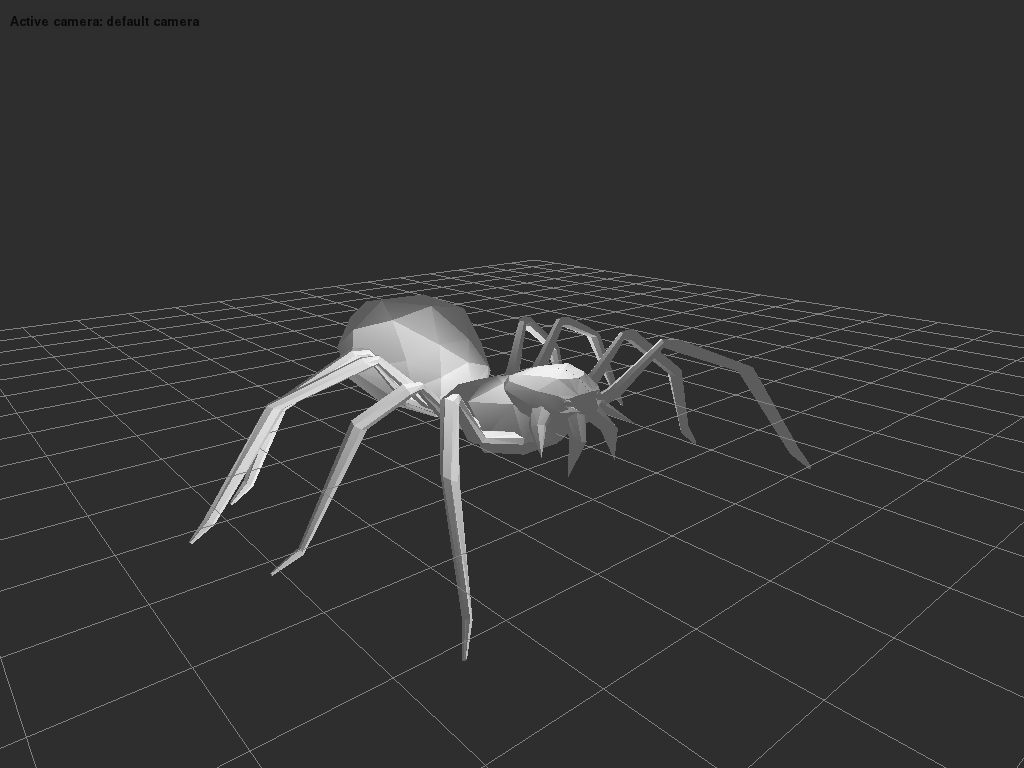
Screenshot

To use it:

python ./scripts/3d_viewer.py <path to your model>

You can use this code as starting point in your applications.

Writing your own code

To get started with impasse, examine the simpler sample.py script in scripts/, which illustrates the basic usage. All Assimp data structures are wrapped using ctypes. All the data+length fields in Assimp's data structures (such as aiMesh::mNumVertices, aiMesh::mVertices) are replaced by list-like wrapper classes, so you can call len() on them to get their respective size and access members using [].

For example, to load a file named hello.3ds and print the first vertex of the first mesh, you would do (proper error handling substituted by assertions ...):

from impasse import load

scene = load('hello.3ds')

assert len(scene.meshes)
mesh = scene.meshes[0]

assert len(mesh.vertices)
print(mesh.vertices[0])

Another example to list the 'top nodes' in a scene:

from impasse import load

scene = load('hello.3ds')
for c in scene.root_node.children:
    print(str(c))

All of assimp's coordinate classes are returned as NumPy arrays, so you can work with them using library for 3d math that handles NumPy arrays. Using transforms.py to modify the scene:

import math

import numpy
import transformations
import impasse

# assimp returns an immutable scene, we have to copy it if we want to change it
scene = impasse.load('hello.3ds').copy_mutable()
transform = scene.root_node.transformation
# Rotate the root node's transform by 180 deg on X
transform = numpy.dot(transformations.rotation_matrix(math.pi, (1, 0, 0)), transform)
scene.root_node.transformation = transform
impasse.export(scene, 'whatever.obj', 'obj')

Installing

Install impasse by running:

pip install impasse

or, if you want to install from the source directory:

pip install -e .

Impasse requires an assimp dynamic library (DLL on Windows, .so on linux, .dynlib on macOS) in order to work. The default search directories are:

  • the current directory
  • on linux additionally: /usr/lib, /usr/local/lib, /usr/lib/ -linux-gnu

To build that library, refer to the Assimp master INSTALL instructions. To look in more places, edit ./impasse/helper.py. There's an additional_dirs list waiting for your entries.

Progress

All features present in PyAssimp are now present in Assimp (plus a few more!) Since the API largely mirrors PyAssimp's, most existing code should work in Impasse with minor changes.

Note that Impasse is not complete. Many assimp features are still missing, mostly around mutating scenes. Notably, anything that would require a new or delete in assimp's C++ API is not supported.

Performance

Impasse tries to avoid unnecessary copies or conversions of data owned by C, and most classes are just thin layers around the underlying CFFI structs. NumPy arrays that directly map to the underlying structs' memory are used for the coordinate structs like Matrix4x4 and Vector3D.

Testing with a similar quicktest.py script against assimp's test model directory:

Impasse

** Loaded 169 models, got controlled errors for 28 files, 0 uncontrolled

real	0m1.460s
user	0m1.676s
sys	0m0.571s

PyAssimp

** Loaded 165 models, got controlled errors for 28 files, 4 uncontrolled

real	0m7.607s
user	0m7.746s
sys	0m0.579s
Comments
  • Nicer way of referring to material property keys

    Nicer way of referring to material property keys

        ('$mat.twosided', 0): [0]
        ('$mat.refracti', 0): [1.]
        ('$mat.bumpscaling', 0): [1.]
        ('$clr.specular', 0): [1. 1. 1.]
    

    Those keys are in the data returned by assimp, but I'm not sure if the prefix is that meaningful. PyAssimp strips off everything before the first .. If they're meaningful or there are collisions without those prefixes, we should keep a string enum of common ones that's easier to refer to.

    enhancement 
    opened by SaladDais 3
  • Rebase on top of original assimp sources to keep PyAssimp's commit history intact

    Rebase on top of original assimp sources to keep PyAssimp's commit history intact

    Now that I think of it, it's preferable to keep the commit history for assimp even if most of it's unrelated to PyAssimp. Make a commit deleting all assimp sources and moving PyAssimp to the repo root, then rebase impasse on top of that.

    Rewriting history isn't nice since I've already based my sources on top of a squashed commit, but impact should be mininal since nobody's using this yet.

    opened by SaladDais 1
  • Make mapping classes mix-ins

    Make mapping classes mix-ins

    Other than name collisions with keys / values, I don't think there's any reason to keep the explicit as_mapping() method rather than just putting them on a mixin for the SerializeableStructs. Can define manual renames for any of those.

    This'd give us a closer API to what PyAssimp already has

    enhancement 
    opened by SaladDais 1
  • Add accessors for mesh and texture that return instances rather than indexes

    Add accessors for mesh and texture that return instances rather than indexes

    All of the struct wrapper have a _scene member that should allow them to transparently look up the texture / material by the index in the attr they wrap.

    enhancement 
    opened by SaladDais 1
  • Get scene mutability working

    Get scene mutability working

    Per the C api you have to create a copy of the scene to get a non-const version: https://github.com/assimp/assimp/blob/master/include/assimp/cexport.h#L109-L123 . Right now all the structs we return have wrappers enforcing the const-ness of scene returned from the the aiImportFile() function. Need to expose the copying functions so people can get a scene they can modify before export.

    enhancement 
    opened by SaladDais 1
  • Package assimp shared library so assimp isn't required to be on the system

    Package assimp shared library so assimp isn't required to be on the system

    Would be nice so people don't have to do some weird conda thing if they want to install the package including assimp.

    I think it should be enough to have osx aarch64, osx x64, linux x64 and windows x64 packages. We don't need to do python version-specific builds, since we'll just be building the assimp library itself and binding against it with cffi. It should be provided in an optional, separate package with the shared library in the package data for the given platform's build.

    enhancement 
    opened by SaladDais 0
  • Add ability to alloc new structs, append to sequences

    Add ability to alloc new structs, append to sequences

    This is tricky since assimp makes liberal use of new[] and delete[] on types that have non-trivial destructors (like aiTexture.) malloc()ing and free()ing those is technically possible but inadvisable, and requires knowledge of the platform / compiler's C++ ABI.

    Likewise, assimp's C API doesn't appear to expose a wrapper around those new[] and delete[] calls. Adding functions to assimp to do those would be the least nasal demon-y approach but wouldn't be available in stable distros' libs.

    A third approach would be to have Scenes keep track of the original values of mutated ptrs, then put everything back in place when the GC happens so anything that'd been internally alloc'd with new could be deleted by assimp. Would also have to keep a list of things we'd malloc()d in our own code to manually free(). Can see a lot of nasty corner cases with this one.

    enhancement help wanted 
    opened by SaladDais 0
Releases(v5.2.0)
Owner
Salad Dais
Code as craft
Salad Dais
Glyphtracer is an app for converting images of letters to a font

Glyphtracer takes an image that contains pictures of several letters. It recognizes all them and lets the user tag each letter to a Unicode code point. It then converts the images to vector form and

Jussi Pakkanen 38 Dec 24, 2022
missing-pixel-filler is a python package that, given images that may contain missing data regions (like satellite imagery with swath gaps), returns these images with the regions filled.

Missing Pixel Filler This is the official code repository for the Missing Pixel Filler by SpaceML. missing-pixel-filler is a python package that, give

SpaceML 11 Jul 19, 2022
This is an app that allows users to upload photos and display and store the photos in a file until the user deletes them.

Qt Photo App This is an app that allows users to upload photos and display and store the photos in a file until the user deletes them. Setup python3 -

Kathy Yang 5 Jan 22, 2022
A simple image to text converter with GUI!

TEXTEMAGE! Textemage is a quick tool that extracts text from images, it is a Python based GUI program(also available in executable version). This is a

Akascape 5 Oct 26, 2022
Digital image process Basic algorithm

These are some basic algorithms that I have implemented by my hands in the process of learning digital image processing, such as mean and median filtering, sharpening algorithms, interpolation scalin

JingYu 2 Nov 03, 2022
Detecting haze image with hazer.

hazer-py Detecting haze image with hazer. What is hazer Hazer is a lib for getting "haze degree". This repository is python version of hazer: https://

Joey777210 2 Dec 27, 2021
Clip Bing Maps backgound as RGB geotif image using center-point from vector data of a shapefile and Bing Maps zoom

Clip Bing Maps backgound as RGB geotif image using center-point from vector data of a shapefile and Bing Maps zoom. Also, rasterize shapefile vectors as corresponding label image.

Gounari Olympia 2 Nov 22, 2021
A Python package implementing various CFA (Colour Filter Array) demosaicing algorithms and related utilities.

Colour - Demosaicing A Python package implementing various CFA (Colour Filter Array) demosaicing algorithms and related utilities. It is open source a

colour-science 218 Dec 04, 2022
GPU-accelerated image processing using cupy and CUDA

napari-cupy-image-processing GPU-accelerated image processing using cupy and CUDA This napari plugin was generated with Cookiecutter using with @napar

Robert Haase 16 Oct 26, 2022
A python script for extracting/removing exif data from images by @AbirHasan2005

Image-Exif A Python script for extracting exif metadata from images. How to use? Using this script you can extract exif data from image and save in .c

Abir Hasan 13 Dec 16, 2022
🖼️ Draw Images or GIFs in your terminal

Drawitor Draw Images/GIFs in your terminal. Install pip install drawitor CLI Tool drawitor cat_dancing.gif Library The library is written in a simple

Eliaz Bobadilla 7 Dec 15, 2022
【萝莉图片算法】高损图像压缩算法!?

【萝莉图片算法】高损图像压缩算法!? 我又发明出新算法了! 这次我发明的是新型高损图像压缩算法——萝莉图片算法!为什么是萝莉图片,这是因为它是使动用法,让图片变小所以是萝莉图片,大家一定要学好语文哦! 压缩效果 太神奇了!压缩率竟然高达99.97%! 与常见压缩算法对比 在图片最终大小为1KB的情况

黄巍 49 Oct 17, 2022
SGTL - Spectral Graph Theory Library

SGTL - Spectral Graph Theory Library SGTL is a python library of spectral graph theory methods. The library is still very new and so there are many fe

Peter Macgregor 6 Oct 01, 2022
DrawBot is a powerful, free application for macOS that invites you to write Python scripts to generate two-dimensional graphics

DrawBot is a powerful, free application for macOS that invites you to write Python scripts to generate two-dimensional graphics.

Frederik Berlaen 344 Jan 06, 2023
A pure python implementation of the GIMP XCF image format. Use this to interact with GIMP image formats

Pure Python implementation of the GIMP image formats (.xcf projects as well as brushes, patterns, etc)

FHPyhtonUtils 8 Dec 30, 2022
A tool for hiding data inside of images

Stegenography-tool a tool for hiding data inside of images Quick test: do python steg-encode.py test/message.txt test/covid19.png to generate the test

luke 2 Nov 02, 2021
Unique image & metadata generation using weighted layer collections.

nft-generator-py nft-generator-py is a python based NFT generator which programatically generates unique images using weighted layer files. The progra

Jonathan Becker 243 Dec 31, 2022
The friendly PIL fork (Python Imaging Library)

Pillow Python Imaging Library (Fork) Pillow is the friendly PIL fork by Alex Clark and Contributors. PIL is the Python Imaging Library by Fredrik Lund

Pillow 10.4k Dec 31, 2022
A simple python script to reveal the contents of a proof of vaccination QR code.

vaxidecoder A simple python script to reveal the contents of a proof of vaccination QR code. It takes a QR code image as input, and returns JSon data.

Hafidh 2 Feb 28, 2022
Design custom QR codes with this web app!

My-QR.Art This web app lets users design their own QR codes to any domain. It can be acessed on my-qr.art. You can find some more background info abou

Marien Raat 406 Dec 20, 2022