Graph Attention Networks

Overview

GAT

Graph Attention Networks (Veličković et al., ICLR 2018): https://arxiv.org/abs/1710.10903

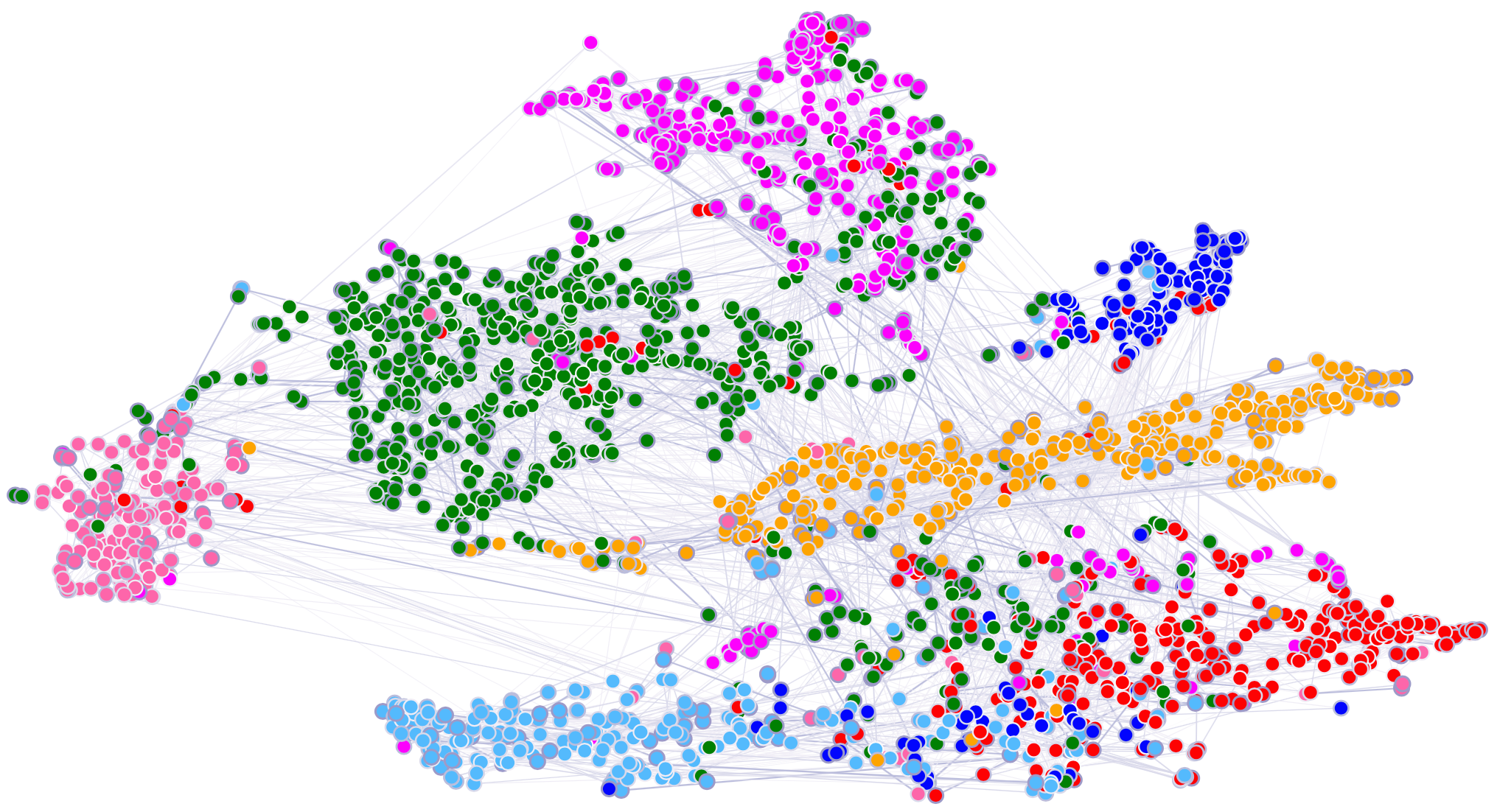
GAT layer t-SNE + Attention coefficients on Cora

Overview

Here we provide the implementation of a Graph Attention Network (GAT) layer in TensorFlow, along with a minimal execution example (on the Cora dataset). The repository is organised as follows:

  • data/ contains the necessary dataset files for Cora;
  • models/ contains the implementation of the GAT network (gat.py);
  • pre_trained/ contains a pre-trained Cora model (achieving 84.4% accuracy on the test set);
  • utils/ contains:
    • an implementation of an attention head, along with an experimental sparse version (layers.py);
    • preprocessing subroutines (process.py);
    • preprocessing utilities for the PPI benchmark (process_ppi.py).

Finally, execute_cora.py puts all of the above together and may be used to execute a full training run on Cora.

Sparse version

An experimental sparse version is also available, working only when the batch size is equal to 1. The sparse model may be found at models/sp_gat.py.

You may execute a full training run of the sparse model on Cora through execute_cora_sparse.py.

Dependencies

The script has been tested running under Python 3.5.2, with the following packages installed (along with their dependencies):

  • numpy==1.14.1
  • scipy==1.0.0
  • networkx==2.1
  • tensorflow-gpu==1.6.0

In addition, CUDA 9.0 and cuDNN 7 have been used.

Reference

If you make advantage of the GAT model in your research, please cite the following in your manuscript:

@article{
  velickovic2018graph,
  title="{Graph Attention Networks}",
  author={Veli{\v{c}}kovi{\'{c}}, Petar and Cucurull, Guillem and Casanova, Arantxa and Romero, Adriana and Li{\`{o}}, Pietro and Bengio, Yoshua},
  journal={International Conference on Learning Representations},
  year={2018},
  url={https://openreview.net/forum?id=rJXMpikCZ},
  note={accepted as poster},
}

For getting started with GATs, as well as graph representation learning in general, we highly recommend the pytorch-GAT repository by Aleksa Gordić. It ships with an inductive (PPI) example as well.

GAT is a popular method for graph representation learning, with optimised implementations within virtually all standard GRL libraries:

We recommend using either one of those (depending on your favoured framework), as their implementations have been more readily battle-tested.

Early on post-release, two unofficial ports of the GAT model to various frameworks quickly surfaced. To honour the effort of their developers as early adopters of the GAT layer, we leave pointers to them here.

License

MIT

Owner
Petar Veličković
Senior Research Scientist
Petar Veličković
A Diagnostic Dataset for Compositional Language and Elementary Visual Reasoning

CLEVR Dataset Generation This is the code used to generate the CLEVR dataset as described in the paper: CLEVR: A Diagnostic Dataset for Compositional

Facebook Research 503 Jan 04, 2023
Python framework for Stochastic Differential Equations modeling

SDElearn: a Python package for SDE modeling This package implements functionalities for working with Stochastic Differential Equations models (SDEs fo

4 May 10, 2022
Hardware-accelerated DNN model inference ROS2 packages using NVIDIA Triton/TensorRT for both Jetson and x86_64 with CUDA-capable GPU

Isaac ROS DNN Inference Overview This repository provides two NVIDIA GPU-accelerated ROS2 nodes that perform deep learning inference using custom mode

NVIDIA Isaac ROS 62 Dec 14, 2022
Twin-deep neural network for semi-supervised learning of materials properties

Deep Semi-Supervised Teacher-Student Material Synthesizability Prediction Citation: Semi-supervised teacher-student deep neural network for materials

MLEG 3 Dec 14, 2022
Python Implementation of Chess Playing AI with variable difficulty

Chess AI with variable difficulty level implemented using the MiniMax AB-Pruning Algorithm

Ali Imran 7 Feb 20, 2022
Focal Loss for Dense Rotation Object Detection

Convert ResNets weights from GluonCV to Tensorflow Abstract GluonCV released some new resnet pre-training weights and designed some new resnets (such

17 Nov 24, 2021
"Projelerle Yapay Zeka Ve Bilgisayarlı Görü" Kitabımın projeleri

"Projelerle Yapay Zeka Ve Bilgisayarlı Görü" Kitabımın projeleri Bu Github Reposundaki tüm projeler; kaleme almış olduğum "Projelerle Yapay Zekâ ve Bi

Ümit Aksoylu 4 Aug 03, 2022
sequitur is a library that lets you create and train an autoencoder for sequential data in just two lines of code

sequitur sequitur is a library that lets you create and train an autoencoder for sequential data in just two lines of code. It implements three differ

Jonathan Shobrook 305 Dec 21, 2022
DenseCLIP: Language-Guided Dense Prediction with Context-Aware Prompting

DenseCLIP: Language-Guided Dense Prediction with Context-Aware Prompting Created by Yongming Rao*, Wenliang Zhao*, Guangyi Chen, Yansong Tang, Zheng Z

Yongming Rao 321 Dec 27, 2022
NNR conformation conditional and global probabilities estimation and analysis in peptides or proteins fragments

NNR and global probabilities estimation and analysis in peptides or protein fragments This module calculates global and NNR conformation dependent pro

0 Jul 15, 2021
TilinGNN: Learning to Tile with Self-Supervised Graph Neural Network (SIGGRAPH 2020)

TilinGNN: Learning to Tile with Self-Supervised Graph Neural Network (SIGGRAPH 2020) About The goal of our research problem is illustrated below: give

59 Dec 09, 2022
A modular domain adaptation library written in PyTorch.

A modular domain adaptation library written in PyTorch.

Kevin Musgrave 225 Dec 29, 2022
Bolt Online Learning Toolbox

Bolt Online Learning Toolbox Bolt features discriminative learning of linear predictors (e.g. SVM or Logistic Regression) using fast online learning a

Peter Prettenhofer 87 Dec 12, 2022
Voice Gender Recognition

In this project it was used some different Machine Learning models to identify the gender of a voice (Female or Male) based on some specific speech and voice attributes.

Anne Livia 1 Jan 27, 2022
Official implementation for the paper: "Multi-label Classification with Partial Annotations using Class-aware Selective Loss"

Multi-label Classification with Partial Annotations using Class-aware Selective Loss Paper | Pretrained models Official PyTorch Implementation Emanuel

99 Dec 27, 2022
Codes for TIM2021 paper "Anchor-Based Spatio-Temporal Attention 3-D Convolutional Networks for Dynamic 3-D Point Cloud Sequences"

Codes for TIM2021 paper "Anchor-Based Spatio-Temporal Attention 3-D Convolutional Networks for Dynamic 3-D Point Cloud Sequences"

Intelligent Robotics and Machine Vision Lab 4 Jul 19, 2022
Meaningful titles for tabs and PDF downloads! Also supports tab search.

arxiv-utils If you are a researcher that reads a lot on ArXiv, you'll benefit a lot from this web extension. Renames the title of PDF page to the pape

Johnson 174 Dec 20, 2022
Cards Against Humanity AI

cah-ai This is a Cards Against Humanity AI implemented using a pre-trained Semantic Search model. How it works A player is described by a combination

Alex Nichol 2 Aug 22, 2022
SCALE: Modeling Clothed Humans with a Surface Codec of Articulated Local Elements (CVPR 2021)

SCALE: Modeling Clothed Humans with a Surface Codec of Articulated Local Elements (CVPR 2021) This repository contains the official PyTorch implementa

Qianli Ma 133 Jan 05, 2023
Trains an agent with stochastic policy gradient ascent to solve the Lunar Lander challenge from OpenAI

Introduction This script trains an agent with stochastic policy gradient ascent to solve the Lunar Lander challenge from OpenAI. In order to run this

Momin Haider 0 Jan 02, 2022