Reverse engineer your pytorch vision models, in style

Related tags

Deep Learningrover
Overview

🔍 Rover

Reverse engineer your CNNs, in style

Open In Colab

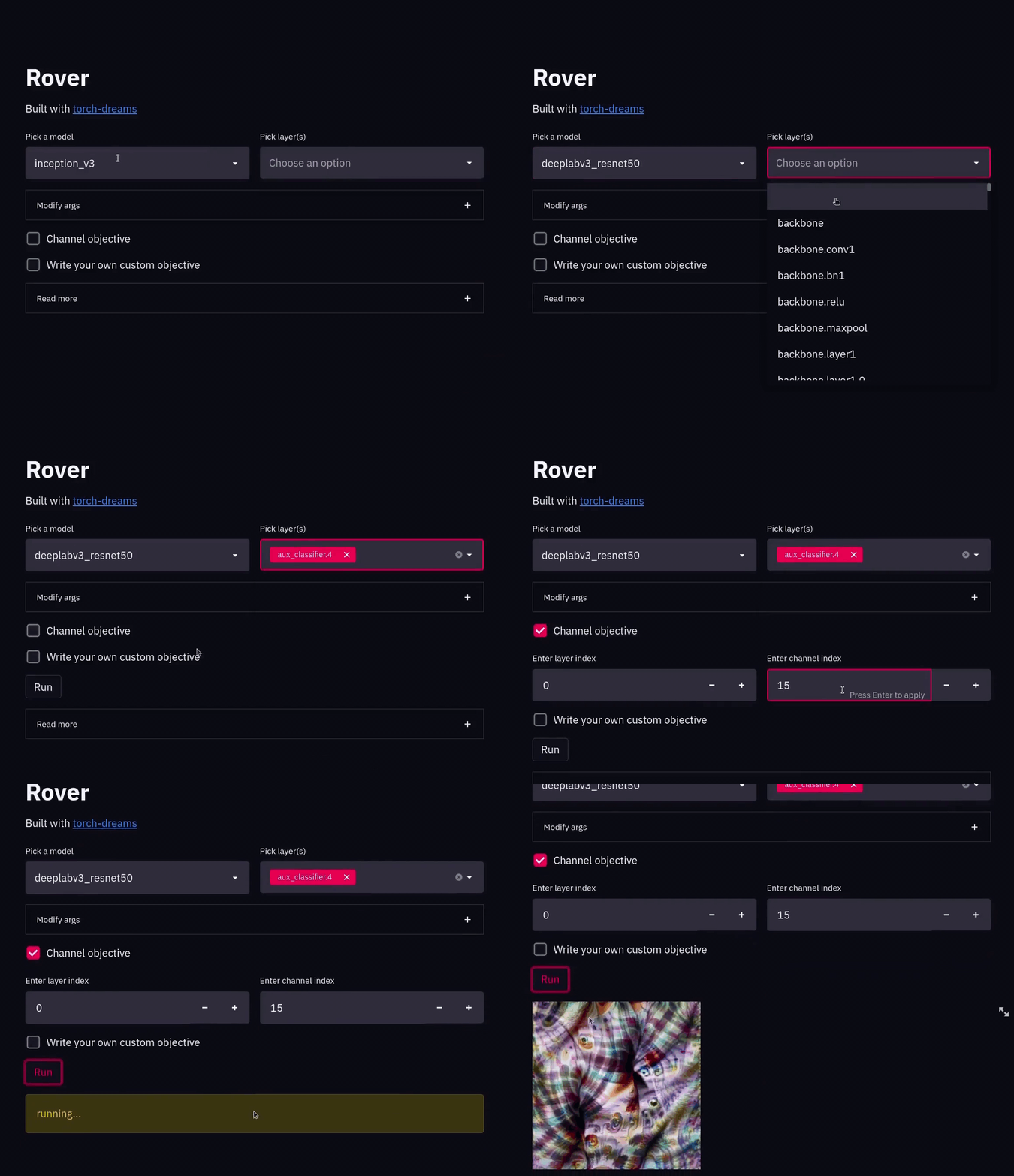
Rover will help you break down your CNN and visualize the features from within the model. No need to write weirdly abstract code to visualize your model's features anymore.

💻 Usage

git clone https://github.com/Mayukhdeb/rover.git; cd rover

install requirements:

pip install -r requirements.txt
from rover import core
from rover.default_models import models_dict

core.run(models_dict = models_dict)

and then run the script with streamlit as:

$ streamlit run your_script.py

if everything goes right, you'll see something like:

You can now view your Streamlit app in your browser.

  Local URL: http://localhost:8501

🧙 Custom models

rover supports pretty much any PyTorch model with an input of shape [N, 3, H, W] (even segmentation models/VAEs and all that fancy stuff) with imagenet normalization on input.

import torchvision.models as models 
model = models.resnet34(pretrained= True)  ## or any other model (need not be from torchvision.models)

models_dict = {
    'my model': model,  ## add in any number of models :)
}

core.run(
    models_dict = models_dict
)

🖼️ Channel objective

Optimizes a single channel from one of the layer(s) selected.

  • layer index: specifies which layer you want to use out of the layers selected.
  • channel index: specifies the exact channel which needs to be visualized.

🧙‍♂️ Writing your own objective

This is for the smarties who like to write their own objective function. The only constraint is that the function should be named custom_func.

Here's an example:

def custom_func(layer_outputs):
    '''
    layer_outputs is a list containing 
    the outputs (torch.tensor) of each layer you selected

    In this example we'll try to optimize the following:
    * the entire first layer -> layer_outputs[0].mean()
    * 20th channel of the 2nd layer -> layer_outputs[1][20].mean()
    '''
    loss = layer_outputs[0].mean() + layer_outputs[1][20].mean()
    return -loss

Running on google colab

Check out this notebook. I'll also include the instructions here just in case.

Clone the repo + install dependencies

!git clone https://github.com/Mayukhdeb/rover.git
!pip install torch-dreams --quiet
!pip install streamlit --quiet

Navigate into the repo

import os 
os.chdir('rover')

Write your file into a script from a cell. Here I wrote it into test.py

%%writefile  test.py

from rover import core
from rover.default_models import models_dict

core.run(models_dict = models_dict)

Run script on a thread

import threading

proc = threading.Thread(target= os.system, args=['streamlit run test.py'])
proc.start()

Download ngrok:

!wget https://bin.equinox.io/c/4VmDzA7iaHb/ngrok-stable-linux-amd64.zip
!unzip -o ngrok-stable-linux-amd64.zi

More ngrok stuff

get_ipython().system_raw('./ngrok http 8501 &')

Get your URL where rover is hosted

!curl -s http://localhost:4040/api/tunnels | python3 -c \
    "import sys, json; print(json.load(sys.stdin)['tunnels'][0]['public_url'])"

💻 Args

  • width (int, optional): Width of image to be optimized
  • height (int, optional): Height of image to be optimized
  • iters (int, optional): Number of iterations, higher -> stronger visualization
  • lr (float, optional): Learning rate
  • rotate (deg) (int, optional): Max rotation in default transforms
  • scale max (float, optional): Max image size factor.
  • scale min (float, optional): Minimum image size factor.
  • translate (x) (float, optional): Maximum translation factor in x direction
  • translate (y) (float, optional): Maximum translation factor in y direction
  • weight decay (float, optional): Weight decay for default optimizer. Helps prevent high frequency noise.
  • gradient clip (float, optional): Maximum value of the norm of gradient.

Run locally

Clone the repo

git clone https://github.com/Mayukhdeb/rover.git

install requirements

pip install -r requirements.txt

showtime

streamlit run test.py
Owner
Mayukh Deb
Learning about life, one epoch at a time
Mayukh Deb
[NeurIPS 2021] Deceive D: Adaptive Pseudo Augmentation for GAN Training with Limited Data

Deceive D: Adaptive Pseudo Augmentation for GAN Training with Limited Data (NeurIPS 2021) This repository will provide the official PyTorch implementa

Liming Jiang 238 Nov 25, 2022
Implementation of the ALPHAMEPOL algorithm, presented in Unsupervised Reinforcement Learning in Multiple Environments.

ALPHAMEPOL This repository contains the implementation of the ALPHAMEPOL algorithm, presented in Unsupervised Reinforcement Learning in Multiple Envir

3 Dec 23, 2021
A python tutorial on bayesian modeling techniques (PyMC3)

Bayesian Modelling in Python Welcome to "Bayesian Modelling in Python" - a tutorial for those interested in learning how to apply bayesian modelling t

Mark Regan 2.4k Jan 06, 2023
PyTorch implementation of paper “Unbiased Scene Graph Generation from Biased Training”

A new codebase for popular Scene Graph Generation methods (2020). Visualization & Scene Graph Extraction on custom images/datasets are provided. It's also a PyTorch implementation of paper “Unbiased

Kaihua Tang 824 Jan 03, 2023
Lyapunov-guided Deep Reinforcement Learning for Stable Online Computation Offloading in Mobile-Edge Computing Networks

PyTorch code to reproduce LyDROO algorithm [1], which is an online computation offloading algorithm to maximize the network data processing capability subject to the long-term data queue stability an

Liang HUANG 87 Dec 28, 2022
Official implementation of the paper Do pedestrians pay attention? Eye contact detection for autonomous driving

Do pedestrians pay attention? Eye contact detection for autonomous driving Official implementation of the paper Do pedestrians pay attention? Eye cont

VITA lab at EPFL 26 Nov 02, 2022
A lightweight library to compare different PyTorch implementations of the same network architecture.

TorchBug is a lightweight library designed to compare two PyTorch implementations of the same network architecture. It allows you to count, and compar

Arjun Krishnakumar 5 Jan 02, 2023
Official implementation of Rethinking Graph Neural Architecture Search from Message-passing (CVPR2021)

Rethinking Graph Neural Architecture Search from Message-passing Intro The GNAS can automatically learn better architecture with the optimal depth of

Shaofei Cai 48 Sep 30, 2022
Lexical Substitution Framework

LexSubGen Lexical Substitution Framework This repository contains the code to reproduce the results from the paper: Arefyev Nikolay, Sheludko Boris, P

Samsung 37 Sep 15, 2022
Image Segmentation Animation using Quadtree concepts.

QuadTree Image Segmentation Animation using QuadTree concepts. Usage usage: quad.py [-h] [-fps FPS] [-i ITERATIONS] [-ws WRITESTART] [-b] [-img] [-s S

Alex Eidt 29 Dec 25, 2022
Paper Title: Heterogeneous Knowledge Distillation for Simultaneous Infrared-Visible Image Fusion and Super-Resolution

HKDnet Paper Title: "Heterogeneous Knowledge Distillation for Simultaneous Infrared-Visible Image Fusion and Super-Resolution" Email:

wasteland 11 Nov 12, 2022
Populating 3D Scenes by Learning Human-Scene Interaction https://posa.is.tue.mpg.de/

Populating 3D Scenes by Learning Human-Scene Interaction [Project Page] [Paper] License Software Copyright License for non-commercial scientific resea

Mohamed Hassan 81 Nov 08, 2022
Repository relating to the CVPR21 paper TimeLens: Event-based Video Frame Interpolation

TimeLens: Event-based Video Frame Interpolation This repository is about the High Speed Event and RGB (HS-ERGB) dataset, used in the 2021 CVPR paper T

Robotics and Perception Group 544 Dec 19, 2022
Official implementation of "UCTransNet: Rethinking the Skip Connections in U-Net from a Channel-wise Perspective with Transformer"

[AAAI2022] UCTransNet This repo is the official implementation of "UCTransNet: Rethinking the Skip Connections in U-Net from a Channel-wise Perspectiv

Haonan Wang 199 Jan 03, 2023
Face uncertainty quantification or estimation using PyTorch.

Face-uncertainty-pytorch This is a demo code of face uncertainty quantification or estimation using PyTorch. The uncertainty of face recognition is af

Kaen 3 Sep 16, 2022
Autoregressive Predictive Coding: An unsupervised autoregressive model for speech representation learning

Autoregressive Predictive Coding This repository contains the official implementation (in PyTorch) of Autoregressive Predictive Coding (APC) proposed

iamyuanchung 173 Dec 18, 2022
Code for our EMNLP 2021 paper "Learning Kernel-Smoothed Machine Translation with Retrieved Examples"

KSTER Code for our EMNLP 2021 paper "Learning Kernel-Smoothed Machine Translation with Retrieved Examples" [paper]. Usage Download the processed datas

jiangqn 23 Nov 24, 2022
Enabling dynamic analysis of Legacy Embedded Systems in full emulated environment

PENecro This project is based on "Enabling dynamic analysis of Legacy Embedded Systems in full emulated environment", published on hardwear.io USA 202

Ta-Lun Yen 10 May 17, 2022
Theano is a Python library that allows you to define, optimize, and evaluate mathematical expressions involving multi-dimensional arrays efficiently. It can use GPUs and perform efficient symbolic differentiation.

============================================================================================================ `MILA will stop developing Theano https:

9.6k Dec 31, 2022
Train an RL agent to execute natural language instructions in a 3D Environment (PyTorch)

Gated-Attention Architectures for Task-Oriented Language Grounding This is a PyTorch implementation of the AAAI-18 paper: Gated-Attention Architecture

Devendra Chaplot 234 Nov 05, 2022