DeepVoxels
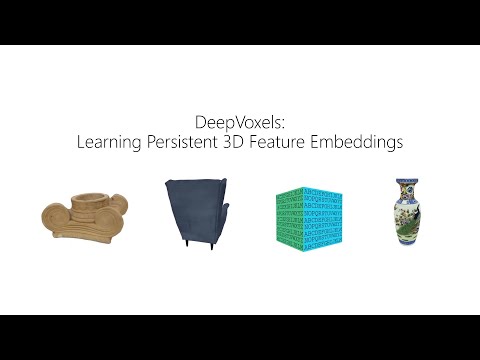
DeepVoxels is an object-specific, persistent 3D feature embedding. It is found by globally optimizing over all available 2D observations of an object in a deeplearning framework. At test time, the training set can be discarded, and DeepVoxels can be used to render novel views of the same object.
Usage
Installation
This code was developed in python 3.7 and pytorch 1.0. I recommend to use anaconda for dependency management. You can create an environment with name "deepvoxels" with all dependencies like so:
conda env create -f environment.yml
High-Level structure
The code is organized as follows:
- dataio.py loads training and testing data.
- data_util.py and util.py contain utility functions.
- run_deepvoxels.py contains the training and testing code as well as setting up the dataset, dataloading, command line arguments etc.
- deep_voxels.py contains the core DeepVoxels model.
- custom_layers.py contains implementations of the integration and occlusion submodules.
- projection.py contains utility functions for 3D and projective geometry.
Data
The datasets have been rendered from a set of high-quality 3D scans of a variety of objects. The datasets are available for download here. Each object has its own directory, which is the directory that the "data_root" command-line argument of the run_deepvoxels.py script is pointed to.
Coordinate and camera parameter conventions
This code uses an "OpenCV" style camera coordinate system, where the Y-axis points downwards (the up-vector points in the negative Y-direction), the X-axis points right, and the Z-axis points into the image plane. Camera poses are assumed to be in a "camera2world" format, i.e., they denote the matrix transform that transforms camera coordinates to world coordinates.
The code also reads an "intrinsics.txt" file from the dataset directory. This file is expected to be structured as follows:
f cx cy
origin_x origin_y origin_z
near_plane (if 0, defaults to sqrt(3)/2)
scale
img_height img_width
The focal length, cx and cy are in pixels. (origin_x, origin_y, origin_z) denotes the origin of the voxel grid in world coordinates. The near plane is also expressed in world units. Per default, each voxel has a sidelength of 1 in world units - the scale is a factor that scales the sidelength of each voxel. Finally, height and width are the resolution of the image.
To create your own dataset, I recommend using the amazing, open-source Colmap. Follow the instructions on the website to install it. I have written a little wrapper in python that will automatically reconstruct a directory of images, and then extract the camera extrinsic & intrinsic camera parameters. It can be used like so:
python colmap_wrapper.py --img_dir [path to directory with images] \
                         --trgt_dir [path where output will be written to]
To get the scale and origin of the voxel grid as well as the near plane, one has to inspect the reconstructed point cloud and manually edit the intrinsics.txt file written out by colmap_wrapper.py.
Training
- See
python run_deepvoxels.py --helpfor all train options. Example train call:
python run_deepvoxels.py --train_test train \
                         --data_root [path to directory with dataset] \
                         --logging_root [path to directory where tensorboard summaries and checkpoints should be written to]
To monitor progress, the training code writes tensorboard summaries every 100 steps into a "runs" subdirectory in the logging_root.
Testing
Example test call:
python run_deepvoxels.py --train_test test \
                         --data_root [path to directory with dataset] ]
                         --logging_root [path to directoy where test output should be written to] \
                         --checkpoint [path to checkpoint]
Misc
Citation:
If you find our work useful in your research, please consider citing:
@inproceedings{sitzmann2019deepvoxels,
	author = {Sitzmann, Vincent
	          and Thies, Justus
	          and Heide, Felix
	          and Nie{\ss}ner, Matthias
	          and Wetzstein, Gordon
	          and Zollh{\"o}fer, Michael},
	title = {DeepVoxels: Learning Persistent 3D Feature Embeddings},
	booktitle = {Proc. CVPR},
	year={2019}
}
Follow-up work
Check out our new project, Scene Representation Networks, where we replace the voxel grid with a continuous function that naturally generalizes across scenes and smoothly parameterizes scene surfaces!
Submodule "pytorch_prototyping"
The code in the subdirectory "pytorch_prototyping" comes from a little library of custom pytorch modules that I use throughout my research projects. You can find it here.
Other cool projects
Some of the code in this project is based on code from these two very cool papers:
Check them out!
Contact:
If you have any questions, please email Vincent Sitzmann at [email protected].

 204 Jul 14, 2022
 81 Dec 29, 2022
 13 Dec 13, 2022
 618 Dec 27, 2022
 1 Jan 08, 2022
 55 Jan 04, 2023
 61 Dec 28, 2022
 24 May 16, 2022
 96 Dec 27, 2022
 144 Jan 08, 2023
 72 Dec 22, 2022
 283 Oct 19, 2022
 1 Jan 10, 2022
 3 Aug 28, 2022
 1 Dec 18, 2021
 1.4k Jan 06, 2023
 116 Nov 24, 2022
 95 Dec 04, 2022
 194 Dec 27, 2022
 21 Dec 15, 2022