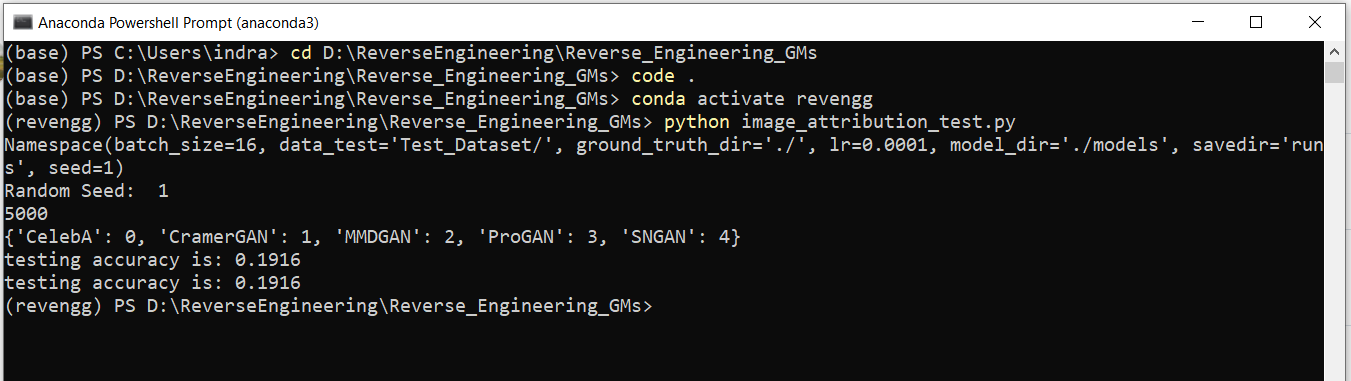
Official Pytorch implementation of paper "Reverse Engineering of Generative Models: Inferring Model Hyperparameters from Generated Images"

Overview

Reverse_Engineering_GMs

Official Pytorch implementation of paper "Reverse Engineering of Generative Models: Inferring Model Hyperparameters from Generated Images".

The paper and supplementary can be found at https://arxiv.org/abs/2106.07873

alt text

Prerequisites

  • PyTorch 1.5.0
  • Numpy 1.14.2
  • Scikit-learn 0.22.2

Getting Started

Datasets

For reverse enginnering:

For deepfake detection:

  • Download the CelebA/LSUN dataset

For image_attribution:

  • Generate 110,000 images for four different GAN models as specified in https://github.com/ningyu1991/GANFingerprints/
  • For real images, use 110,000 of CelebA dataset.
  • For training: we used 100,000 images and remaining 10,000 for testing.

Training

  • Provide the train and test path in respective codes as sepecified below.
  • Provide the model path to resume training
  • Run the code

For reverse engineering, run:

python reverse_eng.py

For deepfake detection, run:

python deepfake_detection.py

For image attribution, run:

python image_attribution.py

Testing using pre-trained models

For reverse engineering, run:

python reverse_eng_test.py

For deepfake detection, run:

python deepfake_detection_test.py

For image attribution, run:

python image_attribution_test.py

If you would like to use our work, please cite:

@misc{asnani2021reverse,
      title={Reverse Engineering of Generative Models: Inferring Model Hyperparameters from Generated Images}, 
      author={Vishal Asnani and Xi Yin and Tal Hassner and Xiaoming Liu},
      year={2021},
      eprint={2106.07873},
      archivePrefix={arXiv},
      primaryClass={cs.CV}
}
Comments
  • loaded state dict contains a parameter group that doesn't match the size of optimizer's group

    loaded state dict contains a parameter group that doesn't match the size of optimizer's group

    Hello, I have met a problem (as in the picture below) when executing the file "reverse_eng_test.py" loading the model "11_model_set_1.pickle". Could you please tell me what does the error mean? Because I am not familiar with the architecture of the model and the given pre-trained model "11_model_set_1.pickle". Upon the error is the output of the code ( print(state1['optimizer_1']) ) added by me to see the state of the "state1['optimizer_1']". Thank you!

    image

    opened by hyhchaos 9
  • The .npy files in the rev_eng_updated.py could not be found in the main folders or the .zip or tar.gz file

    The .npy files in the rev_eng_updated.py could not be found in the main folders or the .zip or tar.gz file

    The .npy files in the rev_eng_updated.py could not be found in the main folders or the .zip or tar.gz file. The lost .npy files are in the following codes:

    ground_truth_net_all=torch.from_numpy(np.load("ground_truth_net_131_15dim.npy")) ground_truth_loss_9_all=torch.from_numpy(np.load("ground_truth_loss_131_10dim.npy"))

    ground_truth_net_all_dev=torch.from_numpy(np.load("net_dev_131_dim.npy")) ground_truth_loss_9_all_dev=torch.from_numpy(np.load("ground_truth_loss_131_10dim.npy"))

    ground_truth_net_cluster=torch.from_numpy(np.load("net_cluster_131_dim.npy")) ground_truth_loss_9_cluster=torch.from_numpy(np.load("loss_cluster_131_dim.npy")) #ground_truth_net_all=torch.from_numpy(np.load("random_ground_truth_net_arch_91_15dim.npy")) #ground_truth_loss_all=torch.from_numpy(np.load("random_ground_truth_loss_91_3dim.npy")) #ground_truth_loss_9_all=torch.from_numpy(np.load("random_ground_truth_loss_91_9dim.npy"))

    ground_truth_p=torch.from_numpy(np.load("p_131_.npy"))

    If you could tell me where I can find them, thank you very much. Best wishes!

    opened by zhangtzq 3
  • deepfake_detection.py gives an error ValueError: loaded state dict contains a parameter group that doesn't match the size of optimizer's group

    deepfake_detection.py gives an error ValueError: loaded state dict contains a parameter group that doesn't match the size of optimizer's group

    @vishal3477 I couldn't run **fake_detection_test.py". It gives the following error below. Thanks,

    optimizer.load_state_dict(state1['optimizer_1'])
    

    deepfake_detection_test_error

    opened by ssablak 3
  • What is

    What is "ground_truth_dir" in "reverse_eng_test.py"?

    I have downloaded the data and model. When I run the "reverse_eng_test.py" file, I find that I can not provide the below files. Could you please answer how can I get these files? Thank you very much!

    ground_truth_net_all=torch.from_numpy(np.load(opt.ground_truth_dir+ "ground_truth_net_arch_100_15dim.npy"))
    ground_truth_loss_all=torch.from_numpy(np.load(opt.ground_truth_dir+ "ground_truth_loss_100_3dim.npy"))
    ground_truth_loss_9_all=torch.from_numpy(np.load(opt.ground_truth_dir+ "ground_truth_loss_100_9dim.npy"))
    
    opened by hyhchaos 3
  • torch.rfft is deprecated

    torch.rfft is deprecated

    @vishal3477 Since rfft is deprecated in the newer torch versions. It gives the following error. rfft

    I tried to fix it, but it starts to give an error as rfft2error

    Could you please help me how to define rfft in the newer version of pytorch? Thanks. -Steve

    opened by ssablak 2
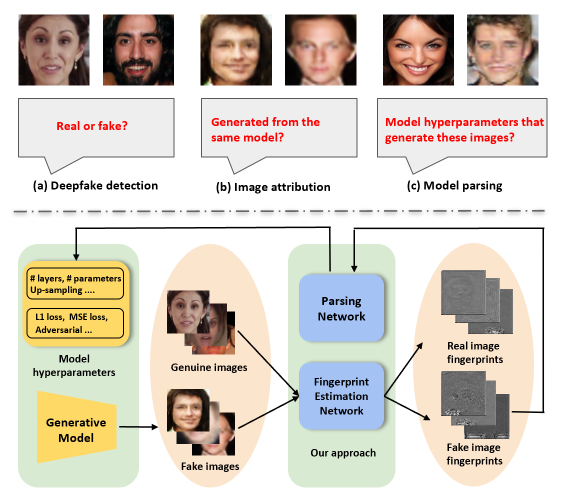
  • Getting only 0.1916 Accuracy in Image Attribution

    Getting only 0.1916 Accuracy in Image Attribution

    image

    I'm getting only 0.1916 accuracy in image attribution task, in the test dataset in each of the five classes I've puted 1K generated images from respective GANs and 1K real images from CelebA, and I'm using the pre-trained model.

    I'm using the following code in image_attribution_test.py file:

    from torchvision import datasets, models, transforms #from model import * import os import torch from torch.autograd import Variable from skimage import io from scipy import fftpack import numpy as np from torch import nn import datetime from models import encoder_image_attr from models import fen import torch.nn.functional as F from sklearn.metrics import accuracy_score from sklearn import metrics import argparse

    parser = argparse.ArgumentParser()
    parser.add_argument('--lr', default=0.0001, type=float, help='learning rate')
    parser.add_argument('--data_test',default='Test_Dataset/',help='root directory for testing data')
    parser.add_argument('--ground_truth_dir',default='./',help='directory for ground truth')
    parser.add_argument('--seed', default=1, type=int, help='manual seed')
    parser.add_argument('--batch_size', default=16, type=int, help='batch size')
    parser.add_argument('--savedir', default='runs')
    parser.add_argument('--model_dir', default='./models')


    opt = parser.parse_args()
    print(opt)
    print("Random Seed: ", opt.seed)
    
    device=torch.device("cuda:0")
    torch.backends.deterministic = True
    torch.manual_seed(opt.seed)
    torch.cuda.manual_seed_all(opt.seed)
    sig = "sig"
    
    
    test_path=opt.data_test
    save_dir=opt.savedir
    
    os.makedirs('%s/logs/%s' % (save_dir, sig), exist_ok=True)
    os.makedirs('%s/result_2/%s' % (save_dir, sig), exist_ok=True)
    
    transform_train = transforms.Compose([
    transforms.Resize((128,128)),
    transforms.ToTensor(),
    transforms.Normalize((0.6490, 0.6490, 0.6490), (0.1269, 0.1269, 0.1269))
    ])
    
    
    test_set=datasets.ImageFolder(test_path, transform_train)
    
    
    test_loader = torch.utils.data.DataLoader(test_set,batch_size=opt.batch_size,shuffle =True, num_workers=1)


    model=fen.DnCNN().to(device)
    
    model_params = list(model.parameters())    
    optimizer = torch.optim.Adam(model_params, lr=opt.lr)
    l1=torch.nn.MSELoss().to(device)
    l_c = torch.nn.CrossEntropyLoss().to(device)
    
    model_2=encoder_image_attr.encoder(num_hidden=512).to(device)
    optimizer_2 = torch.optim.Adam(model_2.parameters(), lr=opt.lr)
    state = {
        'state_dict_cnn':model.state_dict(),
        'optimizer_1': optimizer.state_dict(),
        'state_dict_class':model_2.state_dict(),
        'optimizer_2': optimizer_2.state_dict()
        
    }
    
    
    state1 = torch.load("pre_trained_models/image_attribution/celeba/0_model_27_384000.pickle")
    optimizer.load_state_dict(state1['optimizer_1'])
    model.load_state_dict(state1['state_dict_cnn'])
    optimizer_2.load_state_dict(state1['optimizer_2'])
    model_2.load_state_dict(state1['state_dict_class'])


    def test(batch, labels):
        model.eval()
        model_2.eval()
        with torch.no_grad():
            y,low_freq_part,max_value ,y_orig,residual, y_trans,residual_gray =model(batch.type(torch.cuda.FloatTensor))
            y_2=torch.unsqueeze(y.clone(),1)
            classes, features=model_2(y_2)
            classes_f=torch.max(classes, dim=1)[0]
            
            n=25
            zero=torch.zeros([y.shape[0],2*n+1,2*n+1], dtype=torch.float32).to(device)  
            zero_1=torch.zeros(residual_gray.shape, dtype=torch.float32).to(device)
            loss1=0.5*l1(low_freq_part,zero).to(device) 
            loss2=-0.001*max_value.to(device)
            loss3 = 0.01*l1(residual_gray,zero_1).to(device)
            loss_c =10*l_c(classes,labels.type(torch.cuda.LongTensor))
            loss5=0.1*l1(y,y_trans).to(device)
            loss=(loss1+loss2+loss3+loss_c+loss5)
        return y, loss.item(), loss1.item(),loss2.item(),loss3.item(),loss_c.item(),loss5.item(),y_orig, features,residual,torch.max(classes, dim=1)[1], classes[:,1]
    
    
    print(len(test_set))
    print(test_set.class_to_idx)
    epochs=2
    
    
    for epoch in range(epochs):
        all_y=[]
        all_y_test=[]
        flag1=0
        count=0
        itr=0
        
        for batch_idx_test, (inputs_test,labels_test) in enumerate(test_loader):
    
            out,loss,loss1,loss2,loss3,loss4,loss5, out_orig,features,residual,pred,scores=test(Variable(torch.FloatTensor(inputs_test)),Variable(torch.LongTensor(labels_test)))
    
            if flag1==0:
                all_y_test=labels_test
                all_y_pred_test=pred.detach()
                all_scores=scores.detach()
                flag1=1
    
            else:
                all_y_pred_test=torch.cat([all_y_pred_test,pred.detach()], dim=0)
                all_y_test=torch.cat([all_y_test,labels_test], dim=0)
                all_scores=torch.cat([all_scores,scores], dim=0)
        fpr1, tpr1, thresholds1 = metrics.roc_curve(all_y_test, np.asarray(all_scores.cpu()), pos_label=1)
        print("testing accuracy is:", accuracy_score(all_y_test,np.asarray(all_y_pred_test.cpu())))
    
    opened by indrakumarmhaski 1
  • Groundtruth Files Issue

    Groundtruth Files Issue

    Hi Vishal, Where can I download the following files? I see three .npy files on the repo but the naming is not matching the exact files between repo and source code.

    I changed the filename in repo below

    FROM ground_truth_loss_func_3dim_file.npy ground_truth_loss_func_8dim_file.npy ground_truth_net_arch_15dim_file.npy groundtruth2

    TO below ground_truth_loss_100_9dim.npy ground_truth_net_arch_100_15dim.npy ground_truth_loss_100_3dim.npy

    groundtruthfiles

    But it didn't run through. It gives the following error

    error

    Thanks, -Steve

    opened by ssablak 1
  • I have a question

    I have a question

    hello, do i need to create all the paths in the reverse_eng.py ? what do i need to save for wach folder?

    parser.add_argument('--lr', default=0.0001, type=float, help='learning rate') parser.add_argument('--data_train',default='mnt/scratch/asnanivi/GAN_data_6/set_1/train',help='root directory for training data') parser.add_argument('--data_test',default='mnt/scratch/asnanivi/GAN_data_6/set_1/test',help='root directory for testing data') parser.add_argument('--ground_truth_dir',default='./',help='directory for ground truth') parser.add_argument('--seed', default=1, type=int, help='manual seed') parser.add_argument('--batch_size', default=16, type=int, help='batch size') parser.add_argument('--savedir', default='/mnt/scratch/asnanivi/runs') parser.add_argument('--model_dir', default='./models') parser.add_argument('--N_given', nargs='+', help='position number of GM from list of GMs used in testing', default=[1,2,3,4,5,6])

    os.chmod('./mnt/scratch',0o777) os.makedirs('.%s/result_3/%s' % (save_dir, sig), exist_ok=True)

    i also had a mistake:Couldn't find any class folder in mnt/scratch/asnanivi/GAN_data_6/set_1/train

    Thanks!

    opened by YZF-Myself 1
  • There is no codes about the cluster prediction about the discrete type network structure parameter in the encoder_rev_eng.py file

    There is no codes about the cluster prediction about the discrete type network structure parameter in the encoder_rev_eng.py file

    I'm sorry to have bothered you. But I didn't find the code for discrete type network structure parameter clustering prediction in the encoder_rev_eng.py file of the original models folder or in the latest Reverse Engineering 2.0 code compressed file. However, your article states the clustering prediction about discrete type network structure parameters, which is important to the result. Looking forward to your reply.

    opened by zhangtzq 5
  • Ground truth file missing

    Ground truth file missing

    Hi, thank you for sharing your code and data. I'm trying to run the reverse_eng_train.py and reverse_eng_test.py scripts, but both are failing due to missing files required in the following lines:

    ground_truth_net_all=torch.from_numpy(np.load(opt.ground_truth_dir+ "ground_truth_net_arch_100_15dim.npy"))
    ground_truth_loss_all=torch.from_numpy(np.load(opt.ground_truth_dir+ "ground_truth_loss_100_3dim.npy"))
    ground_truth_loss_9_all=torch.from_numpy(np.load(opt.ground_truth_dir+ "ground_truth_loss_100_9dim.npy"))
    

    I downloaded the dataset of trained models from the google drive link in the Readme, but couldn't find any information about where we can access those ground-truth data.

    Also, could you verify that the file in the google drive 11_model_set_1.pickle contains the 100 trained models? When I load the file (e.g. data = torch.load('11_model_set_1.pickle), I am getting a checkpoint of a single model (and optimizers). I'd appreciate if you could verify that this is the right file to download the trained models.

    Thank you!

    opened by cocoaaa 1
  • Parameter setting in deepfake detection

    Parameter setting in deepfake detection

    Thank you very much for your contribution.In the deepfake detection module of the paper, parameter lambda1-4 are set as follows which is inconsistent with the code: 参数设置

    loss1=0.05*l1(low_freq_part,zero).to(device) 
    loss2=-0.001*max_value.to(device)
    loss3 = 0.01*l1(residual_gray,zero_1).to(device)
    loss_c =20*l_c(classes,labels.type(torch.cuda.LongTensor))
    loss5=0.1*l1(y,y_trans).to(device)
    

    Can you explain that? Thank you.

    opened by wytcsuch 5
Releases(v2.0)
McGill Physics Hackathon 2021: Reaction-Diffusion Models for the Generation of Biological Patterns

DiffuseAnimals: Reaction-Diffusion Models for the Generation of Biological Patterns Introduction Reaction-diffusion equations can be utilized in order

Austin Szuminsky 2 Mar 07, 2022
High accurate tool for automatic faces detection with landmarks

faces_detanator High accurate tool for automatic faces detection with landmarks. The library is based on public detectors with high accuracy (TinaFace

Ihar 7 May 10, 2022
EFENet: Reference-based Video Super-Resolution with Enhanced Flow Estimation

EFENet EFENet: Reference-based Video Super-Resolution with Enhanced Flow Estimation Code is a bit messy now. I woud clean up soon. For training the EF

Yaping Zhao 19 Nov 05, 2022
Chatbot in 200 lines of code using TensorLayer

Seq2Seq Chatbot This is a 200 lines implementation of Twitter/Cornell-Movie Chatbot, please read the following references before you read the code: Pr

TensorLayer Community 820 Dec 17, 2022
Reinfore learning tool box, contains trpo, a3c algorithm for continous action space

RL_toolbox all the algorithm is running on pycharm IDE, or the package loss error may exist. implemented algorithm: trpo a3c a3c:for continous action

yupei.wu 44 Oct 10, 2022
Photo-Realistic Single Image Super-Resolution Using a Generative Adversarial Network

Super Resolution Examples We run this script under TensorFlow 2.0 and the TensorLayer2.0+. For TensorLayer 1.4 version, please check release. 🚀 🚀 🚀

TensorLayer Community 2.9k Jan 08, 2023
The first machine learning framework that encourages learning ML concepts instead of memorizing class functions.

SeaLion is designed to teach today's aspiring ml-engineers the popular machine learning concepts of today in a way that gives both intuition and ways of application. We do this through concise algori

Anish 324 Dec 27, 2022
Official implementation of the Neurips 2021 paper Searching Parameterized AP Loss for Object Detection.

Parameterized AP Loss By Chenxin Tao, Zizhang Li, Xizhou Zhu, Gao Huang, Yong Liu, Jifeng Dai This is the official implementation of the Neurips 2021

46 Jul 06, 2022
Official pytorch implementation of paper "Image-to-image Translation via Hierarchical Style Disentanglement".

HiSD: Image-to-image Translation via Hierarchical Style Disentanglement Official pytorch implementation of paper "Image-to-image Translation

364 Dec 14, 2022
With this package, you can generate mixed-integer linear programming (MIP) models of trained artificial neural networks (ANNs) using the rectified linear unit (ReLU) activation function

With this package, you can generate mixed-integer linear programming (MIP) models of trained artificial neural networks (ANNs) using the rectified linear unit (ReLU) activation function. At the momen

ChemEngAI 40 Dec 27, 2022
A machine learning package for streaming data in Python. The other ancestor of River.

scikit-multiflow is a machine learning package for streaming data in Python. creme and scikit-multiflow are merging into a new project called River. W

670 Dec 30, 2022
Pytorch implementation of PTNet for high-resolution and longitudinal infant MRI synthesis

Pyramid Transformer Net (PTNet) Project | Paper Pytorch implementation of PTNet for high-resolution and longitudinal infant MRI synthesis. PTNet: A Hi

Xuzhe Johnny Zhang 6 Jun 08, 2022
Pre-Trained Image Processing Transformer (IPT)

Pre-Trained Image Processing Transformer (IPT) By Hanting Chen, Yunhe Wang, Tianyu Guo, Chang Xu, Yiping Deng, Zhenhua Liu, Siwei Ma, Chunjing Xu, Cha

HUAWEI Noah's Ark Lab 332 Dec 18, 2022
PyTorch Implementation of PIXOR: Real-time 3D Object Detection from Point Clouds

PIXOR: Real-time 3D Object Detection from Point Clouds This is a custom implementation of the paper from Uber ATG using PyTorch 1.0. It represents the

Philip Huang 270 Dec 14, 2022
Deep Learning and Reinforcement Learning Library for Scientists and Engineers 🔥

TensorLayer is a novel TensorFlow-based deep learning and reinforcement learning library designed for researchers and engineers. It provides an extens

TensorLayer Community 7.1k Dec 29, 2022
Contrastive Fact Verification

VitaminC This repository contains the dataset and models for the NAACL 2021 paper: Get Your Vitamin C! Robust Fact Verification with Contrastive Evide

47 Dec 19, 2022
A few stylization coreML models that I've trained with CreateML

CoreML-StyleTransfer A few stylization coreML models that I've trained with CreateML You can open and use the .mlmodel files in the "models" folder in

Doron Adler 8 Aug 18, 2022
[CoRL 21'] TANDEM: Tracking and Dense Mapping in Real-time using Deep Multi-view Stereo

TANDEM: Tracking and Dense Mapping in Real-time using Deep Multi-view Stereo Lukas Koestler1*    Nan Yang1,2*,†    Niclas Zeller2,3    Daniel Cremers1

TUM Computer Vision Group 744 Jan 04, 2023
Unbiased Learning To Rank Algorithms (ULTRA)

This is an Unbiased Learning To Rank Algorithms (ULTRA) toolbox, which provides a codebase for experiments and research on learning to rank with human annotated or noisy labels.

71 Dec 01, 2022
This is the repository of the NeurIPS 2021 paper "Curriculum Disentangled Recommendation withNoisy Multi-feedback"

Curriculum_disentangled_recommendation This is the repository of the NeurIPS 2021 paper "Curriculum Disentangled Recommendation with Noisy Multi-feedb

14 Dec 20, 2022