A (PyTorch) imbalanced dataset sampler for oversampling low frequent classes and undersampling high frequent ones.

Overview

Imbalanced Dataset Sampler

license

Introduction

In many machine learning applications, we often come across datasets where some types of data may be seen more than other types. Take identification of rare diseases for example, there are probably more normal samples than disease ones. In these cases, we need to make sure that the trained model is not biased towards the class that has more data. As an example, consider a dataset where there are 5 disease images and 20 normal images. If the model predicts all images to be normal, its accuracy is 80%, and F1-score of such a model is 0.88. Therefore, the model has high tendency to be biased toward the ‘normal’ class.

To solve this problem, a widely adopted technique is called resampling. It consists of removing samples from the majority class (under-sampling) and / or adding more examples from the minority class (over-sampling). Despite the advantage of balancing classes, these techniques also have their weaknesses (there is no free lunch). The simplest implementation of over-sampling is to duplicate random records from the minority class, which can cause overfitting. In under-sampling, the simplest technique involves removing random records from the majority class, which can cause loss of information.

resampling

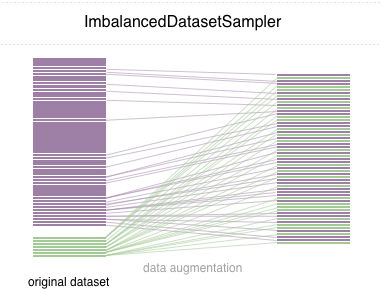
In this repo, we implement an easy-to-use PyTorch sampler ImbalancedDatasetSampler that is able to

  • rebalance the class distributions when sampling from the imbalanced dataset
  • estimate the sampling weights automatically
  • avoid creating a new balanced dataset
  • mitigate overfitting when it is used in conjunction with data augmentation techniques

Usage

For a simple start install the package via one of following ways:

pip install https://github.com/ufoym/imbalanced-dataset-sampler/archive/master.zip

Simply pass an ImbalancedDatasetSampler for the parameter sampler when creating a DataLoader. For example:

from torchsampler import ImbalancedDatasetSampler

train_loader = torch.utils.data.DataLoader(
    train_dataset,
    sampler=ImbalancedDatasetSampler(train_dataset),
    batch_size=args.batch_size,
    **kwargs
)

Then in each epoch, the loader will sample the entire dataset and weigh your samples inversely to your class appearing probability.

Example: Imbalanced MNIST Dataset

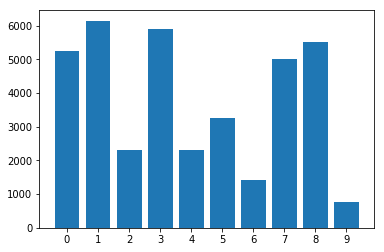
Distribution of classes in the imbalanced dataset:

With Imbalanced Dataset Sampler:

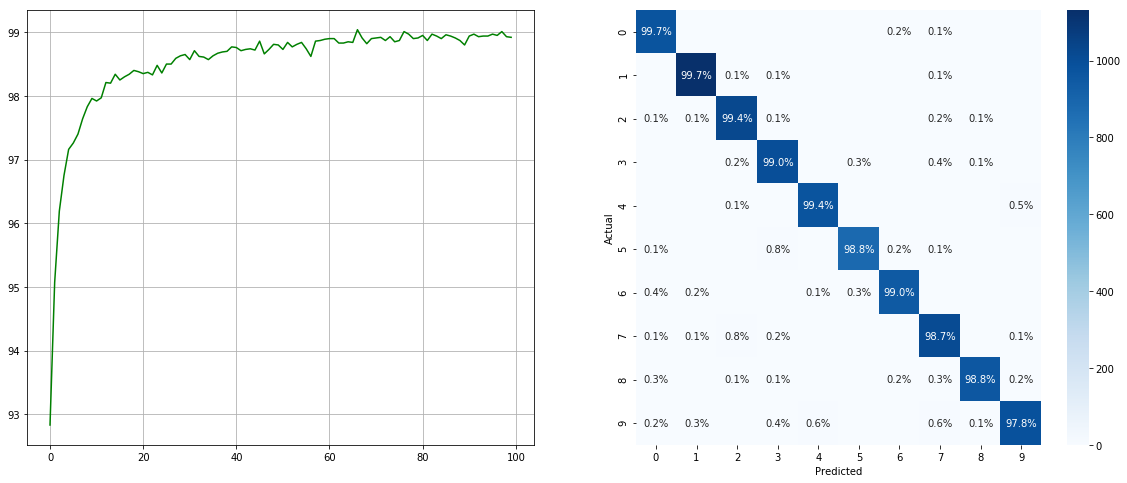
(left: test acc in each epoch; right: confusion matrix)

Without Imbalanced Dataset Sampler:

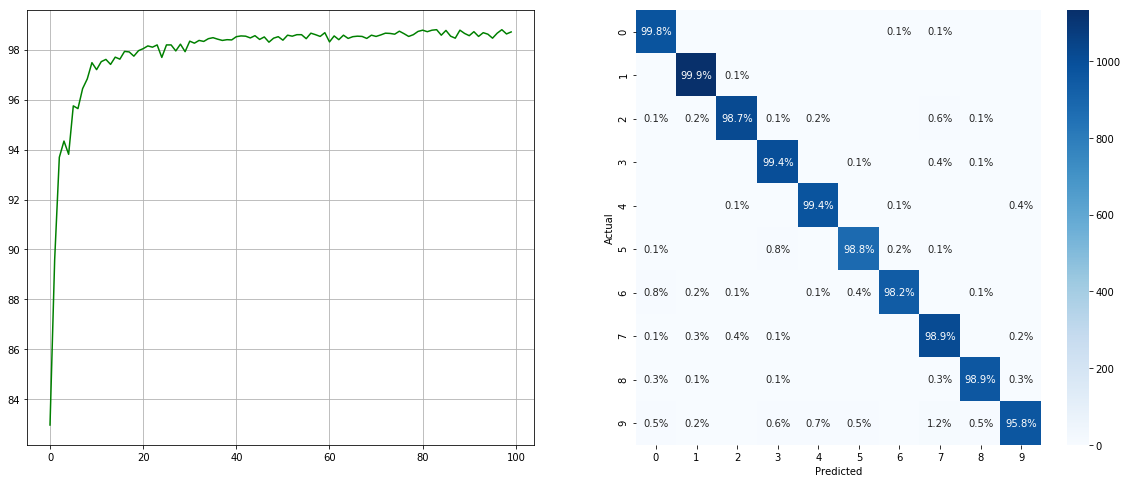
(left: test acc in each epoch; right: confusion matrix)

Note that there are significant improvements for minor classes such as 2 6 9, while the accuracy of the other classes is preserved.

Contributing

We appreciate all contributions. If you are planning to contribute back bug-fixes, please do so without any further discussion. If you plan to contribute new features, utility functions or extensions, please first open an issue and discuss the feature with us.

Licensing

MIT licensed.

Comments
  • NotImplemented Error while running ImbalancedDatasetSampler

    NotImplemented Error while running ImbalancedDatasetSampler

    I followed the steps exactly according to the readme file. Yet I am getting a notimplemented error. There's no explanation for the error as well.

    Here's my code: `from torchvision import transforms from torchsampler import ImbalancedDatasetSampler

    batch_size = 128 val_split = 0.2 shuffle_dataset=True random_seed=42

    dataset_size = len(melanoma_dataset) indices = list(range(dataset_size)) split = int(np.floor(val_split * dataset_size)) if shuffle_dataset : np.random.seed(random_seed) np.random.shuffle(indices) train_indices, test_indices = indices[split:], indices[:split]

    train_loader = torch.utils.data.DataLoader(melanoma_dataset,batch_size=batch_size,sampler=ImbalancedDatasetSampler(melanoma_dataset)) test_loader = torch.utils.data.DataLoader(melanoma_dataset,batch_size=batch_size,sampler=test_sampler)`

    opened by aryamansriram 8
  • 'MyDataset' object has no attribute 'get_labels'

    'MyDataset' object has no attribute 'get_labels'

    When I try to use my own Dataset class, I get the error 'MyDataset' object has no attribute 'get_labels' and cannot proceed.

    The content of the Dataloader is as follows, and there is nothing strange about it. It processes the image data and label data in .npz format.

    class MyDataset(data.Dataset):
        def __init__(self, images, labels, transform=None):
            self.images = images
            self.labels = labels
            self.transform = transform
    
        def __len__(self):
            return len(self.images)
    
        def __getitem__(self, index):
            image = self.images[index]
            label = self.labels[index]
    
            if self.transform is not None:
                image = self.transform(image=image)["image"]
    
            return image, label
    
    train_dataset = MyDataset(train_imgs, train_labels, transform=transform)
    train_dataloader = torch.utils.data.DataLoader(train_dataset,
                                                   sampler=ImbalancedDatasetSampler(train_dataset),
                                                   batch_size= batch_size,
                                                   shuffle=True,
                                                   num_workers=2)
    

    Is there something wrong with the code? I don't think it's a typo.

    How can I fix it so that it works correctly?

    opened by kuri54 5
  • Reduce time for handling large imbalanced dataset

    Reduce time for handling large imbalanced dataset

    In the current code, it has lots of costs for calculating weights and statistics of the number of each label when calling init(). It might be a problem when incoming a large dataset, so I changed this part using pandas. I checked it reduces time within 1 second when I use over 5 million data. (In previous code, it takes 20 minutes to use a sampler)

    opened by hwany-j 3
  • pip install error

    pip install error

    Follows your method to install the package: git clone https://github.com/ufoym/imbalanced-dataset-sampler.git cd imbalanced-dataset-sampler python setup.py install pip install .

    But when I run "pip install .", I met the error as follows: FileNotFoundError: [Errno 2] No such file or directory: '/home/miniconda3/envs/pytorch/lib/python3.7/site-packages/torchsampler-0.1-py3.7.egg'

    How can I resolve it?

    opened by wly-ai-bj 3
  • Publish package to PyPi and GitHub Releases

    Publish package to PyPi and GitHub Releases

    Here at https://github.com/neuropoly/ we think your project is very useful and would like to build on it! Unfortunately if we write a setup.cfg for ourselves that depends on "torchsampler", it fails to install, because https://pypi.org/project/torchsampler/ is a 404:

    Screenshot 2022-04-29 at 14-51-02 Page Not Found (404)

    This Workflow script makes publishing the conventional way easy and reliable, and will mean that projects like ours can build on your work!

    To use it,

    1. Create an account at https://pypi.org/
    2. Go to https://pypi.org/manage/account/token/ and make a token
    3. Go to then go to https://github.com/kousu/imbalanced-dataset-sampler/settings/secrets/actions and paste the token in there, with name "PYPI_TOKEN"

    Then every time you are ready to publish,

    1. Go to https://github.com/ufoym/imbalanced-dataset-sampler/releases/new,
    2. Fill in a new tag like "1.0.0"
    3. Click Publish.

    It will run the Action and then in a minute or so will show up on https://github.com/kousu/imbalanced-dataset-sampler/releases/ and https://pypi.org/project/torchsampler/#history

    For your first few runs, while you get used to this script, I recommend using "rc" suffixes to post versions without committing to them. For example, I've used this script myself to produce

    Screenshot 2022-04-29 at 15-04-19 radicale-bsdauth

    the ones with the yellow "pre-release" tags get ignored by pip by default, unless a user opts into them with pip install --pre.

    Publishing to PyPI will avoid issues like

    • https://github.com/ufoym/imbalanced-dataset-sampler/issues/20
    • https://github.com/ufoym/imbalanced-dataset-sampler/issues/15
    • https://github.com/ufoym/imbalanced-dataset-sampler/issues/12

    and again, let us build on your work. Without publishing to pypi, it means our install instructions need to include yours:

    pip install https://github.com/ufoym/imbalanced-dataset-sampler/archive/master.zip neuropoly-seg-model
    

    which is pretty awkward for us.

    Thanks a lot for your work, it's really helping out our research prototyping.

    opened by kousu 2
  • latest commit cannot get correct labels from ImageFolder dataset

    latest commit cannot get correct labels from ImageFolder dataset

    the ImageFolder.imgs return a list of 2-element tuple, such as:

    [
    ('classA/img01.jpg', 0),
    ('classB/img01.jpg', 1),
    ...
    ('classN/img01.jpg', N-1)
    ]
    

    if we use dataset.imgs[:][1], it cannot not get correct labels of all samples.

    at this line: https://github.com/ufoym/imbalanced-dataset-sampler/blob/756b0b61ca48a026e9a5c216296a520a10faf7df/torchsampler/imbalanced.py#L46

    opened by TriLoo 2
  • reduce the time when calling sampler

    reduce the time when calling sampler

    In the current code, it has lots of costs for calculating weights and statistics of the number of each label when calling init(). It might be a problem when incoming a large dataset, so I changed this part using pandas. I checked it reduces time within 1 second when I use over 5 million data. (In previous code, it takes 20 minutes to use a sampler)

    opened by hwany-j 2
  • Use setuptools_scm

    Use setuptools_scm

    Follows up https://github.com/ufoym/imbalanced-dataset-sampler/pull/47

    setuptools-scm makes git the single-source of truth for the version of the package, and works well with the build script in #47 (which is triggered by tagging a new version in git).

    The other thing setuptools-scm does is make git the single source of truth for your MANIFEST, so this drops check-manifest and also most of the contents of your MANIFEST.in -- except the prune lines, those are still doing something for the moment.

    opened by kousu 1
  • Too much time cost

    Too much time cost

    It slower than before too many times when I use this sampler

    (self.indices[i] for i in torch.multinomial(self.weights, self.num_samples, replacement=True)) it seems that this expression cost too much time!

    Any one have any solution?

    opened by nothingeasy 1
  • AttributeError: 'ConcatDataset' object has no attribute 'img_norm_cfg'

    AttributeError: 'ConcatDataset' object has no attribute 'img_norm_cfg'

    when i run test.py, there is an error: File "tools/test.py", line 211, in
    main()
    File "tools/test.py", line 181, in main
    outputs = single_gpu_test(model, data_loader, args.show, args.log_dir)
    File "tools/test.py", line 39, in single_gpu_test
    model.module.show_result(data, result, dataset.img_norm_cfg, dataset='DOTA1_5') AttributeError: 'ConcatDataset' object has no attribute 'img_norm_cfg'

    How can I solve this problem?

    opened by ZSX2018 0
  • I think solve issue 32

    I think solve issue 32

    https://github.com/ufoym/imbalanced-dataset-sampler/issues/32

    this issue, return one element when ImageFolder, so, i changed return part

    I hope this helps.

    opened by LeeTaeHoon97 0
  • ValueError: Cannot set a frame with no defined index and a value that cannot be converted to a Series

    ValueError: Cannot set a frame with no defined index and a value that cannot be converted to a Series
    Hi, I am using BERT for multi label classification. The dataset is imbalance and I use ImbalancedDatasetSampler as the sampler.

    The train data has been tokenized, has id, mask and label:

    (tensor([ 101, 112, 872, 4761, 6887, 1914, 840, 1914, 7353, 6818, 3300, 784, 720, 1408, 136, 1506, 1506, 3300, 4788, 2357, 5456, 119, 119, 119, 4696, 4638, 741, 677, 1091, 4638, 872, 1420, 1521, 119, 119, 119, 872, 2157, 6929, 1779, 4788, 2357, 3221, 686, 4518, 677, 3297, 1920, 4638, 4788, 2357, 117, 1506, 1506, 117, 7745, 872, 4638, 1568, 2124, 3221, 6432, 2225, 1217, 2861, 4478, 4105, 2357, 3221, 686, 4518, 677, 3297, 1920, 4638, 4105, 2357, 1568, 119, 119, 119, 1506, 1506, 1506, 112, 112, 4268, 4268, 117, 1961, 4638, 1928, 1355, 5456, 106, 2769, 812, 1920, 2812, 7370, 3488, 2094, 6963, 6206, 5436, 677, 3341, 2769, 4692, 1168, 3312, 1928, 5361, 7027, 3300, 1928, 1355, 119, 119, 119, 671, 2137, 3221, 8584, 809, 1184, 1931, 1168, 4638, 117, 872, 6432, 3221, 679, 3221, 136, 138, 4495, 4567, 140, 102, 0, 0, 0, 0, 0, 0, 0, 0, 0, 0, 0, 0, 0, 0, 0, 0, 0, 0, 0, 0, 0, 0, 0, 0, 0, 0, 0, 0, 0, 0, 0, 0, 0, 0, 0, 0, 0, 0, 0, 0, 0, 0, 0, 0, 0, 0, 0, 0, 0, 0, 0, 0, 0, 0, 0, 0, 0, 0, 0, 0, 0, 0, 0, 0, 0, 0, 0, 0, 0, 0, 0, 0, 0, 0, 0, 0, 0, 0, 0, 0, 0, 0, 0, 0, 0, 0, 0, 0, 0, 0, 0, 0, 0, 0, 0, 0, 0, 0, 0, 0, 0, 0, 0, 0, 0, 0, 0, 0, 0, 0, 0, 0, 0, 0, 0]), tensor([1, 1, 1, 1, 1, 1, 1, 1, 1, 1, 1, 1, 1, 1, 1, 1, 1, 1, 1, 1, 1, 1, 1, 1, 1, 1, 1, 1, 1, 1, 1, 1, 1, 1, 1, 1, 1, 1, 1, 1, 1, 1, 1, 1, 1, 1, 1, 1, 1, 1, 1, 1, 1, 1, 1, 1, 1, 1, 1, 1, 1, 1, 1, 1, 1, 1, 1, 1, 1, 1, 1, 1, 1, 1, 1, 1, 1, 1, 1, 1, 1, 1, 1, 1, 1, 1, 1, 1, 1, 1, 1, 1, 1, 1, 1, 1, 1, 1, 1, 1, 1, 1, 1, 1, 1, 1, 1, 1, 1, 1, 1, 1, 1, 1, 1, 1, 1, 1, 1, 1, 1, 1, 1, 1, 1, 1, 1, 1, 1, 1, 1, 1, 1, 1, 1, 1, 1, 1, 1, 1, 1, 0, 0, 0, 0, 0, 0, 0, 0, 0, 0, 0, 0, 0, 0, 0, 0, 0, 0, 0, 0, 0, 0, 0, 0, 0, 0, 0, 0, 0, 0, 0, 0, 0, 0, 0, 0, 0, 0, 0, 0, 0, 0, 0, 0, 0, 0, 0, 0, 0, 0, 0, 0, 0, 0, 0, 0, 0, 0, 0, 0, 0, 0, 0, 0, 0, 0, 0, 0, 0, 0, 0, 0, 0, 0, 0, 0, 0, 0, 0, 0, 0, 0, 0, 0, 0, 0, 0, 0, 0, 0, 0, 0, 0, 0, 0, 0, 0, 0, 0, 0, 0, 0, 0, 0, 0, 0, 0, 0, 0, 0, 0, 0, 0, 0, 0]), tensor(0))

    When using

    from torch.utils.data import DataLoader, RandomSampler, SequentialSampler

    they are fine:

    batch_size=3
    dataloader_train_o = DataLoader(
        dataset_train,
        sampler=RandomSampler(dataset_train),
        batch_size=batch_size,
        # **kwargs
    )
    

    However, replace the sampler to ImbalancedDatasetSampler

    batch_size=3
    dataloader_train_o = DataLoader(
        dataset_train,
        sampler=ImbalancedDatasetSampler(dataset_train),
        batch_size=batch_size,
        # **kwargs
    )
    

    The error print below


    ValueError Traceback (most recent call last) File D:\ProgramData\Anaconda3\envs\pytorch\lib\site-packages\pandas\core\frame.py:3892, in DataFrame._ensure_valid_index(self, value) 3891 try: -> 3892 value = Series(value) 3893 except (ValueError, NotImplementedError, TypeError) as err:

    File D:\ProgramData\Anaconda3\envs\pytorch\lib\site-packages\pandas\core\series.py:451, in Series.init(self, data, index, dtype, name, copy, fastpath) 450 else: --> 451 data = sanitize_array(data, index, dtype, copy) 453 manager = get_option("mode.data_manager")

    File D:\ProgramData\Anaconda3\envs\pytorch\lib\site-packages\pandas\core\construction.py:601, in sanitize_array(data, index, dtype, copy, raise_cast_failure, allow_2d) 599 subarr = maybe_infer_to_datetimelike(subarr) --> 601 subarr = _sanitize_ndim(subarr, data, dtype, index, allow_2d=allow_2d) 603 if isinstance(subarr, np.ndarray): 604 # at this point we should have dtype be None or subarr.dtype == dtype

    File D:\ProgramData\Anaconda3\envs\pytorch\lib\site-packages\pandas\core\construction.py:652, in _sanitize_ndim(result, data, dtype, index, allow_2d) 651 return result --> 652 raise ValueError("Data must be 1-dimensional") 653 if is_object_dtype(dtype) and isinstance(dtype, ExtensionDtype): 654 # i.e. PandasDtype("O")

    ValueError: Data must be 1-dimensional

    The above exception was the direct cause of the following exception:

    ValueError Traceback (most recent call last) Input In [49], in <cell line: 5>() 2 from torchsampler import ImbalancedDatasetSampler 4 batch_size=3 5 dataloader_train_o = DataLoader( 6 dataset_train, ----> 7 sampler=ImbalancedDatasetSampler(dataset_train), 8 batch_size=batch_size, 9 # **kwargs 10 ) 12 dataloader_validation_o = DataLoader( 13 dataset_val, 14 sampler=SequentialSampler(dataset_val), 15 batch_size=batch_size, 16 # **kwargs 17 )

    File D:\ProgramData\Anaconda3\envs\pytorch\lib\site-packages\torchsampler\imbalanced.py:37, in ImbalancedDatasetSampler.init(self, dataset, labels, indices, num_samples, callback_get_label) 35 # distribution of classes in the dataset 36 df = pd.DataFrame() ---> 37 df["label"] = self._get_labels(dataset) if labels is None else labels 38 df.index = self.indices 39 df = df.sort_index()

    File D:\ProgramData\Anaconda3\envs\pytorch\lib\site-packages\pandas\core\frame.py:3655, in DataFrame.setitem(self, key, value) 3652 self._setitem_array([key], value) 3653 else: 3654 # set column -> 3655 self._set_item(key, value)

    File D:\ProgramData\Anaconda3\envs\pytorch\lib\site-packages\pandas\core\frame.py:3832, in DataFrame._set_item(self, key, value) 3822 def _set_item(self, key, value) -> None: 3823 """ 3824 Add series to DataFrame in specified column. 3825 (...) 3830 ensure homogeneity. 3831 """ -> 3832 value = self._sanitize_column(value) 3834 if ( 3835 key in self.columns 3836 and value.ndim == 1 3837 and not is_extension_array_dtype(value) 3838 ): 3839 # broadcast across multiple columns if necessary 3840 if not self.columns.is_unique or isinstance(self.columns, MultiIndex):

    File D:\ProgramData\Anaconda3\envs\pytorch\lib\site-packages\pandas\core\frame.py:4528, in DataFrame._sanitize_column(self, value) 4515 def _sanitize_column(self, value) -> ArrayLike: 4516 """ 4517 Ensures new columns (which go into the BlockManager as new blocks) are 4518 always copied and converted into an array. (...) 4526 numpy.ndarray or ExtensionArray 4527 """ -> 4528 self._ensure_valid_index(value) 4530 # We should never get here with DataFrame value 4531 if isinstance(value, Series):

    File D:\ProgramData\Anaconda3\envs\pytorch\lib\site-packages\pandas\core\frame.py:3894, in DataFrame._ensure_valid_index(self, value) 3892 value = Series(value) 3893 except (ValueError, NotImplementedError, TypeError) as err: -> 3894 raise ValueError( 3895 "Cannot set a frame with no defined index " 3896 "and a value that cannot be converted to a Series" 3897 ) from err 3899 # GH31368 preserve name of index 3900 index_copy = value.index.copy()

    ValueError: Cannot set a frame with no defined index and a value that cannot be converted to a Series
    opened by zhangjizby 1
  • Implementation for Pytorch-geometric dataset

    Implementation for Pytorch-geometric dataset

    I have added a few lines that allow to work with pytorch-geometric dataset. Since Pytorch-geometric data is saved as a list before being loaded by a Pytorch-geometric Dataloader, the modification is pretty simple. Hope this could be helpful to someone.

    Best,

    Anna

    `from typing import Callable

    import pandas as pd import torch import torch.utils.data import torchvision

    class ImbalancedDatasetSampler(torch.utils.data.sampler.Sampler): """Samples elements randomly from a given list of indices for imbalanced dataset

    Arguments:
        indices: a list of indices
        num_samples: number of samples to draw
        callback_get_label: a callback-like function which takes two arguments - dataset and index
    """
    
    def __init__(self, dataset, indices: list = None, num_samples: int = None, callback_get_label: Callable = None):
        # if indices is not provided, all elements in the dataset will be considered
        self.indices = list(range(len(dataset))) if indices is None else indices
    
        # define custom callback
        self.callback_get_label = callback_get_label
    
        # if num_samples is not provided, draw `len(indices)` samples in each iteration
        self.num_samples = len(self.indices) if num_samples is None else num_samples
    
        # distribution of classes in the dataset
        df = pd.DataFrame()
        df["label"] = self._get_labels(dataset)
        df.index = self.indices
        df = df.sort_index()
    
        label_to_count = df["label"].value_counts()
    
        weights = 1.0 / label_to_count[df["label"]]
    
        self.weights = torch.DoubleTensor(weights.to_list())
    
    def _get_labels(self, dataset):
        if self.callback_get_label:
            return self.callback_get_label(dataset)
        elif isinstance(dataset, torchvision.datasets.MNIST):
            return dataset.train_labels.tolist()
        elif isinstance(dataset, torchvision.datasets.ImageFolder):
            return [x[1] for x in dataset.imgs]
        elif isinstance(dataset, torchvision.datasets.DatasetFolder):
            return dataset.samples[:][1]
        elif isinstance(dataset, torch.utils.data.Subset):
            return dataset.dataset.imgs[:][1]
        elif isinstance(dataset, torch.utils.data.Dataset):
            return dataset.get_labels()
        elif isinstance(dataset, list):
            return [dataset[i].y.item() for i in range(len(dataset))]  #here the modification
        else:
            raise NotImplementedError
    
    def __iter__(self):
        return (self.indices[i] for i in torch.multinomial(self.weights, self.num_samples, replacement=True))
    
    def __len__(self):
        return self.num_samples
    

    `

    opened by avarbella 0
  • callback_get_label no longer works as described

    callback_get_label no longer works as described

    callback_get_label: a callback-like function which takes two arguments - dataset and index

    This no longer seems to be the case?

    Please update how the new use-case looks like, because above commit breaks a lot of my previous code.

    @hwany-j

    opened by zimonitrome 3
Owner
Explainer for black box models that predict molecule properties

Explaining why that molecule exmol is a package to explain black-box predictions of molecules. The package uses model agnostic explanations to help us

White Laboratory 172 Dec 19, 2022
A Temporal Extension Library for PyTorch Geometric

Documentation | External Resources | Datasets PyTorch Geometric Temporal is a temporal (dynamic) extension library for PyTorch Geometric. The library

Benedek Rozemberczki 1.9k Jan 07, 2023
A generalist algorithm for cell and nucleus segmentation.

Cellpose | A generalist algorithm for cell and nucleus segmentation. Cellpose was written by Carsen Stringer and Marius Pachitariu. To learn about Cel

MouseLand 733 Dec 29, 2022
Improved Fitness Optimization Landscapes for Sequence Design

ReLSO Improved Fitness Optimization Landscapes for Sequence Design Description Citation How to run Training models Original data source Description In

Krishnaswamy Lab 44 Dec 20, 2022
EfficientNetV2-with-TPU - Cifar-10 case study

EfficientNetV2-with-TPU EfficientNet EfficientNetV2 adalah jenis jaringan saraf convolutional yang memiliki kecepatan pelatihan lebih cepat dan efisie

Sultan syach 1 Dec 28, 2021
A Python wrapper for Google Tesseract

Python Tesseract Python-tesseract is an optical character recognition (OCR) tool for python. That is, it will recognize and "read" the text embedded i

Matthias A Lee 4.6k Jan 05, 2023
Link prediction using Multiple Order Local Information (MOLI)

Understanding the network formation pattern for better link prediction Authors: [e

Wu Lab 0 Oct 18, 2021
CLEAR algorithm for multi-view data association

CLEAR: Consistent Lifting, Embedding, and Alignment Rectification Algorithm The Matlab, Python, and C++ implementation of the CLEAR algorithm, as desc

MIT Aerospace Controls Laboratory 30 Jan 02, 2023
Unofficial PyTorch implementation of Attention Free Transformer (AFT) layers by Apple Inc.

aft-pytorch Unofficial PyTorch implementation of Attention Free Transformer's layers by Zhai, et al. [abs, pdf] from Apple Inc. Installation You can i

Rishabh Anand 184 Dec 12, 2022
This repository is the official implementation of Unleashing the Power of Contrastive Self-Supervised Visual Models via Contrast-Regularized Fine-Tuning (NeurIPS21).

Core-tuning This repository is the official implementation of ``Unleashing the Power of Contrastive Self-Supervised Visual Models via Contrast-Regular

vanint 18 Dec 17, 2022
TreeSubstitutionCipher - Encryption system based on trees and substitution

Tree Substitution Cipher Generation Algorithm: Generate random tree. Tree nodes

stepa 1 Jan 08, 2022
Pytorch implementation AttnGAN: Fine-Grained Text to Image Generation with Attentional Generative Adversarial Networks

AttnGAN Pytorch implementation for reproducing AttnGAN results in the paper AttnGAN: Fine-Grained Text to Image Generation with Attentional Generative

Tao Xu 1.2k Dec 26, 2022
Codes for our IJCAI21 paper: Dialogue Discourse-Aware Graph Model and Data Augmentation for Meeting Summarization

DDAMS This is the pytorch code for our IJCAI 2021 paper Dialogue Discourse-Aware Graph Model and Data Augmentation for Meeting Summarization [Arxiv Pr

xcfeng 55 Dec 27, 2022
PoseCamera is python based SDK for human pose estimation through RGB webcam.

PoseCamera PoseCamera is python based SDK for human pose estimation through RGB webcam. Install install posecamera package through pip pip install pos

WonderTree 7 Jul 20, 2021
[CVPR 2022 Oral] Balanced MSE for Imbalanced Visual Regression https://arxiv.org/abs/2203.16427

Balanced MSE Code for the paper: Balanced MSE for Imbalanced Visual Regression Jiawei Ren, Mingyuan Zhang, Cunjun Yu, Ziwei Liu CVPR 2022 (Oral) News

Jiawei Ren 267 Jan 01, 2023
Hcpy - Interface with Home Connect appliances in Python

Interface with Home Connect appliances in Python This is a very, very beta inter

Trammell Hudson 116 Dec 27, 2022
Finetune alexnet with tensorflow - Code for finetuning AlexNet in TensorFlow >= 1.2rc0

Finetune AlexNet with Tensorflow Update 15.06.2016 I revised the entire code base to work with the new input pipeline coming with TensorFlow = versio

Frederik Kratzert 766 Jan 04, 2023
[CVPR 2022] Thin-Plate Spline Motion Model for Image Animation.

[CVPR2022] Thin-Plate Spline Motion Model for Image Animation Source code of the CVPR'2022 paper "Thin-Plate Spline Motion Model for Image Animation"

yoyo-nb 1.4k Dec 30, 2022
PyTorch Connectomics: segmentation toolbox for EM connectomics

Introduction The field of connectomics aims to reconstruct the wiring diagram of the brain by mapping the neural connections at the level of individua

Zudi Lin 132 Dec 26, 2022
Autotype on websites that have copy-paste disabled like Moodle, HackerEarth contest etc.

Autotype A quick and small python script that helps you autotype on websites that have copy paste disabled like Moodle, HackerEarth contests etc as it

Tushar 32 Nov 03, 2022