Keras implementation of AdaBound

Overview

AdaBound for Keras

Keras port of AdaBound Optimizer for PyTorch, from the paper Adaptive Gradient Methods with Dynamic Bound of Learning Rate.

Usage

Add the adabound.py script to your project, and import it. Can be a dropin replacement for Adam Optimizer.

Also supports AMSBound variant of the above, equivalent to AMSGrad from Adam.

from adabound import AdaBound

optm = AdaBound(lr=1e-03,
                final_lr=0.1,
                gamma=1e-03,
                weight_decay=0.,
                amsbound=False)

Results

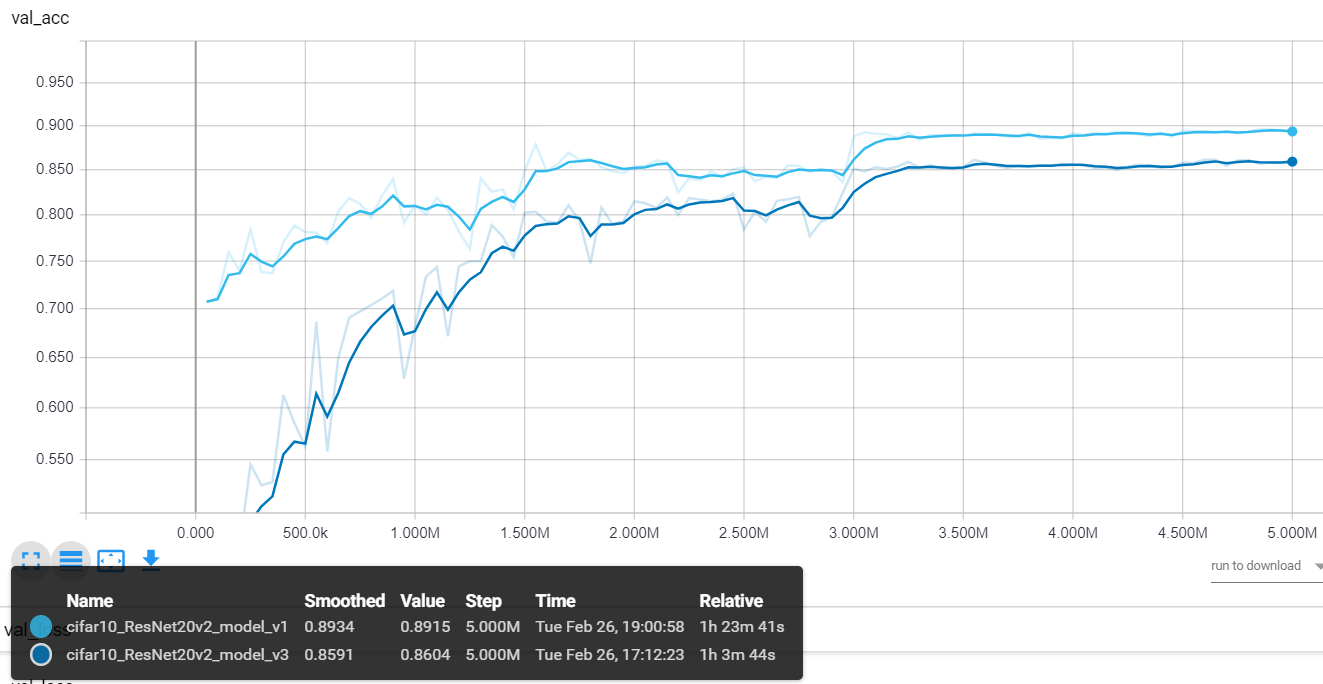
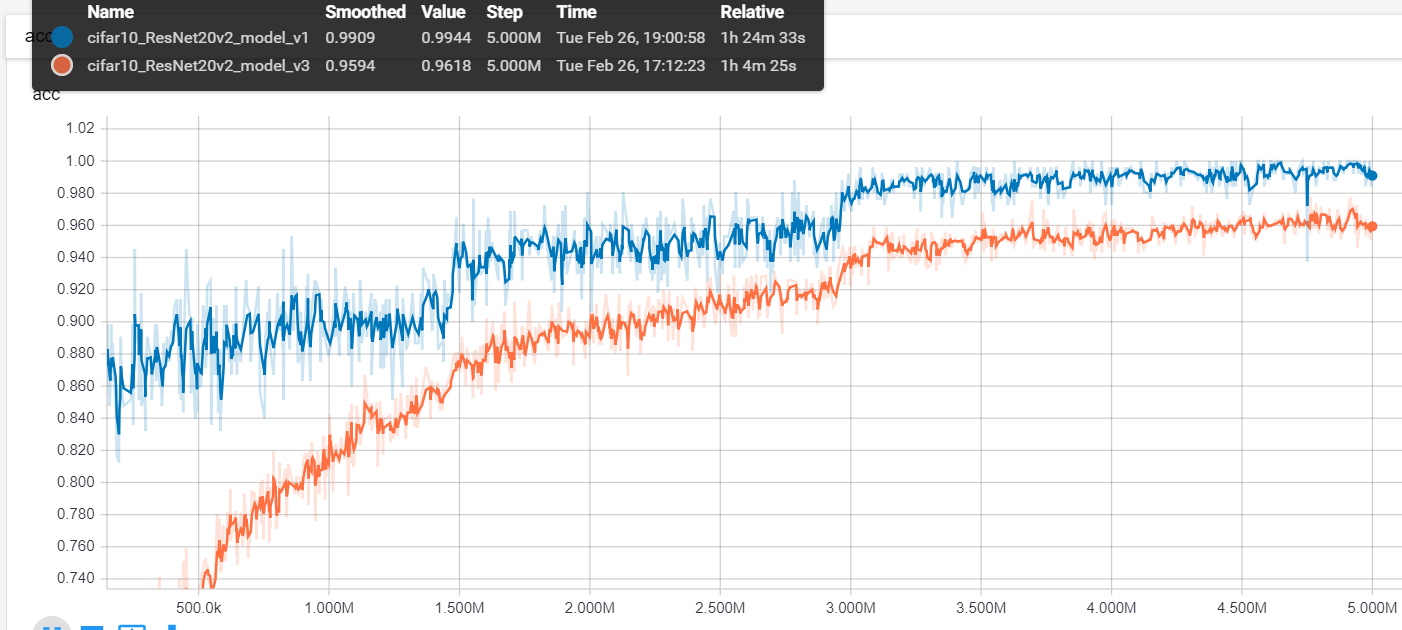
With a wide ResNet 34 and horizontal flips data augmentation, and 100 epochs of training with batchsize 128, it hits 92.16% (called v1).

Weights are available inside the Releases tab

NOTE

  • The smaller ResNet 20 models have been removed as they did not perform as expected and were depending on a flaw during the initial implementation. The ResNet 32 shows the actual performance of this optimizer.

With a small ResNet 20 and width + height data + horizontal flips data augmentation, and 100 epochs of training with batchsize 1024, it hits 89.5% (called v1).

On a small ResNet 20 with only width and height data augmentations, with batchsize 1024 trained for 100 epochs, the model gets close to 86% on the test set (called v3 below).

Train Set Accuracy

Train Set Loss

Test Set Accuracy

Test Set Loss

Requirements

  • Keras 2.2.4+ & Tensorflow 1.12+ (Only supports TF backend for now).
  • Numpy
Comments
  • suggestion: allow to train x2 or x3 bigger networks on same vram with TF backend

    suggestion: allow to train x2 or x3 bigger networks on same vram with TF backend

    same as my PR https://github.com/keras-team/keras-contrib/pull/478 works only with TF backend

    class AdaBound(Optimizer):
        """AdaBound optimizer.
        Default parameters follow those provided in the original paper.
        # Arguments
            lr: float >= 0. Learning rate.
            final_lr: float >= 0. Final learning rate.
            beta_1: float, 0 < beta < 1. Generally close to 1.
            beta_2: float, 0 < beta < 1. Generally close to 1.
            gamma: float >= 0. Convergence speed of the bound function.
            epsilon: float >= 0. Fuzz factor. If `None`, defaults to `K.epsilon()`.
            decay: float >= 0. Learning rate decay over each update.
            weight_decay: Weight decay weight.
            amsbound: boolean. Whether to apply the AMSBound variant of this
                algorithm.
            tf_cpu_mode: only for tensorflow backend
                  0 - default, no changes.
                  1 - allows to train x2 bigger network on same VRAM consuming RAM
                  2 - allows to train x3 bigger network on same VRAM consuming RAM*2
                      and CPU power.
        # References
            - [Adaptive Gradient Methods with Dynamic Bound of Learning Rate]
              (https://openreview.net/forum?id=Bkg3g2R9FX)
            - [Adam - A Method for Stochastic Optimization]
              (https://arxiv.org/abs/1412.6980v8)
            - [On the Convergence of Adam and Beyond]
              (https://openreview.net/forum?id=ryQu7f-RZ)
        """
    
        def __init__(self, lr=0.001, final_lr=0.1, beta_1=0.9, beta_2=0.999, gamma=1e-3,
                     epsilon=None, decay=0., amsbound=False, weight_decay=0.0, tf_cpu_mode=0, **kwargs):
            super(AdaBound, self).__init__(**kwargs)
    
            if not 0. <= gamma <= 1.:
                raise ValueError("Invalid `gamma` parameter. Must lie in [0, 1] range.")
    
            with K.name_scope(self.__class__.__name__):
                self.iterations = K.variable(0, dtype='int64', name='iterations')
                self.lr = K.variable(lr, name='lr')
                self.beta_1 = K.variable(beta_1, name='beta_1')
                self.beta_2 = K.variable(beta_2, name='beta_2')
                self.decay = K.variable(decay, name='decay')
    
            self.final_lr = final_lr
            self.gamma = gamma
    
            if epsilon is None:
                epsilon = K.epsilon()
            self.epsilon = epsilon
            self.initial_decay = decay
            self.amsbound = amsbound
    
            self.weight_decay = float(weight_decay)
            self.base_lr = float(lr)
            self.tf_cpu_mode = tf_cpu_mode
    
        def get_updates(self, loss, params):
            grads = self.get_gradients(loss, params)
            self.updates = [K.update_add(self.iterations, 1)]
    
            lr = self.lr
            if self.initial_decay > 0:
                lr = lr * (1. / (1. + self.decay * K.cast(self.iterations,
                                                          K.dtype(self.decay))))
    
            t = K.cast(self.iterations, K.floatx()) + 1
    
            # Applies bounds on actual learning rate
            step_size = lr * (K.sqrt(1. - K.pow(self.beta_2, t)) /
                              (1. - K.pow(self.beta_1, t)))
    
            final_lr = self.final_lr * lr / self.base_lr
            lower_bound = final_lr * (1. - 1. / (self.gamma * t + 1.))
            upper_bound = final_lr * (1. + 1. / (self.gamma * t))
    
            e = K.tf.device("/cpu:0") if self.tf_cpu_mode > 0 else None
            if e: e.__enter__()
            ms = [K.zeros(K.int_shape(p), dtype=K.dtype(p)) for p in params]
            vs = [K.zeros(K.int_shape(p), dtype=K.dtype(p)) for p in params]
            if self.amsbound:
                vhats = [K.zeros(K.int_shape(p), dtype=K.dtype(p)) for p in params]
            else:
                vhats = [K.zeros(1) for _ in params]
            if e: e.__exit__(None, None, None)
            
            self.weights = [self.iterations] + ms + vs + vhats
    
            for p, g, m, v, vhat in zip(params, grads, ms, vs, vhats):
                # apply weight decay
                if self.weight_decay != 0.:
                    g += self.weight_decay * K.stop_gradient(p)
    
                e = K.tf.device("/cpu:0") if self.tf_cpu_mode == 2 else None
                if e: e.__enter__()                    
                m_t = (self.beta_1 * m) + (1. - self.beta_1) * g
                v_t = (self.beta_2 * v) + (1. - self.beta_2) * K.square(g)
                if self.amsbound:
                    vhat_t = K.maximum(vhat, v_t)
                    self.updates.append(K.update(vhat, vhat_t))
                if e: e.__exit__(None, None, None)
                
                if self.amsbound:
                    denom = (K.sqrt(vhat_t) + self.epsilon)
                else:
                    denom = (K.sqrt(v_t) + self.epsilon)                        
    
                # Compute the bounds
                step_size_p = step_size * K.ones_like(denom)
                step_size_p_bound = step_size_p / denom
                bounded_lr_t = m_t * K.minimum(K.maximum(step_size_p_bound,
                                                         lower_bound), upper_bound)
    
                p_t = p - bounded_lr_t
    
                self.updates.append(K.update(m, m_t))
                self.updates.append(K.update(v, v_t))
                new_p = p_t
    
                # Apply constraints.
                if getattr(p, 'constraint', None) is not None:
                    new_p = p.constraint(new_p)
    
                self.updates.append(K.update(p, new_p))
            return self.updates
    
        def get_config(self):
            config = {'lr': float(K.get_value(self.lr)),
                      'final_lr': float(self.final_lr),
                      'beta_1': float(K.get_value(self.beta_1)),
                      'beta_2': float(K.get_value(self.beta_2)),
                      'gamma': float(self.gamma),
                      'decay': float(K.get_value(self.decay)),
                      'epsilon': self.epsilon,
                      'weight_decay': self.weight_decay,
                      'amsbound': self.amsbound}
            base_config = super(AdaBound, self).get_config()
            return dict(list(base_config.items()) + list(config.items()))
    
    opened by iperov 13
  • AdaBound.iterations

    AdaBound.iterations

    this param is not saved.

    I looked at official pytorch implementation from original paper. https://github.com/Luolc/AdaBound/blob/master/adabound/adabound.py

    it has

    # State initialization
    if len(state) == 0:
        state['step'] = 0
    

    state is saved with the optimizer.

    also it has

    # Exponential moving average of gradient values
    state['exp_avg'] = torch.zeros_like(p.data)
    # Exponential moving average of squared gradient values
    state['exp_avg_sq'] = torch.zeros_like(p.data)
    

    these values should also be saved

    So your keras implementation is wrong.

    opened by iperov 10
  • Using SGDM with lr=0.1 leads to not learning

    Using SGDM with lr=0.1 leads to not learning

    Thanks for sharing your keras version of adabound and I found that when changing optimizer from adabound to SGDM (lr=0.1), the resnet doesn't learn at all like the fig below. image

    I remember that in the original paper it uses SGDM (lr=0.1) for comparisons and I'm wondering how this could be.

    opened by syorami 10
  • clip by value

    clip by value

    https://github.com/CyberZHG/keras-adabound/blob/master/keras_adabound/optimizers.py

    K.minimum(K.maximum(step, lower_bound), upper_bound)

    will not work?

    opened by iperov 2
  • Unexpected keyword argument passed to optimizer: amsbound

    Unexpected keyword argument passed to optimizer: amsbound

    I installed with pip install keras-adabound imported with: from keras_adabound import AdaBound and declared the optimizer as: opt = AdaBound(lr=1e-03,final_lr=0.1, gamma=1e-03, weight_decay=0., amsbound=False) Then, I'm getting the error: TypeError: Unexpected keyword argument passed to optimizer: amsbound

    changing the pip install to adabound (instead of keras-adabound) and the import to from adabound import AdaBound, the keyword amsbound is recognized, but then I get the error: TypeError: __init__() missing 1 required positional argument: 'params'

    Am I mixing something up here or missing something?

    opened by stabilus 0
  • Unclear how to import and use tf.keras version

    Unclear how to import and use tf.keras version

    I have downloaded the files and placed them in a folder in the site packages for my virtual environment but I can't get this to work. I have added the folder path to sys.path and verified it is listed. I'm running Tensorflow 2.1.0. What am I doing wrong?

    opened by mnweaver1 0
  • about lr

    about lr

    Thanks for a good optimizer According to usage optm = AdaBound(lr=1e-03, final_lr=0.1, gamma=1e-03, weight_decay=0., amsbound=False) Does the learning rate gradually increase by the number of steps?


    final lr is described as Final learning rate. but it actually is leaning rate relative to base lr and current klearning rate? https://github.com/titu1994/keras-adabound/blob/5ce819b6ca1cd95e32d62e268bd2e0c99c069fe8/adabound.py#L72

    opened by tanakataiki 1
Releases(0.1)
Owner
Somshubra Majumdar
Interested in Machine Learning, Deep Learning and Data Science in general
Somshubra Majumdar
DeepOBS: A Deep Learning Optimizer Benchmark Suite

DeepOBS - A Deep Learning Optimizer Benchmark Suite DeepOBS is a benchmarking suite that drastically simplifies, automates and improves the evaluation

Aaron Bahde 7 May 12, 2020
Copy Paste positive polyp using poisson image blending for medical image segmentation

Copy Paste positive polyp using poisson image blending for medical image segmentation According poisson image blending I've completely used it for bio

Phạm Vũ Hùng 2 Oct 19, 2021
Official PyTorch implementation for paper Context Matters: Graph-based Self-supervised Representation Learning for Medical Images

Context Matters: Graph-based Self-supervised Representation Learning for Medical Images Official PyTorch implementation for paper Context Matters: Gra

49 Nov 23, 2022
Based on Yolo's low-power, ultra-lightweight universal target detection algorithm, the parameter is only 250k, and the speed of the smart phone mobile terminal can reach ~300fps+

Based on Yolo's low-power, ultra-lightweight universal target detection algorithm, the parameter is only 250k, and the speed of the smart phone mobile terminal can reach ~300fps+

567 Dec 26, 2022
Source code for "MusCaps: Generating Captions for Music Audio" (IJCNN 2021)

MusCaps: Generating Captions for Music Audio Ilaria Manco1 2, Emmanouil Benetos1, Elio Quinton2, Gyorgy Fazekas1 1 Queen Mary University of London, 2

Ilaria Manco 57 Dec 07, 2022
Vpw analyzer - A visual J1850 VPW analyzer written in Python

VPW Analyzer A visual J1850 VPW analyzer written in Python Requires Tkinter, Pan

7 May 01, 2022
The codes and models in 'Gaze Estimation using Transformer'.

GazeTR We provide the code of GazeTR-Hybrid in "Gaze Estimation using Transformer". We recommend you to use data processing codes provided in GazeHub.

65 Dec 27, 2022
Data and code for the paper "Importance of Kernel Bandwidth in Quantum Machine Learning"

Reproducibility materials for "Importance of Kernel Bandwidth in Quantum Machine Learning" Repo structure: code contains Python scripts used to genera

Ruslan Shaydulin 3 Oct 23, 2022
EDCNN: Edge enhancement-based Densely Connected Network with Compound Loss for Low-Dose CT Denoising

EDCNN: Edge enhancement-based Densely Connected Network with Compound Loss for Low-Dose CT Denoising By Tengfei Liang, Yi Jin, Yidong Li, Tao Wang. Th

workingcoder 115 Jan 05, 2023
Danfeng Hong, Lianru Gao, Jing Yao, Bing Zhang, Antonio Plaza, Jocelyn Chanussot. Graph Convolutional Networks for Hyperspectral Image Classification, IEEE TGRS, 2021.

Graph Convolutional Networks for Hyperspectral Image Classification Danfeng Hong, Lianru Gao, Jing Yao, Bing Zhang, Antonio Plaza, Jocelyn Chanussot T

Danfeng Hong 154 Dec 13, 2022
The implementation of ICASSP 2020 paper "Pixel-level self-paced learning for super-resolution"

Pixel-level Self-Paced Learning for Super-Resolution This is an official implementaion of the paper Pixel-level Self-Paced Learning for Super-Resoluti

Elon Lin 41 Dec 15, 2022
Certis - Certis, A High-Quality Backtesting Engine

Certis - Backtesting For y'all Certis is a powerful, lightweight, simple backtes

Yeachan-Heo 46 Oct 30, 2022
PyTorch implementation of ARM-Net: Adaptive Relation Modeling Network for Structured Data.

A ready-to-use framework of latest models for structured (tabular) data learning with PyTorch. Applications include recommendation, CRT prediction, healthcare analytics, and etc.

48 Nov 30, 2022
Machine Learning Models were applied to predict the mass of the brain based on gender, age ranges, and head size.

Brain Weight in Humans Variations of head sizes and brain weights in humans Kaggle dataset obtained from this link by Anubhab Swain. Image obtained fr

Anne Livia 1 Feb 02, 2022
Bot developed in Python that automates races in pegaxy.

español | português About it: This is a fork from pega-racing-bot. This bot, developed in Python, is to automate races in pegaxy. The game developers

4 Apr 08, 2022
An open-source Deep Learning Engine for Healthcare that aims to treat & prevent major diseases

AlphaCare Background AlphaCare is a work-in-progress, open-source Deep Learning Engine for Healthcare that aims to treat and prevent major diseases. T

Siraj Raval 44 Nov 05, 2022
The final project for "Applying AI to Wearable Device Data" course from "AI for Healthcare" - Udacity.

Motion Compensated Pulse Rate Estimation Overview This project has 2 main parts. Develop a Pulse Rate Algorithm on the given training data. Then Test

Omar Laham 2 Oct 25, 2022
This is the first released system towards complex meters` detection and recognition, which is implemented by computer vision techniques.

A three-stage detection and recognition pipeline of complex meters in wild This is the first released system towards detection and recognition of comp

Yan Shu 19 Nov 28, 2022
Official PyTorch implementation of MAAD: A Model and Dataset for Attended Awareness

MAAD: A Model for Attended Awareness in Driving Install // Datasets // Training // Experiments // Analysis // License Official PyTorch implementation

7 Oct 16, 2022
Numba-accelerated Pythonic implementation of MPDATA with examples in Python, Julia and Matlab

PyMPDATA PyMPDATA is a high-performance Numba-accelerated Pythonic implementation of the MPDATA algorithm of Smolarkiewicz et al. used in geophysical

Atmospheric Cloud Simulation Group @ Jagiellonian University 15 Nov 23, 2022