Unofficial implementation:
- MoCo: Momentum Contrast for Unsupervised Visual Representation Learning (Paper)
- InsDis: Unsupervised Feature Learning via Non-Parametric Instance-level Discrimination (Paper)
Official implementation:
- CMC: Contrastive Multiview Coding (Paper)
- Rethinking Image Mixture for Unsupervised Visual Representation Learning (Paper)
Contrastive Multiview Coding
This repo covers the implementation for CMC (as well as Momentum Contrast and Instance Discrimination), which learns representations from multiview data in a self-supervised way (by multiview, we mean multiple sensory, multiple modal data, or literally multiple viewpoint data. It's flexible to define what is a "view"):
"Contrastive Multiview Coding" Paper, Project Page.
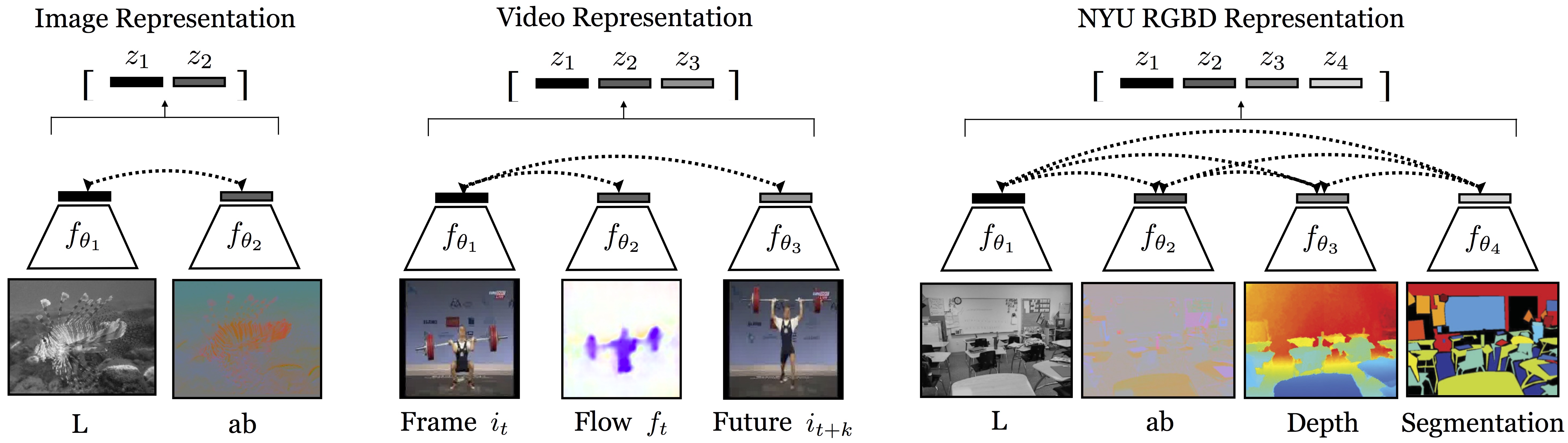
Highlights
(1) Representation quality as a function of number of contrasted views.
We found that, the more views we train with, the better the representation (of each single view).
(2) Contrastive objective v.s. Predictive objective
We compare the contrastive objective to cross-view prediction, finding an advantage to the contrastive approach.
(3) Unsupervised v.s. Supervised
Several ResNets trained with our unsupervised CMC objective surpasses supervisedly trained AlexNet on ImageNet classification ( e.g., 68.4% v.s. 59.3%). For this first time on ImageNet classification, unsupervised methods are surpassing the classic supervised-AlexNet proposed in 2012 (CPC++ and AMDIM also achieve this milestone concurrently).
Updates
Aug 20, 2019 - ResNets on ImageNet have been added.
Nov 26, 2019 - New results updated. Implementation of MoCo and InsDis added.
Jan 18, 2019 - Weights of InsDis and MoCo added.
Installation
This repo was tested with Ubuntu 16.04.5 LTS, Python 3.5, PyTorch 0.4.0, and CUDA 9.0. But it should be runnable with recent PyTorch versions >=0.4.0
Note: It seems to us that training with Pytorch version >= 1.0 yields slightly worse results. If you find the similar discrepancy and figure out the problem, please report this since we are trying to fix it as well.
Training AlexNet/ResNets with CMC on ImageNet
Note: For AlexNet, we split across the channel dimension and use each half to encode L and ab. For ResNets, we use a standard ResNet model to encode each view.
NCE flags:
--nce_k: number of negatives to contrast for each positive. Default: 4096--nce_m: the momentum for dynamically updating the memory. Default: 0.5--nce_t: temperature that modulates the distribution. Default: 0.07 for ImageNet, 0.1 for STL-10
Path flags:
--data_folder: specify the ImageNet data folder.--model_path: specify the path to save model.--tb_path: specify where to save tensorboard monitoring events.
Model flag:
--model: specify which model to use, including alexnet, resnets18, resnets50, and resnets101
IM flag:
--IM: train with IM space.--IM_type: specify the type of IM and other augmentation methods that we implement, including: 'IM', 'global', 'region', 'Cutout', 'RandomErasing'.
Global mixture:
--g_alpha: global mix alpha. Default: 1.0--g_num: global mix num. Default: 2--g_prob: global mix prob. Default: 0.1
Region-level mixture:
--r_beta: region mix beta. Default: 1.0--r_prob: region mix prob. Default: 0.1--r_num: region mix num. Default: 2--r_pixel_decay: region mix pixel decay. Default: 1.0
An example of command line for training CMC (Default: AlexNet on Single GPU)
CUDA_VISIBLE_DEVICES=0 python train_CMC.py --batch_size 256 --num_workers 36 \
 --data_folder /path/to/data
 --model_path /path/to/save
 --tb_path /path/to/tensorboard
Training CMC with ResNets requires at least 4 GPUs, the command of using resnet50v1 looks like
CUDA_VISIBLE_DEVICES=0,1,2,3 python train_CMC.py --model resnet50v1 --batch_size 128 --num_workers 24
 --data_folder path/to/data \
 --model_path path/to/save \
 --tb_path path/to/tensorboard \
To support mixed precision training, simply append the flag --amp, which, however is likely to harm the downstream classification. I measure it on ImageNet100 subset and the gap is about 0.5-1%.
By default, the training scripts will use L and ab as two views for contrasting. You can switch to YCbCr by specifying --view YCbCr, which yields better results (about 0.5-1%). If you want to use other color spaces as different views, follow the line here and other color transfer functions are already available in dataset.py.
Training Linear Classifier
Path flags:
--data_folder: specify the ImageNet data folder. Should be the same as above.--save_path: specify the path to save the linear classifier.--tb_path: specify where to save tensorboard events monitoring linear classifier training.
Model flag --model is similar as above and should be specified.
Specify the checkpoint that you want to evaluate with --model_path flag, this path should directly point to the .pth file.
This repo provides 3 ways to train the linear classifier: single GPU, data parallel, and distributed data parallel.
An example of command line for evaluating, say ./models/alexnet.pth, should look like:
CUDA_VISIBLE_DEVICES=0 python LinearProbing.py --dataset imagenet \
 --data_folder /path/to/data \
 --save_path /path/to/save \
 --tb_path /path/to/tensorboard \
 --model_path ./models/alexnet.pth \
 --model alexnet --learning_rate 0.1 --layer 5
Note: When training linear classifiers on top of ResNets, it's important to use large learning rate, e.g., 30~50. Specifically, change --learning_rate 0.1 --layer 5 to --learning_rate 30 --layer 6 for resnet50v1 and resnet50v2, to --learning_rate 50 --layer 6 for resnet50v3.
Pretrained Models
Pretrained weights can be found in Dropbox.
Note:
- CMC weights are trained with
NCEloss,Labcolor space,4096negatives andampoption. Switching tosoftmax-celoss,YCbCr,65536negatives, and turning offampoption, are likely to improve the results. CMC_resnet50v2.pthandCMC_resnet50v3.pthare trained with FastAutoAugment, which improves the downstream accuracy by 0.8~1%. I will update weights without FastAutoAugment once they are available.
InsDis and MoCo are trained using the same hyperparameters as in MoCo (epochs=200, lr=0.03, lr_decay_epochs=120,160, weight_decay=1e-4), but with only 4 GPUs.
| Arch | #Params(M) | Loss | #Negative | Accuracy(%) | Delta(%) | |
|---|---|---|---|---|---|---|
| InsDis | ResNet50 | 24 | NCE | 4096 | 56.5 | - |
| InsDis | ResNet50 | 24 | Softmax-CE | 4096 | 57.1 | +0.6 |
| InsDis | ResNet50 | 24 | Softmax-CE | 16384 | 58.5 | +1.4 |
| MoCo | ResNet50 | 24 | Softmax-CE | 16384 | 59.4 | +0.9 |
Momentum Contrast and Instance Discrimination
I have implemented and tested MoCo and InsDis on a ImageNet100 subset (but the code allows one to train on full ImageNet simply by setting the flag --dataset imagenet):
The pre-training stage:
- For InsDis:
CUDA_VISIBLE_DEVICES=0,1,2,3 python train_moco_ins.py \ --batch_size 128 --num_workers 24 --nce_k 16384 --softmax - For MoCo:
CUDA_VISIBLE_DEVICES=0,1,2,3 python train_moco_ins.py \
 --batch_size 128 --num_workers 24 --nce_k 16384 --softmax --moco
The linear evaluation stage:
- For both InsDis and MoCo (lr=10 is better than 30 on this subset, for full imagenet please switch to 30):
CUDA_VISIBLE_DEVICES=0 python eval_moco_ins.py --model resnet50 \
 --model_path /path/to/model --num_workers 24 --learning_rate 10
The comparison of CMC (using YCbCr), MoCo and InsDIS on my ImageNet100 subset, is tabulated as below:
| Arch | #Params(M) | Loss | #Negative | Accuracy | |
|---|---|---|---|---|---|
| InsDis | ResNet50 | 24 | NCE | 16384 | -- |
| InsDis | ResNet50 | 24 | Softmax-CE | 16384 | 69.1 |
| MoCo | ResNet50 | 24 | NCE | 16384 | -- |
| MoCo | ResNet50 | 24 | Softmax-CE | 16384 | 73.4 |
| CMC | 2xResNet50half | 12 | NCE | 4096 | -- |
| CMC | 2xResNet50half | 12 | Softmax-CE | 4096 | 75.8 |
Citation
If you find this repo useful for your research, please consider citing the paper
@article{tian2019contrastive,
  title={Contrastive Multiview Coding},
  author={Tian, Yonglong and Krishnan, Dilip and Isola, Phillip},
  journal={arXiv preprint arXiv:1906.05849},
  year={2019}
}
For any questions, please contact Yonglong Tian ([email protected]).
Acknowledgements
Part of this code is inspired by Zhirong Wu's unsupervised learning algorithm lemniscate.

 3.4k Jan 07, 2023
 430 Dec 23, 2022
 0 Feb 06, 2022
 2.6k Dec 22, 2022
 25 Dec 22, 2022
 51 Dec 29, 2022
 344 Nov 21, 2022
 67 Dec 24, 2022
 197 Nov 26, 2022
 13 Nov 07, 2022
 83 Jan 05, 2023
 119 Dec 08, 2022
 550 Dec 21, 2022
 117 Nov 05, 2022
 2 Oct 11, 2022
 10 Dec 10, 2022
 274 Dec 27, 2022
 63 Dec 07, 2022
 111 Dec 29, 2022
 16 Oct 10, 2022