PyTorch inference for "Progressive Growing of GANs" with CelebA snapshot

Overview

Progressive Growing of GANs inference in PyTorch with CelebA training snapshot

Description

This is an inference sample written in PyTorch of the original Theano/Lasagne code.

I recreated the network as described in the paper of Karras et al. Since some layers seemed to be missing in PyTorch, these were implemented as well. The network and the layers can be found in model.py.

For the demo, a 100-celeb-hq-1024x1024-ours snapshot was used, which was made publicly available by the authors. Since I couldn't find any model converter between Theano/Lasagne and PyTorch, I used a quick and dirty script to transfer the weights between the models (transfer_weights.py).

This repo does not provide the code for training the networks.

Simple inference

To run the demo, simply execute predict.py. You can specify other weights with the --weights flag.

Example image:

Example image

Latent space interpolation

To try the latent space interpolation, use latent_interp.py. All output images will be saved in ./interp.

You can chose between the "gaussian interpolation" introduced in the original paper and the "slerp interpolation" introduced by Tom White in his paper Sampling Generative Networks using the --type argument.

Use --filter to change the gaussian filter size for the gaussian interpolation and --interp for the interpolation steps for the slerp interpolation.

The following arguments are defined:

  • --weights - path to pretrained PyTorch state dict
  • --output - Directory for storing interpolated images
  • --batch_size - batch size for DataLoader
  • --num_workers - number of workers for DataLoader
  • --type {gauss, slerp} - interpolation type
  • --nb_latents - number of latent vectors to generate
  • --filter - gaussian filter length for interpolating latent space (gauss interpolation)
  • --interp - interpolation length between each latent vector (slerp interpolation)
  • --seed - random seed for numpy and PyTorch
  • --cuda - use GPU

The total number of generated frames depends on the used interpolation technique.

For gaussian interpolation the number of generated frames equals nb_latents, while the slerp interpolation generates nb_latents * interp frames.

Example interpolation:
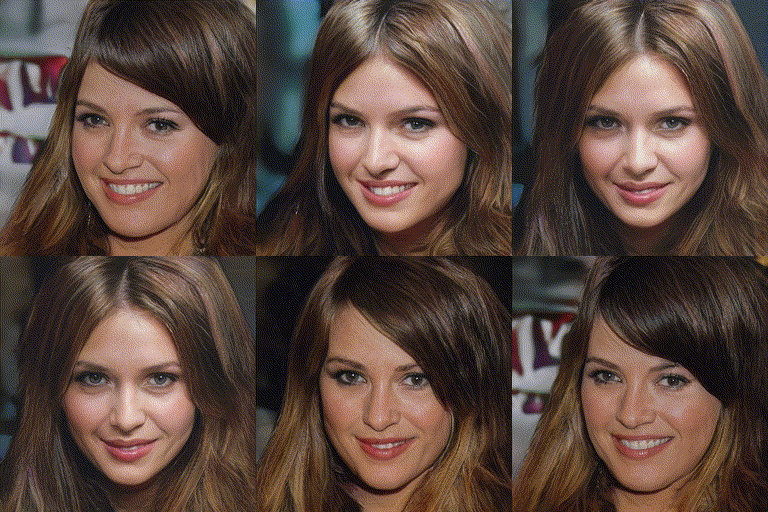
Example interpolation

Live latent space interpolation

A live demo of the latent space interpolation using PyGame can be seen in pygame_interp_demo.py.

Use the --size argument to change the output window size.

The following arguments are defined:

  • --weights - path to pretrained PyTorch state dict
  • --num_workers - number of workers for DataLoader
  • --type {gauss, slerp} - interpolation type
  • --nb_latents - number of latent vectors to generate
  • --filter - gaussian filter length for interpolating latent space (gauss interpolation)
  • --interp - interpolation length between each latent vector (slerp interpolation)
  • --size - PyGame window size
  • --seed - random seed for numpy and PyTorch
  • --cuda - use GPU

Transferring weights

The pretrained lasagne weights can be transferred to a PyTorch state dict using transfer_weights.py.

To transfer other snapshots from the paper (other than CelebA), you have to modify the model architecture accordingly and use the corresponding weights.

Environment

The code was tested on Ubuntu 16.04 with an NVIDIA GTX 1080 using PyTorch v.0.2.0_4.

  • transfer_weights.py needs Theano and Lasagne to load the pretrained weights.
  • pygame_interp_demo.py needs PyGame to visualize the output

A single forward pass took approx. 0.031 seconds.

Links

License

This code is a modified form of the original code under the CC BY-NC license with the following copyright notice:

# Copyright (c) 2017, NVIDIA CORPORATION. All rights reserved.
#
# This work is licensed under the Creative Commons Attribution-NonCommercial
# 4.0 International License. To view a copy of this license, visit
# http://creativecommons.org/licenses/by-nc/4.0/ or send a letter to
# Creative Commons, PO Box 1866, Mountain View, CA 94042, USA.

According the Section 3, I hereby identify Tero Karras et al. and NVIDIA as the original authors of the material.

Owner
Deep Learning Frameworks @NVIDIA
Synthetic structured data generators

Join us on What is Synthetic Data? Synthetic data is artificially generated data that is not collected from real world events. It replicates the stati

YData 850 Jan 07, 2023
Public scripts, services, and configuration for running a smart home K3S network cluster

makerhouse_network Public scripts, services, and configuration for running MakerHouse's home network. This network supports: TODO features here For mo

Scott Martin 1 Jan 15, 2022
A code implementation of AC-GC: Activation Compression with Guaranteed Convergence, in NeurIPS 2021.

Code For AC-GC: Lossy Activation Compression with Guaranteed Convergence This code is intended to be used as a supplemental material for submission to

Dave Evans 2 Nov 01, 2022
Information Gain Filtration (IGF) is a method for filtering domain-specific data during language model finetuning. IGF shows significant improvements over baseline fine-tuning without data filtration.

Information Gain Filtration Information Gain Filtration (IGF) is a method for filtering domain-specific data during language model finetuning. IGF sho

4 Jul 28, 2022
Code for the paper “The Peril of Popular Deep Learning Uncertainty Estimation Methods”

Uncertainty Estimation Methods Code for the paper “The Peril of Popular Deep Learning Uncertainty Estimation Methods” Reference If you use this code,

EPFL Machine Learning and Optimization Laboratory 4 Apr 05, 2022
The reference baseline of final exam for XMU machine learning course

Mini-NICO Baseline The baseline is a reference method for the final exam of machine learning course. Requirements Installation we use /python3.7 /torc

JoaquinChou 3 Dec 29, 2021
Enabling dynamic analysis of Legacy Embedded Systems in full emulated environment

PENecro This project is based on "Enabling dynamic analysis of Legacy Embedded Systems in full emulated environment", published on hardwear.io USA 202

Ta-Lun Yen 10 May 17, 2022
The implementation of the lifelong infinite mixture model

Lifelong infinite mixture model 📋 This is the implementation of the Lifelong infinite mixture model 📋 Accepted by ICCV 2021 Title : Lifelong Infinit

Fei Ye 5 Oct 20, 2022
Official Code for AdvRush: Searching for Adversarially Robust Neural Architectures (ICCV '21)

AdvRush Official Code for AdvRush: Searching for Adversarially Robust Neural Architectures (ICCV '21) Environmental Set-up Python == 3.6.12, PyTorch =

11 Dec 10, 2022
Demo code for ICCV 2021 paper "Sensor-Guided Optical Flow"

Sensor-Guided Optical Flow Demo code for "Sensor-Guided Optical Flow", ICCV 2021 This code is provided to replicate results with flow hints obtained f

10 Mar 16, 2022
Building a real-time environment using webcam frame division in OpenCV and classify cropped images using a fine-tuned vision transformers on hybryd datasets samples for facial emotion recognition.

Visual Transformer for Facial Emotion Recognition (FER) This project has the aim to build an efficient Visual Transformer for the Facial Emotion Recog

Mario Sessa 8 Dec 12, 2022
Sequence to Sequence Models with PyTorch

Sequence to Sequence models with PyTorch This repository contains implementations of Sequence to Sequence (Seq2Seq) models in PyTorch At present it ha

Sandeep Subramanian 708 Dec 19, 2022
Faster RCNN pytorch windows

Faster-RCNN-pytorch-windows Faster RCNN implementation with pytorch for windows Open cmd, compile this comands: cd lib python setup.py build develop T

Hwa-Rang Kim 1 Nov 11, 2022
Local trajectory planner based on a multilayer graph framework for autonomous race vehicles.

Graph-Based Local Trajectory Planner The graph-based local trajectory planner is python-based and comes with open interfaces as well as debug, visuali

TUM - Institute of Automotive Technology 160 Jan 04, 2023
novel deep learning research works with PaddlePaddle

Research 发布基于飞桨的前沿研究工作,包括CV、NLP、KG、STDM等领域的顶会论文和比赛冠军模型。 目录 计算机视觉(Computer Vision) 自然语言处理(Natrual Language Processing) 知识图谱(Knowledge Graph) 时空数据挖掘(Spa

1.5k Dec 29, 2022
Simple sinc interpolation in PyTorch.

Kazane: simple sinc interpolation for 1D signal in PyTorch Kazane utilize FFT based convolution to provide fast sinc interpolation for 1D signal when

Chin-Yun Yu 10 May 03, 2022
Keeping it safe - AI Based COVID-19 Tracker using Deep Learning and facial recognition

Keeping it safe - AI Based COVID-19 Tracker using Deep Learning and facial recognition

Vansh Wassan 15 Jun 17, 2021
the code used for the preprint Embedding-based Instance Segmentation of Microscopy Images.

EmbedSeg Introduction This repository hosts the version of the code used for the preprint Embedding-based Instance Segmentation of Microscopy Images.

JugLab 88 Dec 25, 2022
PyTorch implementation of Histogram Layers from DeepHist: Differentiable Joint and Color Histogram Layers for Image-to-Image Translation

deep-hist PyTorch implementation of Histogram Layers from DeepHist: Differentiable Joint and Color Histogram Layers for Image-to-Image Translation PyT

Winfried Lötzsch 10 Dec 06, 2022
Repo for "Physion: Evaluating Physical Prediction from Vision in Humans and Machines" submission to NeurIPS 2021 (Datasets & Benchmarks track)

Physion: Evaluating Physical Prediction from Vision in Humans and Machines This repo contains code and data to reproduce the results in our paper, Phy

Cognitive Tools Lab 38 Jan 06, 2023