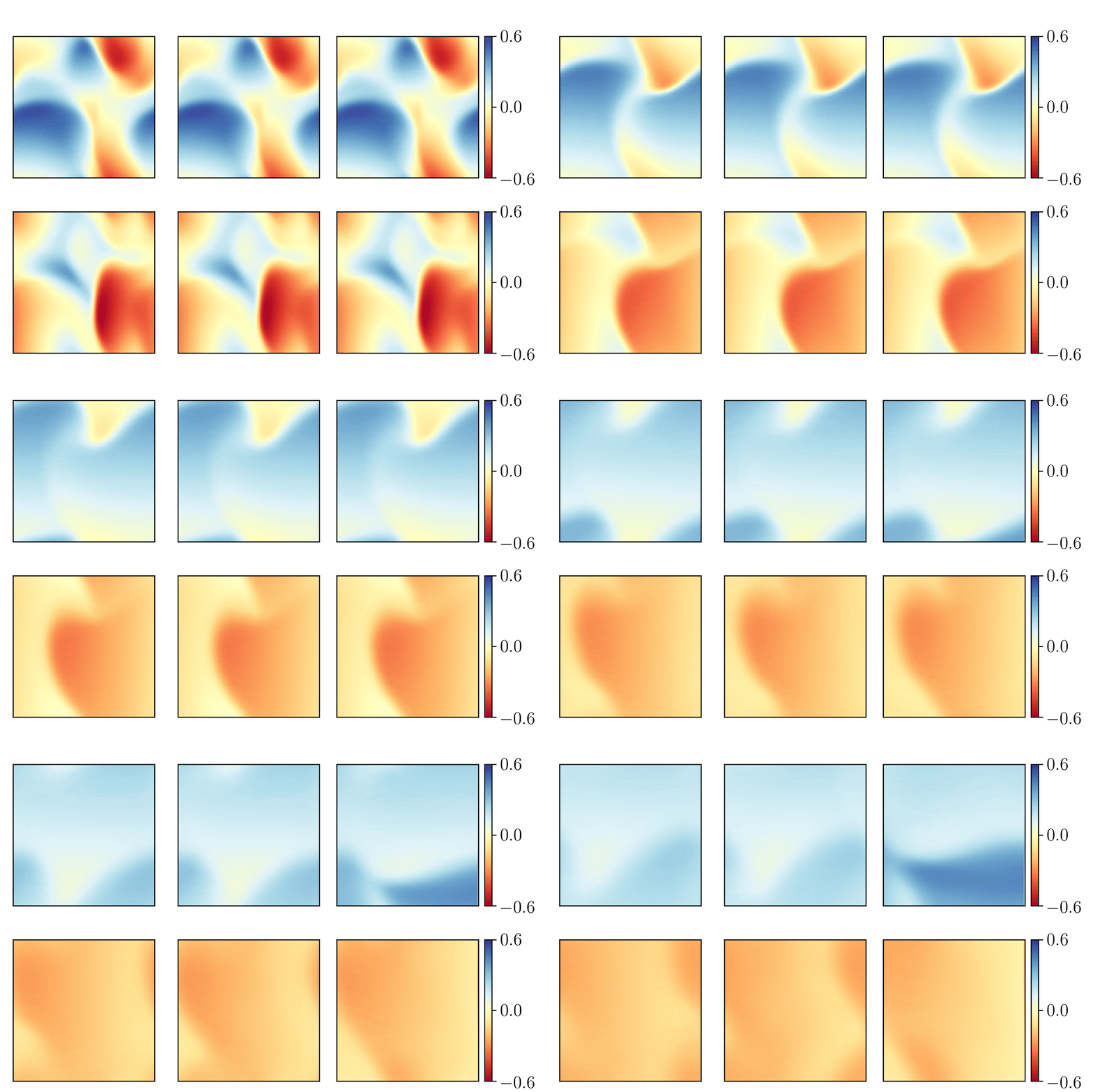
STARCH compuets regional extreme storm physical characteristics and moisture balance based on spatiotemporal precipitation data from reanalysis or climate model data.

Related tags

Deep Learningstarch
Overview

STARCH (Storm Tracking And Regional CHaracterization)

STARCH computes regional extreme storm physical and moisture balance characteristics based on spatiotemporal precipitation data from reanlaysis or climate model data. The algorithm is proposed and implemented in (paper) to identify extreme storms and analyze their moisture balance in the Mississippi Basin based on ERA5 reanlaysis data. Detailed description and implementation of the algorithm can be found in the Jupyter Notebook "Example.ipynb".

Installation

git clone https://github.com/lorenliu13/starch.git

Dependencies

Name Version
geographiclib 1.52
matplotlib 3.4.2
mpu 0.23.1
numpy 1.20.3
pandas 1.3.3
Pillow 9.0.0
scikit_image 0.18.1
scikit_learn 1.0.2
scipy 1.6.3
skimage 0.0
tqdm 4.62.0

cdsapi and urllib3 are necesary when using the code "ERA5_single_levels_download.py" to group download ERA5 data from the ECMWF data center. Basemap Matplotlib Toolkit is necessary when using the plotting function "sequence_strom_plot_basemap()" in the Example.ipynb to visualize the storm tracking results.

Usage

Introduction and implementation of the codes can be found in "Example.ipynb".

Contributing

Feel free to open an issue for bugs and feature requests.

License

STARCH is released under the MIT License.

Authors

Acknowledgements

  • Guo Yu - Feature improvement
You might also like...
Official implementation for NIPS'17 paper: PredRNN: Recurrent Neural Networks for Predictive Learning Using Spatiotemporal LSTMs.

PredRNN: A Recurrent Neural Network for Spatiotemporal Predictive Learning The predictive learning of spatiotemporal sequences aims to generate future

PyTorch Code of "Memory In Memory: A Predictive Neural Network for Learning Higher-Order Non-Stationarity from Spatiotemporal Dynamics"

Memory In Memory Networks It is based on the paper Memory In Memory: A Predictive Neural Network for Learning Higher-Order Non-Stationarity from Spati

Physics-informed convolutional-recurrent neural networks for solving spatiotemporal PDEs

PhyCRNet Physics-informed convolutional-recurrent neural networks for solving spatiotemporal PDEs Paper link: [ArXiv] By: Pu Ren, Chengping Rao, Yang

Multivariate Time Series Forecasting with efficient Transformers. Code for the paper
Multivariate Time Series Forecasting with efficient Transformers. Code for the paper "Long-Range Transformers for Dynamic Spatiotemporal Forecasting."

Spacetimeformer Multivariate Forecasting This repository contains the code for the paper, "Long-Range Transformers for Dynamic Spatiotemporal Forecast

Large Scale Multi-Illuminant (LSMI) Dataset for Developing White Balance Algorithm under Mixed Illumination

Large Scale Multi-Illuminant (LSMI) Dataset for Developing White Balance Algorithm under Mixed Illumination (ICCV 2021) Dataset License This work is l

Diabet Feature Engineering - Predict whether people have diabetes when their characteristics are specified

Diabet Feature Engineering - Predict whether people have diabetes when their characteristics are specified

A new data augmentation method for extreme lighting conditions.

Random Shadows and Highlights This repo has the source code for the paper: Random Shadows and Highlights: A new data augmentation method for extreme l

Code repo for
Code repo for "RBSRICNN: Raw Burst Super-Resolution through Iterative Convolutional Neural Network" (Machine Learning and the Physical Sciences workshop in NeurIPS 2021).

RBSRICNN: Raw Burst Super-Resolution through Iterative Convolutional Neural Network An official PyTorch implementation of the RBSRICNN network as desc

 Physics-Aware Training (PAT) is a method to train real physical systems with backpropagation.
Physics-Aware Training (PAT) is a method to train real physical systems with backpropagation.

Physics-Aware Training (PAT) is a method to train real physical systems with backpropagation. It was introduced in Wright, Logan G. & Onodera, Tatsuhiro et al. (2021)1 to train Physical Neural Networks (PNNs) - neural networks whose building blocks are physical systems.

Comments
  • Consider combination, division, and deformation of the storm objects in tracking

    Consider combination, division, and deformation of the storm objects in tracking

    The track function may be improved following the figure in the study of Zhou et al. (2018) to deal with storm split and merge: image

    Zhou, Yang, Hyemi Kim, and Bin Guan. “Life Cycle of Atmospheric Rivers: Identification and Climatological Characteristics.” Journal of Geophysical Research: Atmospheres 123, no. 22 (2018): 12,715-12,725. https://doi.org/10.1029/2018JD029180.

    Another idea of dealing with spliting and merging of storm objects can be found in Guan et al. (2019), which gives more detailed cases: image

    Guan, Bin, and Duane E. Waliser. “Tracking Atmospheric Rivers Globally: Spatial Distributions and Temporal Evolution of Life Cycle Characteristics.” Journal of Geophysical Research: Atmospheres 124, no. 23 (2019): 12523–52. https://doi.org/10.1029/2019JD031205.

    opened by lorenliu13 0
Releases(v1.0.1)
Owner
Onosama
Onosama
Creative Applications of Deep Learning w/ Tensorflow

Creative Applications of Deep Learning w/ Tensorflow This repository contains lecture transcripts and homework assignments as Jupyter Notebooks for th

Parag K Mital 1.5k Dec 30, 2022
Change Detection in SAR Images Based on Multiscale Capsule Network

SAR_CD_MS_CapsNet Code for the paper "Change Detection in SAR Images Based on Multiscale Capsule Network" , IEEE Geoscience and Remote Sensing Letters

Feng Gao 21 Nov 29, 2022
Visual dialog agents with pre-trained vision-and-language encoders.

Learning Better Visual Dialog Agents with Pretrained Visual-Linguistic Representation Or READ-UP: Referring Expression Agent Dialog with Unified Pretr

7 Oct 08, 2022
MMDetection3D is an open source object detection toolbox based on PyTorch

MMDetection3D is an open source object detection toolbox based on PyTorch, towards the next-generation platform for general 3D detection. It is a part of the OpenMMLab project developed by MMLab.

OpenMMLab 3.2k Jan 05, 2023
QuakeLabeler is a Python package to create and manage your seismic training data, processes, and visualization in a single place — so you can focus on building the next big thing.

QuakeLabeler Quake Labeler was born from the need for seismologists and developers who are not AI specialists to easily, quickly, and independently bu

Hao Mai 15 Nov 04, 2022
Shape-aware Semi-supervised 3D Semantic Segmentation for Medical Images

SASSnet Code for paper: Shape-aware Semi-supervised 3D Semantic Segmentation for Medical Images(MICCAI 2020) Our code is origin from UA-MT You can fin

klein 125 Jan 03, 2023
Finite-temperature variational Monte Carlo calculation of uniform electron gas using neural canonical transformation.

CoulombGas This code implements the neural canonical transformation approach to the thermodynamic properties of uniform electron gas. Building on JAX,

FermiFlow 9 Mar 03, 2022
Probabilistic-Monocular-3D-Human-Pose-Estimation-with-Normalizing-Flows

Probabilistic-Monocular-3D-Human-Pose-Estimation-with-Normalizing-Flows This is the official implementation of the ICCV 2021 Paper "Probabilistic Mono

62 Nov 23, 2022
The dataset of tweets pulling from Twitters with keyword: Hydroxychloroquine, location: US, Time: 2020

HCQ_Tweet_Dataset: FREE to Download. Keywords: HCQ, hydroxychloroquine, tweet, twitter, COVID-19 This dataset is associated with the paper "Understand

2 Mar 16, 2022
Anagram Generator in Python

Anagrams Generator This is a program for computing multiword anagrams. It makes no effort to come up with sentences that make sense; it only finds ana

Day Fundora 5 Nov 17, 2022
Code for Active Learning at The ImageNet Scale.

Code for Active Learning at The ImageNet Scale. This repository implements many popular active learning algorithms and allows training with torch's DDP.

Zeyad Emam 47 Dec 12, 2022
Flax is a neural network ecosystem for JAX that is designed for flexibility.

Flax: A neural network library and ecosystem for JAX designed for flexibility Overview | Quick install | What does Flax look like? | Documentation See

Google 3.9k Jan 02, 2023
This repository contains an implementation of ConvMixer for the ICLR 2022 submission "Patches Are All You Need?".

Patches Are All You Need? 🤷 This repository contains an implementation of ConvMixer for the ICLR 2022 submission "Patches Are All You Need?". Code ov

ICLR 2022 Author 934 Dec 30, 2022
Code for the paper 'A High Performance CRF Model for Clothes Parsing'.

Clothes Parsing Overview This code provides an implementation of the research paper: A High Performance CRF Model for Clothes Parsing Edgar Simo-S

Edgar Simo-Serra 119 Nov 21, 2022
A stable algorithm for GAN training

DRAGAN (Deep Regret Analytic Generative Adversarial Networks) Link to our paper - https://arxiv.org/abs/1705.07215 Pytorch implementation (thanks!) -

195 Oct 10, 2022
Recurrent Scale Approximation (RSA) for Object Detection

Recurrent Scale Approximation (RSA) for Object Detection Codebase for Recurrent Scale Approximation for Object Detection in CNN published at ICCV 2017

Yu Liu (Louis) 239 Dec 28, 2022
All course materials for the Zero to Mastery Machine Learning and Data Science course.

Zero to Mastery Machine Learning Welcome! This repository contains all of the code, notebooks, images and other materials related to the Zero to Maste

Daniel Bourke 1.6k Jan 08, 2023
Source code for our paper "Empathetic Response Generation with State Management"

Source code for our paper "Empathetic Response Generation with State Management" this repository is maintained by both Jun Gao and Yuhan Liu Model Ove

Yuhan Liu 3 Oct 08, 2022
Graph Convolutional Networks for Temporal Action Localization (ICCV2019)

Graph Convolutional Networks for Temporal Action Localization This repo holds the codes and models for the PGCN framework presented on ICCV 2019 Graph

Runhao Zeng 318 Dec 06, 2022
Unofficial implementation of the Involution operation from CVPR 2021

involution_pytorch Unofficial PyTorch implementation of "Involution: Inverting the Inherence of Convolution for Visual Recognition" by Li et al. prese

Rishabh Anand 46 Dec 07, 2022