An implementation of the AlphaZero algorithm for Gomoku (also called Gobang or Five in a Row)

Overview

AlphaZero-Gomoku

This is an implementation of the AlphaZero algorithm for playing the simple board game Gomoku (also called Gobang or Five in a Row) from pure self-play training. The game Gomoku is much simpler than Go or chess, so that we can focus on the training scheme of AlphaZero and obtain a pretty good AI model on a single PC in a few hours.

References:

  1. AlphaZero: Mastering Chess and Shogi by Self-Play with a General Reinforcement Learning Algorithm
  2. AlphaGo Zero: Mastering the game of Go without human knowledge

Update 2018.2.24: supports training with TensorFlow!

Update 2018.1.17: supports training with PyTorch!

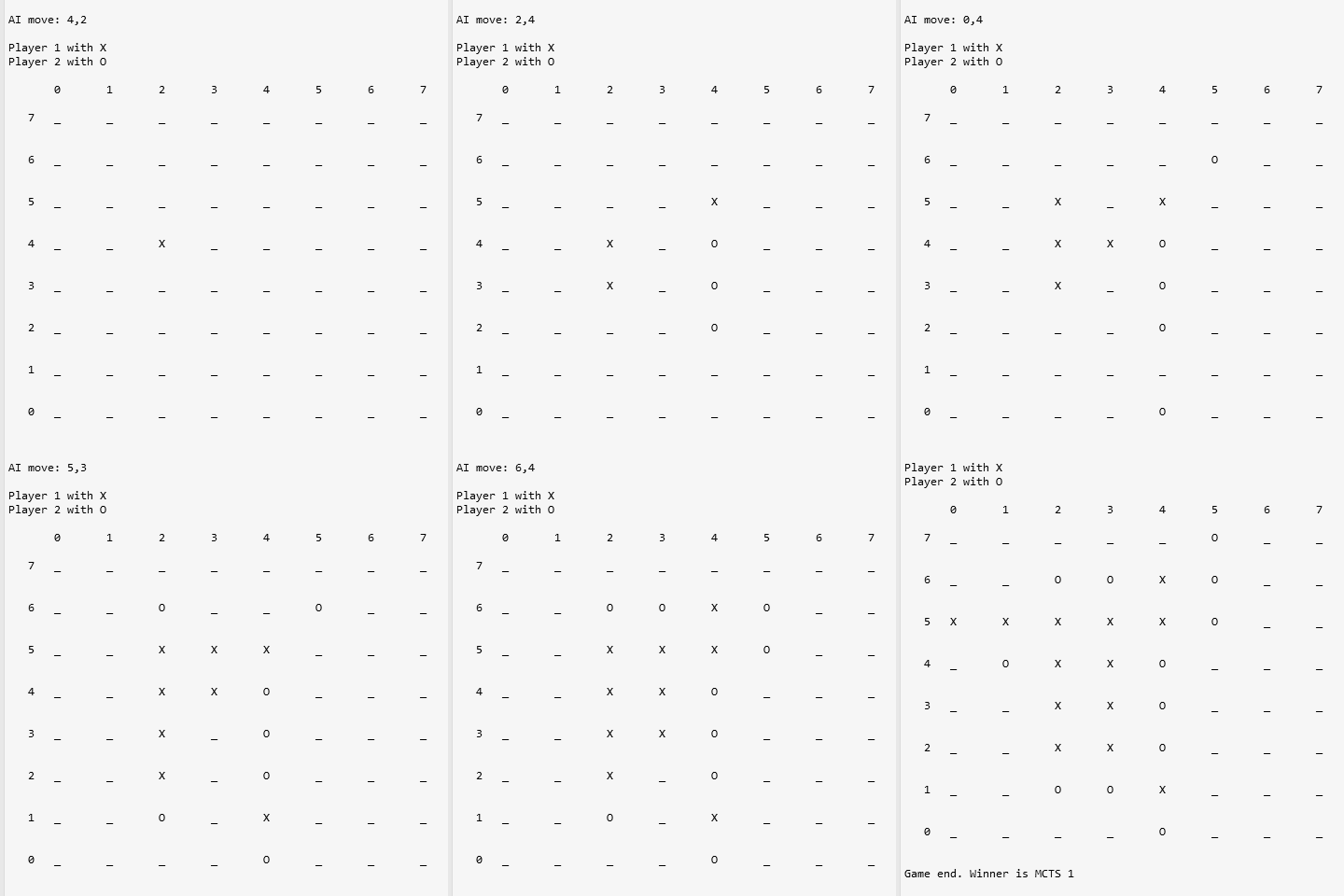
Example Games Between Trained Models

  • Each move with 400 MCTS playouts:
    playout400

Requirements

To play with the trained AI models, only need:

  • Python >= 2.7
  • Numpy >= 1.11

To train the AI model from scratch, further need, either:

  • Theano >= 0.7 and Lasagne >= 0.1
    or
  • PyTorch >= 0.2.0
    or
  • TensorFlow

PS: if your Theano's version > 0.7, please follow this issue to install Lasagne,
otherwise, force pip to downgrade Theano to 0.7 pip install --upgrade theano==0.7.0

If you would like to train the model using other DL frameworks, you only need to rewrite policy_value_net.py.

Getting Started

To play with provided models, run the following script from the directory:

python human_play.py  

You may modify human_play.py to try different provided models or the pure MCTS.

To train the AI model from scratch, with Theano and Lasagne, directly run:

python train.py

With PyTorch or TensorFlow, first modify the file train.py, i.e., comment the line

from policy_value_net import PolicyValueNet  # Theano and Lasagne

and uncomment the line

# from policy_value_net_pytorch import PolicyValueNet  # Pytorch
or
# from policy_value_net_tensorflow import PolicyValueNet # Tensorflow

and then execute: python train.py (To use GPU in PyTorch, set use_gpu=True and use return loss.item(), entropy.item() in function train_step in policy_value_net_pytorch.py if your pytorch version is greater than 0.5)

The models (best_policy.model and current_policy.model) will be saved every a few updates (default 50).

Note: the 4 provided models were trained using Theano/Lasagne, to use them with PyTorch, please refer to issue 5.

Tips for training:

  1. It is good to start with a 6 * 6 board and 4 in a row. For this case, we may obtain a reasonably good model within 500~1000 self-play games in about 2 hours.
  2. For the case of 8 * 8 board and 5 in a row, it may need 2000~3000 self-play games to get a good model, and it may take about 2 days on a single PC.

Further reading

My article describing some details about the implementation in Chinese: https://zhuanlan.zhihu.com/p/32089487

Owner
Junxiao Song
PhD, ECE, HKUST
Junxiao Song
An efficient framework for reinforcement learning.

rl: An efficient framework for reinforcement learning Requirements Introduction PPO Test Requirements name version Python =3.7 numpy =1.19 torch =1

16 Nov 30, 2022
Compare neural networks by their feature similarity

PyTorch Model Compare A tiny package to compare two neural networks in PyTorch. There are many ways to compare two neural networks, but one robust and

Anand Krishnamoorthy 181 Jan 04, 2023
A fast Evolution Strategy implementation in Python

Evostra: Evolution Strategy for Python Evolution Strategy (ES) is an optimization technique based on ideas of adaptation and evolution. You can learn

Mika 251 Dec 08, 2022
Embracing Single Stride 3D Object Detector with Sparse Transformer

SST: Single-stride Sparse Transformer This is the official implementation of paper: Embracing Single Stride 3D Object Detector with Sparse Transformer

TuSimple 385 Dec 28, 2022
PyTorch code for JEREX: Joint Entity-Level Relation Extractor

JEREX: "Joint Entity-Level Relation Extractor" PyTorch code for JEREX: "Joint Entity-Level Relation Extractor". For a description of the model and exp

LAVIS - NLP Working Group 50 Dec 01, 2022
Code for DeepCurrents: Learning Implicit Representations of Shapes with Boundaries

DeepCurrents | Webpage | Paper DeepCurrents: Learning Implicit Representations of Shapes with Boundaries David Palmer*, Dmitriy Smirnov*, Stephanie Wa

Dima Smirnov 36 Dec 08, 2022
CROSS-LINGUAL ABILITY OF MULTILINGUAL BERT: AN EMPIRICAL STUDY

M-BERT-Study CROSS-LINGUAL ABILITY OF MULTILINGUAL BERT: AN EMPIRICAL STUDY Motivation Multilingual BERT (M-BERT) has shown surprising cross lingual a

CogComp 1 Feb 28, 2022
Emblaze - Interactive Embedding Comparison

Emblaze - Interactive Embedding Comparison Emblaze is a Jupyter notebook widget for visually comparing embeddings using animated scatter plots. It bun

CMU Data Interaction Group 77 Nov 24, 2022
A repository with exploration into using transformers to predict DNA ↔ transcription factor binding

Transcription Factor binding predictions with Attention and Transformers A repository with exploration into using transformers to predict DNA ↔ transc

Phil Wang 62 Dec 20, 2022
a reimplementation of Optical Flow Estimation using a Spatial Pyramid Network in PyTorch

pytorch-spynet This is a personal reimplementation of SPyNet [1] using PyTorch. Should you be making use of this work, please cite the paper according

Simon Niklaus 269 Jan 02, 2023
NumQMBasic - A mini-course offered to Undergrad physics students

The best way to use this material is by forking it by click the Fork button at the top, right corner. Then you will get your own copy to play with! Th

Raghu 35 Dec 05, 2022
maximal update parametrization (µP)

Maximal Update Parametrization (μP) and Hyperparameter Transfer (μTransfer) Paper link | Blog link In Tensor Programs V: Tuning Large Neural Networks

Microsoft 694 Jan 03, 2023
《Dual-Resolution Correspondence Network》(NeurIPS 2020)

Dual-Resolution Correspondence Network Dual-Resolution Correspondence Network, NeurIPS 2020 Dependency All dependencies are included in asset/dualrcne

Active Vision Laboratory 45 Nov 21, 2022
SegNet-Basic with Keras

SegNet-Basic: What is Segnet? Deep Convolutional Encoder-Decoder Architecture for Semantic Pixel-wise Image Segmentation Segnet = (Encoder + Decoder)

Yad Konrad 81 Jun 30, 2022
Visualize Camera's Pose Using Extrinsic Parameter by Plotting Pyramid Model on 3D Space

extrinsic2pyramid Visualize Camera's Pose Using Extrinsic Parameter by Plotting Pyramid Model on 3D Space Intro A very simple and straightforward modu

JEONG HYEONJIN 106 Dec 28, 2022
Doubly Robust Off-Policy Evaluation for Ranking Policies under the Cascade Behavior Model

Doubly Robust Off-Policy Evaluation for Ranking Policies under the Cascade Behavior Model About This repository contains the code to replicate the syn

Haruka Kiyohara 12 Dec 07, 2022
The (Official) PyTorch Implementation of the paper "Deep Extraction of Manga Structural Lines"

MangaLineExtraction_PyTorch The (Official) PyTorch Implementation of the paper "Deep Extraction of Manga Structural Lines" Usage model_torch.py [sourc

Miaomiao Li 82 Jan 02, 2023
Implementation of Learning Gradient Fields for Molecular Conformation Generation (ICML 2021).

[PDF] | [Slides] The official implementation of Learning Gradient Fields for Molecular Conformation Generation (ICML 2021 Long talk) Installation Inst

MilaGraph 117 Dec 09, 2022
Python Tensorflow 2 scripts for detecting objects of any class in an image without knowing their label.

Tensorflow-Mobile-Generic-Object-Localizer Python Tensorflow 2 scripts for detecting objects of any class in an image without knowing their label. Ori

Ibai Gorordo 11 Nov 15, 2022
A demonstration of using a live Tensorflow session to create an interactive face-GAN explorer.

Streamlit Demo: The Controllable GAN Face Generator This project highlights Streamlit's new hash_func feature with an app that calls on TensorFlow to

Streamlit 257 Dec 31, 2022