Training and Evaluation Code for Neural Volumes

Overview

Neural Volumes

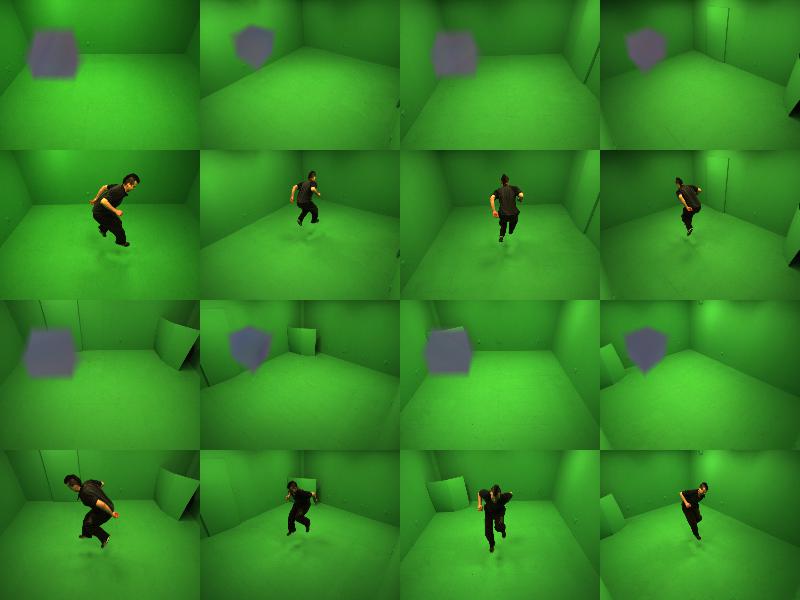
This repository contains training and evaluation code for the paper Neural Volumes. The method learns a 3D volumetric representation of objects & scenes that can be rendered and animated from only calibrated multi-view video.

Neural Volumes

Citing Neural Volumes

If you use Neural Volumes in your research, please cite the paper:

@article{Lombardi:2019,
 author = {Stephen Lombardi and Tomas Simon and Jason Saragih and Gabriel Schwartz and Andreas Lehrmann and Yaser Sheikh},
 title = {Neural Volumes: Learning Dynamic Renderable Volumes from Images},
 journal = {ACM Trans. Graph.},
 issue_date = {July 2019},
 volume = {38},
 number = {4},
 month = jul,
 year = {2019},
 issn = {0730-0301},
 pages = {65:1--65:14},
 articleno = {65},
 numpages = {14},
 url = {http://doi.acm.org/10.1145/3306346.3323020},
 doi = {10.1145/3306346.3323020},
 acmid = {3323020},
 publisher = {ACM},
 address = {New York, NY, USA},
}

File Organization

The root directory contains several subdirectories and files:

data/ --- custom PyTorch Dataset classes for loading included data
eval/ --- utilities for evaluation
experiments/ --- location of input data and training and evaluation output
models/ --- PyTorch modules for Neural Volumes
render.py --- main evaluation script
train.py --- main training script

Requirements

  • Python (3.6+)
    • PyTorch (1.2+)
    • NumPy
    • Pillow
    • Matplotlib
  • ffmpeg (in PATH, needed to render videos)

How to Use

There are two main scripts in the root directory: train.py and render.py. The scripts take a configuration file for the experiment that defines the dataset used and the options for the model (e.g., the type of decoder that is used).

A sample set of input data is provided in the v0.1 release and can be downloaded here and extracted into the root directory of the repository. experiments/dryice1/data contains the input images and camera calibration data, and experiments/dryice1/experiment1 contains an example experiment configuration file (experiments/dryice1/experiment1/config.py).

To train the model:

python train.py experiments/dryice1/experiment1/config.py

To render a video of a trained model:

python render.py experiments/dryice1/experiment1/config.py Render

License

See the LICENSE file for details.

Comments
  • Training with our own data

    Training with our own data

    Hi,
    I have a few questions on how the data should be formatted and the data format of the provided dryice1.

    • The model expects world space coordinate in meters? i.e if my extrinsics are already in meters do I still need the world_scale=1/256. in config.py file?
    • The extrinsics are in world2cam and the rotation convention is like opencv? i.e, y-down,z-forward and x-right, assuming identity for pose.txt file?
    • how long do I need to train for about 200 frames? And in the config.py file it seems you are skipping some frames? This is ok to do for my own sequence as well?
    • in the KRT file, I see that there's 5 parameters above the RT matrix. This is the distortion correction in opencv format? But it is not used yes?
    • I did not visualize your cameras, so I am not sure how they are distributed. Is it gonna be a problem if I use 50 cameras equally distributed in a half-hemisphere and the subject is already at world origin and 3.5 meters from every cameras? My question is do I need to filter the training cameras so that the back side of subject that is not seen by input 3 cameras is excluded?
    • How do I choose the input cameras? I have a visualization of the cameras . Which camera config should I use? Is this more a question of which testing camera poses I intend to have, i.e narrower the testing cameras' range of view, the closer input training cameras can be? Config_0 is more orthogonal and Config_1 sees less of the backside.
    opened by zawlin 32
  • Some questions about coordination transformation

    Some questions about coordination transformation

    Hello, Thanks for releasing your code. I am impressed by your work. Now I hope to run your code with my our dataset. I have two questions.

    Firstly, I see the pose.txt is used in the code to put the objects in the center. If I use my own data, will the file still work?

    Secondly, I see the code set the raypos is among -1 and 1. Is it the matrix in this pose file that narrows the range to -1 to 1? My own dataset' range is different.

    Thirdly, does the code limit the scope of the template? Does it have to be between 0-255?

    Thanks a lot in advance!

    opened by maobenz 3
  • Location of the volume

    Location of the volume

    Hi there,

    I wonder whether the origin of the volume is (0,0,0)?

    I'm testing the method on a public dataset (http://people.csail.mit.edu/drdaniel/mesh_animation), and I know exactly where (0,0,0) is in the images. But the volume seems to float around the scene. This is the first preview for training process: prog_000001

    Each camera is pointing to the opposite side of the scene, so I expect the same for the volume location in images. But for some reason, they are on the same side in the images. Can you help?

    Thank you.

    opened by lochuynh1989 3
  • Any plan to release all data that presented in the paper?

    Any plan to release all data that presented in the paper?

    Hi @stephenlombardi ,

    Thanks for sharing this great work. I was wondering do you have any plan to release all the data that you used in the paper (apart from the dryice)?

    Best, Zirui

    opened by ziruiw-dev 2
  • Block-wise initialization scheme

    Block-wise initialization scheme

    Hi, is there any paper describing the used block-wise weight initialization scheme?

    https://github.com/facebookresearch/neuralvolumes/blob/8c5fad49b2b05b4b2e79917ee87299e7c1676d59/models/utils.py#L73

    opened by denkorzh 2
  • Is there a way to render a 3D file from this?

    Is there a way to render a 3D file from this?

    Hello, I was wondering if there is a way to export an .obj/,fbx file along with corresponding materials from this? If not, do you have any suggestions as to how to go about that if I were to try extend the code to incorporate that functionality?

    opened by arlorostirolla 1
  • How Can I train and render a Person Image

    How Can I train and render a Person Image

    Hi my name is Luan I am trying to render a Person Image but I am not being able to run can you create and for me a folder with the Setting setup to use a person image? Thank you.

    opened by LuanDalOrto 1
  • code for hybrid rendering (section 6.2) doesn't exist?

    code for hybrid rendering (section 6.2) doesn't exist?

    Hello,

    First of all, thank you for releasing the code for your seminal work. I really think neural volumes is one of the works that popularized differentiable rendering and inspired future works such as neural radiance fields.

    My question is whether this codebase includes the code for the hybrid rendering method outlined in section 6.2 of the paper. I'm trying to fit Neural Volumes to multi-view video of a full-body human being, similar to the 5th subfigure in Fig. 1 of the main paper, but after reading it more carefully it seems as though I would need to use hybrid rendering to be able to render the fine details of the human being.

    Could you

    1. confirm the existence of hybrid rendering in this codebase AND
    2. whether or not hybrid rendering was used to render the full-bodied human being in Fig. 1 of the main paper.

    Thank you in advance.

    opened by andrewsonga 1
  • Misaligned views in rendering

    Misaligned views in rendering

    Hi,

    I am working on MIT dataset to test the network. When I specify a camera to render, it looks fine throughout timeline. However, while rendering the rotating video, the cameras are misaligned as shown in attached screenshot. All cameras look like clustered at the center and views are spread around within the range cameras cover. Is it possible to be any error in KRT or configuration?

    Any suggestion is welcome. issue_MIT_5_cams

    opened by CorneliusHsiao 1
Releases(v0.1)
Owner
Meta Research
Meta Research
A dual benchmarking study of visual forgery and visual forensics techniques

A dual benchmarking study of facial forgery and facial forensics In recent years, visual forgery has reached a level of sophistication that humans can

8 Jul 06, 2022
T2F: text to face generation using Deep Learning

⭐ [NEW] ⭐ T2F - 2.0 Teaser (coming soon ...) Please note that all the faces in the above samples are generated ones. The T2F 2.0 will be using MSG-GAN

Animesh Karnewar 533 Dec 22, 2022
Multi-modal co-attention for drug-target interaction annotation and Its Application to SARS-CoV-2

CoaDTI Multi-modal co-attention for drug-target interaction annotation and Its Application to SARS-CoV-2 Abstract Environment The test was conducted i

Layne_Huang 7 Nov 14, 2022
An end-to-end machine learning library to directly optimize AUC loss

LibAUC An end-to-end machine learning library for AUC optimization. Why LibAUC? Deep AUC Maximization (DAM) is a paradigm for learning a deep neural n

Andrew 75 Dec 12, 2022
This is an open-source toolkit for Heterogeneous Graph Neural Network(OpenHGNN) based on DGL [Deep Graph Library] and PyTorch.

This is an open-source toolkit for Heterogeneous Graph Neural Network(OpenHGNN) based on DGL [Deep Graph Library] and PyTorch.

BUPT GAMMA Lab 519 Jan 02, 2023
Code for CVPR2021 paper "Learning Salient Boundary Feature for Anchor-free Temporal Action Localization"

AFSD: Learning Salient Boundary Feature for Anchor-free Temporal Action Localization This is an official implementation in PyTorch of AFSD. Our paper

Tencent YouTu Research 146 Dec 24, 2022
Implementation of the paper "Shapley Explanation Networks"

Shapley Explanation Networks Implementation of the paper "Shapley Explanation Networks" at ICLR 2021. Note that this repo heavily uses the experimenta

68 Dec 27, 2022
Semi-Supervised 3D Hand-Object Poses Estimation with Interactions in Time

Semi Hand-Object Semi-Supervised 3D Hand-Object Poses Estimation with Interactions in Time (CVPR 2021).

96 Dec 27, 2022
Code that accompanies the paper Semi-supervised Deep Kernel Learning: Regression with Unlabeled Data by Minimizing Predictive Variance

Semi-supervised Deep Kernel Learning This is the code that accompanies the paper Semi-supervised Deep Kernel Learning: Regression with Unlabeled Data

58 Oct 26, 2022
AdamW optimizer for bfloat16 models in pytorch.

Image source AdamW optimizer for bfloat16 models in pytorch. Bfloat16 is currently an optimal tradeoff between range and relative error for deep netwo

Alex Rogozhnikov 8 Nov 20, 2022
Implementation of H-Transformer-1D, Hierarchical Attention for Sequence Learning

H-Transformer-1D Implementation of H-Transformer-1D, Transformer using hierarchical Attention for sequence learning with subquadratic costs. For now,

Phil Wang 123 Nov 17, 2022
LinkNet - This repository contains our Torch7 implementation of the network developed by us at e-Lab.

LinkNet This repository contains our Torch7 implementation of the network developed by us at e-Lab. You can go to our blogpost or read the article Lin

e-Lab 158 Nov 11, 2022
Machine Learning toolbox for Humans

Reproducible Experiment Platform (REP) REP is ipython-based environment for conducting data-driven research in a consistent and reproducible way. Main

Yandex 662 Nov 20, 2022
UFT - Universal File Transfer With Python

UFT 2.0.0 UFT (Universal File Transfer) is a CLI tool , which can be used to upl

Merwin 1 Feb 18, 2022
Official implementation of "An Image is Worth 16x16 Words, What is a Video Worth?" (2021 paper)

An Image is Worth 16x16 Words, What is a Video Worth? paper Official PyTorch Implementation Gilad Sharir, Asaf Noy, Lihi Zelnik-Manor DAMO Academy, Al

213 Nov 12, 2022
Clustering with variational Bayes and population Monte Carlo

pypmc pypmc is a python package focusing on adaptive importance sampling. It can be used for integration and sampling from a user-defined target densi

45 Feb 06, 2022
This is an open solution to the Home Credit Default Risk challenge 🏡

Home Credit Default Risk: Open Solution This is an open solution to the Home Credit Default Risk challenge 🏡 . More competitions 🎇 Check collection

minerva.ml 427 Dec 27, 2022
A way to store images in YAML.

YAMLImg A way to store images in YAML. I made this after seeing Roadcrosser's JSON-G because it was too inspiring to ignore this opportunity. Installa

5 Mar 14, 2022
Learning to Prompt for Vision-Language Models.

CoOp Paper: Learning to Prompt for Vision-Language Models Authors: Kaiyang Zhou, Jingkang Yang, Chen Change Loy, Ziwei Liu CoOp (Context Optimization)

Kaiyang 679 Jan 04, 2023
bio_inspired_min_nets_improve_the_performance_and_robustness_of_deep_networks

Code Submission for: Bio-inspired Min-Nets Improve the Performance and Robustness of Deep Networks Run with docker To build a docker environment, chan

0 Dec 09, 2021