FlowTorch is a PyTorch library for learning and sampling from complex probability distributions using a class of methods called Normalizing Flows

Overview

Copyright © Meta Platforms, Inc

This source code is licensed under the MIT license found in the LICENSE.txt file in the root directory of this source tree.

Overview

FlowTorch is a PyTorch library for learning and sampling from complex probability distributions using a class of methods called Normalizing Flows.

Installing

An easy way to get started is to install from source:

git clone https://github.com/facebookincubator/flowtorch.git
cd flowtorch
pip install -e .

Further Information

We refer you to the FlowTorch website for more information about installation, using the library, and becoming a contributor. Here is a handy guide:

Comments
  • Ported Jacobian and inverse tests for Bijector from Pyro

    Ported Jacobian and inverse tests for Bijector from Pyro

    This PR, ports the two most important (and complex) tests from Pyro for bijectors: comparing the numerical Jacobian to the analytical one, and confirming that the Bijector.inverse method is correct for invertible bijectors.

    enhancement CLA Signed Merged 
    opened by stefanwebb 20
  • Lazy parameters and bijectors with metaclasses

    Lazy parameters and bijectors with metaclasses

    Motivation

    Shape information for a normalizing flow only becomes known when the base distribution has been specified. We have been searching for an ideal solution to express the delayed instantiation of Bijector and Params for this purpose. Several possible solutions are outlined in #57.

    Changes proposed

    The purpose of this PR is to showcase a prototype for a solution that uses metaclasses to express delayed instantiation. This works by intercepting .__call__ when a class initiated and returning a lazy wrapper around the class and bound arguments if only partial arguments are given to .__init__. If all arguments are given then the actual object is initialized. The lazy wrapper can have additional arguments bound to it, and will only become non-lazy when all the arguments are filled (or have defaults).

    enhancement CLA Signed refactor 
    opened by stefanwebb 16
  • Docusaurus v2/API docs integration + Meta rebranding

    Docusaurus v2/API docs integration + Meta rebranding

    Motivation

    The API docs are currently lacking content and use an inflexible system to specify which modules to include.

    Also, I am unable to make the repo public until I have rebranded FB as Meta Platforms

    Changes proposed

    I have integrated the new API markdown autogen tool with Docusaurus v2 styling into the website. It uses a general configuration file with regular expressions to specify what to include/exclude, displays a box/label for each symbol, plus it's signature if it has one and its raw docstring.

    The remaining tasks are parsing/formatting the docstring, adding symbol lists to module pages, and some small cosmetic fixes.

    I also completed the Meta rebranding in the copyright notices etc.

    Test Plan

    cd website
    yarn build
    yarn serve
    
    CLA Signed 
    opened by stefanwebb 12
  • Autogenerating imports for for `flowtorch.parameters` and `flowtorch.bijectors`

    Autogenerating imports for for `flowtorch.parameters` and `flowtorch.bijectors`

    Motivation

    It is tiresome to have to add new components to init.py for bijectors, distributions and parameters. We should be able to automatically generate it!

    Changes proposed

    Autogen for distributions was completed in a previous PR. This one completes it for parameters and bijectors.

    I also uncovered and fixed a bug in how utils.list_bijectors(), utils.list_distributions(), and utils.list_parameters were working

    CLA Signed Merged 
    opened by stefanwebb 10
  • First sample scripts

    First sample scripts

    Motivation

    We would like a number of example scripts to demonstrate how to use FlowTorch.

    Changes proposed

    I have created a new folder, /samples, and added the simple example from the landing page of the website. At the moment it is a Python script, although I think in the future they will be converted into Jupyter notebooks that are mirrored on Colab.

    Test Plan

    The sample plots figures that demonstrate learning is working.

    CLA Signed Merged 
    opened by stefanwebb 10
  • Parameterless bijectors

    Parameterless bijectors

    This PR migrates code from pyro.distributions.transforms and torch.distributions.transforms for parameterless bijectors.

    These are easy so I wanted to get them all over now!

    enhancement CLA Signed Merged 
    opened by stefanwebb 10
  • Empty params class: `flowtorch.params.Empty`

    Empty params class: `flowtorch.params.Empty`

    This PR adds a flowtorch.params.Empty class that will be used for flowtorch.bijectors.FixedBijector bijectors like Sigmoid, Exp, etc. that don't have any learnable parameters.

    I have fixed a number of other things in order to get all the tests running!

    enhancement CLA Signed 
    opened by stefanwebb 10
  • Autoregressive Bijector type

    Autoregressive Bijector type

    Motivation

    See #22 and #6.

    Changes proposed

    This PR implements a new bijectors.Autoregressive meta bijector. We then refactor bijectors.AffineAutoregressive as a class that inherits from bijectors.Affine and bijectors.Autoregressive.

    This change makes it easy to implement new autoregressive bijectors, like spline and neural autoregressive flow. All you have to do is implement the corresponding element-wise operator and inherit from the two

    CLA Signed Merged 
    opened by stefanwebb 9
  • Test that type hints are present for all Bijector classes' methods

    Test that type hints are present for all Bijector classes' methods

    Motivation

    mypy is excellent for checking types and preventing bugs, however it is not applied if type hints aren't declared for a function, method etc. Enforcing this via a unit test should lead to better code!

    Changes proposed

    I've written a unit test that will raise an exception when a methods arguments do not have type hints. Also, added stubs for additional tests on a Bijector/Params definition

    CLA Signed unit tests 
    opened by stefanwebb 9
  • Fixes pypi release, configured against test pypi

    Fixes pypi release, configured against test pypi

    Summary: Separates a pypi release workflow based off of github releases (these create tags so we dont get dev version numbers from setuptools_scm)

    Differential Revision: D28419348

    CLA Signed fb-exported Merged 
    opened by feynmanliang 9
  • CI installs stable Pytorch release

    CI installs stable Pytorch release

    Our CI was installing the nightly build of PyTorch, since 1.8.1 hadn't been released and we needed newly developed features in torch.distributions.constraints.

    Now that 1.8.1 is out, I have changed the config file to install the stable release.

    This PR contains the same changes from the flowtorch.params.Empty one so it can pass tests - @feynmanliang could you please merge the other one first? Then only the relevant changes should appear here

    CLA Signed Merged 
    opened by stefanwebb 9
  • Multivariate Bijectors Tutorial issue

    Multivariate Bijectors Tutorial issue

    Issue Description

    The Multivariate Bijectors tutorial notebook has an issue: someone hit a keyboard interrupt and so it's not complete.

    Steps to Reproduce

    No steps to reproduce needed, here's a snapshot stright from this github (https://github.com/facebookincubator/flowtorch/blob/main/tutorials/multivariate_bijections.ipynb) image

    Expected Behavior

    Users should expect the tutorial to be complete.

    opened by maulberto3 1
  • Issue with log_prob values not exported to Cuda

    Issue with log_prob values not exported to Cuda

    Issue Description

    A clear and concise description of the issue. If it's a feature request, please add [Feature Request] to the title.

    Not able to get all the data into 'device (CUDA)'. Facing problem at 'loss = -dist_y.log_prob(data).mean()'. Looks like data cant be transferred to GPU. Do we need to regester data as buffer and work around it?

    Error: Expected all tensors to be on the same device, but found at least two devices, cpu and cuda:1! (when checking argument for argument mat1 in method wrapper_addmm)

    Steps to Reproduce

    Please provide steps to reproduce the issue attaching any error messages and stack traces.

    dataset = torch.tensor(data_train, dtype=torch.float)
    trainloader = torch.utils.data.DataLoader(dataset, batch_size=1024)
    for steps in range(t_steps):
        step_loss=0
        for i, data in enumerate(trainloader):
            data = data.to(device)
            if i==0:
                print(data.shape)
                #p_getsizeof(data)
            try:
                optimizer.zero_grad()
                loss = -dist_y.log_prob(data).mean()
                loss.backward()
                optimizer.step()
            except ValueError as e:
                print('Error')
                print('Skipping thatbatch')
    

    Expected Behavior

    What did you expect to happen?

    Matrices should be computated in the CUDA device and not show a conflit of data being at 2 different place.

    System Info

    Please provide information about your setup

    • PyTorch Version (run print(torch.__version__)
    • Python version

    Additional Context

    opened by bigmb 2
  • [WIP] Conv1x1

    [WIP] Conv1x1

    Motivation

    Proposes a 1x1 convolution bijector.

    Test Plan

    from flowtorch.bijectors import Conv1x1Bijector
    import torch
    
    
    def test(LU_decompose, zero_init):
        c = Conv1x1Bijector(LU_decompose=LU_decompose, zero_init=zero_init)
        c = c(shape=torch.Size([10, 20, 20]))
        for p in c.parameters():
            p.data += torch.randn_like(p)/5
    
        x = torch.randn(1, 10, 20, 20)
        y = c.forward(x)
        yp = y.detach_from_flow()
        xp = c.inverse(yp)
        assert (xp/x-1).norm() < 1e-2
    
        assert (xp-x).norm()
        
    for LU_decompose in (True, False):
        for zero_init in (True, False):
            test(True, True)


    Important

    This PR is branched out from the coupling layer. I'll update the branch once the review of the coupling layer is completed.

    CLA Signed 
    opened by vmoens 0
  • Split Bijector

    Split Bijector

    Motivation

    We introduce the Split Bijector, which allows to split a tensor in half, process one half through a sequence of transformations and normalize the other.

    Changes proposed

    The new class first splits the tensor, then passes the outputs to the _param_fn and then to the transform itself. The introduction of a _forward_pre_ops and _inverse_pre_ops methods is necessary as, in the inverse case, we need to first pass the input through the transform inverse to then pass it through the convolutional layer that will give us the normalizing constants. This breaks the _param_fb(...) -> _inverse(...) logic, as we need to do something before _param_fn. As this might be the case for the forward pass too, we introduced a similar _forward_pre_ops method.

    Types of changes

    • [ ] Docs change / refactoring / dependency upgrade
    • [ ] Bug fix (non-breaking change which fixes an issue)
    • [x] New feature (non-breaking change which adds functionality)
    • [ ] Breaking change (fix or feature that would cause existing functionality to change)

    Checklist

    • [x] My code follows the code style of this project.
    • [x] My change requires a change to the documentation.
    • [ ] I have updated the documentation accordingly.
    • [x] I have read the CONTRIBUTING document.
    • [ ] I have added tests to cover my changes.
    • [ ] All new and existing tests passed.
    • [ ] The title of my pull request is a short description of the requested changes.
    CLA Signed 
    opened by vmoens 1
  • Split bijector

    Split bijector

    A splitting bijector splits an input x in two equal parts, x1 and x2 (see for instance Glow paper): image
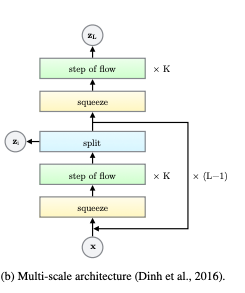
    Of those, only x1 is passed to the remaining part of the flow. x2 on the other hand is "normalized" by a location and scale determined by x1. The transform usually looks like this

    def _forward(self, x):
        x1, x2 = x.chunk(2, -1)
        loc, scale = some_parametric_fun(x1)
        x2 = (x2 - loc) / scale
        log_abs_det_jacobian = scale.reciprocal().log().sum()  # part of the jacobian that accounts for the transform of x2
        log_abs_det_jacobian += self.normal.log_prob(x2).sum()  # since x2 will disappear, we can include its prior log-lik here
        return x1, log_abs_det_jacobian
    

    The _inverse is done like this

    def _inverse(self, y):
        x1 = y
        loc, scale = some_parametric_fun(x1)
        x2 = torch.randn_like(x1)  # since we fit x2 to a gaussian in forward
        log_abs_det_jacobian += self.normal.log_prob(x2).sum()  
        x2 = x2 * scale + loc
        log_abs_det_jacobian = scale.reciprocal().log().sum()  
        return torch.cat([x1, x2], -1), log_abs_det_jacobian
    

    However, I personally find this coding very confusing: First and foremost, it messes up with the logic y = flow(x) -> dist.log_prob(y). What if we don't want a normal? That seems orthogonal to the bijector responsibility to me. Second, it includes in the LADJ a normal log-likelihood, which should come from the prior. Third, it makes the _inverse stochastic, but that should not be the case. Finally, it has an input of -- say -- dimension d and an output of d/2 (and conversely for _inverse).

    For some models (e.g. Glow), when generating data, we don't sample from a Gaussian with unit variance but from a Gaussian with some decreased temperature (e.g. an SD of 0.9 or something). With this logic, we'd have to tell every split layer in a flow to modify the self.normal scale!

    What I would suggest is this: we could use SplitBijector as a wrapper around another bijector. The way that would work is this:

    class SplitBijector(Bijector):
        def __init__(self, bijector):
             ...
             self.bijector = bijector
    
        def _forward(self, x):
            x1, x2 = x.chunk(2, -1)
            loc, scale = some_parametric_fun(x1)
            y2 = (x2 - loc) / scale
            log_abs_det_jacobian = scale.reciprocal().log().sum()  # part of the jacobian that accounts for the transform of x2
            y1 = self.bijector.forward(x1)
            log_abs_det_jacobian += self.bijector.log_abs_det_jacobian(x1, y1)
            y = torch.cat([y1, y2], 0)
            return y, log_abs_det_jacobian
    

    The _inverse would follow. Of course bijector must have the same input and output space! That way, we solve all of our problems: input and output space match, no weird stuff happen with a nested normal log-density, the prior density is only called out of the bijector, and one can tweak it at will without caring about what will happen in the bijector.

    enhancement 
    opened by vmoens 1
Releases(0.8)
  • 0.8(Apr 27, 2022)

    • Fixed a bug in distributions.Flow.parameters() where it returned duplicate parameters
    • Several tutorials converted from .mdx to .ipynb format in anticipation of new tutorial system
    • Removed yarn.lock
    Source code(tar.gz)
    Source code(zip)
  • 0.7(Apr 25, 2022)

    This release add two new minor features.

    A new class flowtorch.bijectors.Invert can be used to swap the forward and inverse operator of a Bijector. This is useful to turn, for example, Inverse Autoregressive Flow (IAF) into Masked Autoregressive Flow (MAF).

    Bijector objects are now nn.Modules, which amongst other benefits allows easily saving and loading of state.

    Source code(tar.gz)
    Source code(zip)
  • 0.6(Mar 3, 2022)

    This small release fixes a bug in bijectors.ops.Spline where the sign of log(det(J)) was inverted for the .inverse method. It also fixes the unit tests so that they pick up this error in the future.

    Source code(tar.gz)
    Source code(zip)
  • 0.5(Feb 3, 2022)

    In this release, we add caching of intermediate values for Bijectors.

    What this means is that you can often reduce computation by calculating log|det(J)| at the same time as y = f(x). It's also useful for performing variational inference on Bijectors that don't have an explicit inverse. The mechanism by which this is achieved is a subclass of torch.Tensor called BijectiveTensor that bundles together (x, y, context, bundle, log_det_J).

    Special shout out to @vmoens for coming up with this neat solution and taking the implementation lead! Looking forward to your future contributions 🥳

    Source code(tar.gz)
    Source code(zip)
  • 0.4(Nov 18, 2021)

    Implementations of Inverse Autoregressive Flow and Neural Spline Flow.

    Basic content for website.

    Some unit tests for bijectors and distributions.

    Source code(tar.gz)
    Source code(zip)
Owner
Meta Incubator
We work hard to contribute our work back to the web, mobile, big data, & infrastructure communities. NB: members must have two-factor auth.
Meta Incubator
Robotic Process Automation in Windows and Linux by using Driagrams.net BPMN diagrams.

BPMN_RPA Robotic Process Automation in Windows and Linux by using BPMN diagrams. With this Framework you can draw Business Process Model Notation base

23 Dec 14, 2022
An automated algorithm to extract the linear blend skinning (LBS) from a set of example poses

Dem Bones This repository contains an implementation of Smooth Skinning Decomposition with Rigid Bones, an automated algorithm to extract the Linear B

Electronic Arts 684 Dec 26, 2022
3D ResNet Video Classification accelerated by TensorRT

Activity Recognition TensorRT Perform video classification using 3D ResNets trained on Kinetics-400 dataset and accelerated with TensorRT P.S Click on

Akash James 39 Nov 21, 2022
Equivariant Imaging: Learning Beyond the Range Space

[Project] Equivariant Imaging: Learning Beyond the Range Space Project about the

Georges Le Bellier 3 Feb 06, 2022
A High-Performance Distributed Library for Large-Scale Bundle Adjustment

MegBA: A High-Performance and Distributed Library for Large-Scale Bundle Adjustment This repo contains an official implementation of MegBA. MegBA is a

旷视研究院 3D 组 336 Dec 27, 2022
Code for Iso-Points: Optimizing Neural Implicit Surfaces with Hybrid Representations

Implementation for Iso-Points (CVPR 2021) Official code for paper Iso-Points: Optimizing Neural Implicit Surfaces with Hybrid Representations paper |

Yifan Wang 66 Nov 08, 2022
An implementation of Deep Graph Infomax (DGI) in PyTorch

DGI Deep Graph Infomax (Veličković et al., ICLR 2019): https://arxiv.org/abs/1809.10341 Overview Here we provide an implementation of Deep Graph Infom

Petar Veličković 491 Jan 03, 2023
End-To-End Memory Network using Tensorflow

MemN2N Implementation of End-To-End Memory Networks with sklearn-like interface using Tensorflow. Tasks are from the bAbl dataset. Get Started git clo

Dominique Luna 339 Oct 27, 2022
This is the code for CVPR 2021 oral paper: Jigsaw Clustering for Unsupervised Visual Representation Learning

JigsawClustering Jigsaw Clustering for Unsupervised Visual Representation Learning Pengguang Chen, Shu Liu, Jiaya Jia Introduction This project provid

DV Lab 73 Sep 18, 2022
Classification of Long Sequential Data using Circular Dilated Convolutional Neural Networks

Classification of Long Sequential Data using Circular Dilated Convolutional Neural Networks arXiv preprint: https://arxiv.org/abs/2201.02143. Architec

19 Nov 30, 2022
Efficient Lottery Ticket Finding: Less Data is More

The lottery ticket hypothesis (LTH) reveals the existence of winning tickets (sparse but critical subnetworks) for dense networks, that can be trained in isolation from random initialization to match

VITA 20 Sep 04, 2022
NER for Indian languages

CL-NERIL: A Cross-Lingual Model for NER in Indian Languages Code for the paper - https://arxiv.org/abs/2111.11815 Setup Setup a virtual environment Th

Akshara P 0 Nov 24, 2021
TilinGNN: Learning to Tile with Self-Supervised Graph Neural Network (SIGGRAPH 2020)

TilinGNN: Learning to Tile with Self-Supervised Graph Neural Network (SIGGRAPH 2020) About The goal of our research problem is illustrated below: give

59 Dec 09, 2022
Implement the Pareto Optimizer and pcgrad to make a self-adaptive loss for multi-task

multi-task_losses_optimizer Implement the Pareto Optimizer and pcgrad to make a self-adaptive loss for multi-task 已经实验过了,不会有cuda out of memory情况 ##Par

14 Dec 25, 2022
SANet: A Slice-Aware Network for Pulmonary Nodule Detection

SANet: A Slice-Aware Network for Pulmonary Nodule Detection This paper (SANet) has been accepted and early accessed in IEEE TPAMI 2021. This code and

Jie Mei 39 Dec 17, 2022
Vehicle speed detection with python

Vehicle-speed-detection In the project simulate the tracker.py first then simulate the SpeedDetector.py. Finally, a new window pops up and the output

3 Dec 15, 2022
A BaSiC Tool for Background and Shading Correction of Optical Microscopy Images

BaSiC Matlab code accompanying A BaSiC Tool for Background and Shading Correction of Optical Microscopy Images by Tingying Peng, Kurt Thorn, Timm Schr

Marr Lab 34 Dec 18, 2022
The Unreasonable Effectiveness of Random Pruning: Return of the Most Naive Baseline for Sparse Training

[ICLR 2022] The Unreasonable Effectiveness of Random Pruning: Return of the Most Naive Baseline for Sparse Training The Unreasonable Effectiveness of

VITA 44 Dec 23, 2022
Paaster is a secure by default end-to-end encrypted pastebin built with the objective of simplicity.

Follow the development of our desktop client here Paaster Paaster is a secure by default end-to-end encrypted pastebin built with the objective of sim

Ward 211 Dec 25, 2022
CCCL: Contrastive Cascade Graph Learning.

CCGL: Contrastive Cascade Graph Learning This repo provides a reference implementation of Contrastive Cascade Graph Learning (CCGL) framework as descr

Xovee Xu 19 Dec 05, 2022