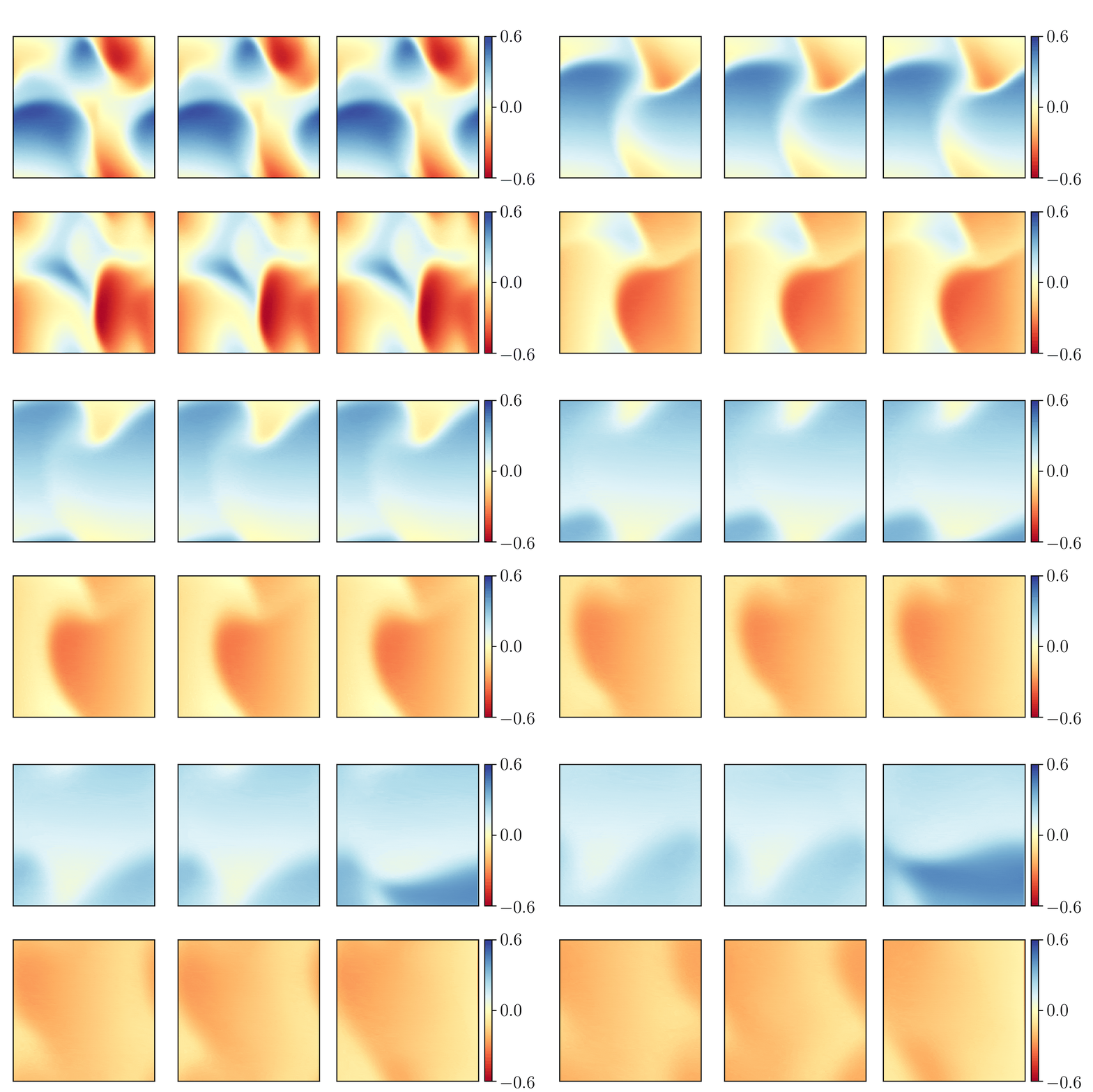
PyTorch code for Composing Partial Differential Equations with Physics-Aware Neural Networks

Related tags

Deep Learningfinn
Overview

FInite volume Neural Network (FINN)

This repository contains the PyTorch code for models, training, and testing, and Python code for data generation to conduct the experiments as reported in the work Composing Partial Differential Equations with Physics-Aware Neural Networks

If you find this repository helpful, please cite our work:

@article{karlbauer2021composing,
	author    = {Karlbauer, Matthias and Praditia, Timothy and Otte, Sebastian and Oladyshkin, Sergey and Nowak, Wolfgang and Butz, Martin V},
	title     = {Composing Partial Differential Equations with Physics-Aware Neural Networks},
	journal   = {arXiv preprint arXiv:2111.11798},
	year      = {2021},
}

Dependencies

We recommend setting up an (e.g. conda) environment with python 3.7 (i.e. conda create -n finn python=3.7). The required packages for data generation and model evaluation are

  • conda install -c anaconda numpy scipy
  • conda install -c pytorch pytorch==1.9.0
  • conda install -c jmcmurray json
  • conda install -c conda-forge matplotlib torchdiffeq jsmin

Models & Experiments

The code of the different pure machine learning models (TCN, ConvLSTM, DISTANA) and physics-aware models (PINN, PhyDNet, FINN) can be found in the models directory.

Each model directory contains a config.json file to specify model parameters, data, etc. Please modify the sections in the respective config.json files as detailed below (further information about data and model architectures is reported in the according data sections of the paper's appendices):

"training": {
	"t_stop": 150  // burger and allen-cahn 150, diff-sorp 400, diff-react 70
},

"validation": {
	"t_start": 150,  // burger and allen-cahn 150, diff-sorp 400, diff-react 70
	"t_stop": 200  // burger and allen-cahn 200, diff-sorp 500, diff-react 100
},

"data": {
	"type": "burger",  // "burger", "diffusion_sorption", "diffusion_reaction", "allen_cahn"
	"name": "data_ext",  // "data_train", "data_ext", "data_test"
}

"model": {
  	"name": "burger"  // "burger", "diff-sorp", "diff-react", "allen-cahn"
	"field_size": [49],  // burger and allen-cahn [49], diff-sorp [26], fhn [49, 49]
	... other settings to be specified according to the model architectures section in the paper's appendix
}

The actual models can be trained and tested by calling the according python train.py or python test.py scripts. Alternatively, python experiment.py can be used to either train or test n models (please consider the settings in the experiment.py script).

Data generation

The Python scripts to generate the burger, diffusion-sorption, diffusion-reaction, and allen-cahn data can be found in the data directory.

In each of the burger, diffusion_sorption, diffusion_reaction, and allen-cahn directories, a data_generation.py and simulator.py script can be found. The former is used to generate train, extrapolation (ext), or test data. For details about the according data generation settings of each dataset, please refer to the corresponding data sections in the paper's appendices.

You might also like...
Official implementation for the paper:
Official implementation for the paper: "Multi-label Classification with Partial Annotations using Class-aware Selective Loss"

Multi-label Classification with Partial Annotations using Class-aware Selective Loss Paper | Pretrained models Official PyTorch Implementation Emanuel

Must-read Papers on Physics-Informed Neural Networks.

PINNpapers Contributed by IDRL lab. Introduction Physics-Informed Neural Network (PINN) has achieved great success in scientific computing since 2017.

Physics-informed convolutional-recurrent neural networks for solving spatiotemporal PDEs

PhyCRNet Physics-informed convolutional-recurrent neural networks for solving spatiotemporal PDEs Paper link: [ArXiv] By: Pu Ren, Chengping Rao, Yang

 Physics-Aware Training (PAT) is a method to train real physical systems with backpropagation.
Physics-Aware Training (PAT) is a method to train real physical systems with backpropagation.

Physics-Aware Training (PAT) is a method to train real physical systems with backpropagation. It was introduced in Wright, Logan G. & Onodera, Tatsuhiro et al. (2021)1 to train Physical Neural Networks (PNNs) - neural networks whose building blocks are physical systems.

Pytorch Implementation of Interaction Networks for Learning about Objects, Relations and Physics

Interaction-Network-Pytorch Pytorch Implementraion of Interaction Networks for Learning about Objects, Relations and Physics. Interaction Network is a

IDRLnet, a Python toolbox for modeling and solving problems through Physics-Informed Neural Network (PINN) systematically.

IDRLnet IDRLnet is a machine learning library on top of PyTorch. Use IDRLnet if you need a machine learning library that solves both forward and inver

PINN(s): Physics-Informed Neural Network(s) for von Karman vortex street

PINN(s): Physics-Informed Neural Network(s) for von Karman vortex street This is

Implementation of "Scaled-YOLOv4: Scaling Cross Stage Partial Network" using PyTorch framwork.

YOLOv4-large This is the implementation of "Scaled-YOLOv4: Scaling Cross Stage Partial Network" using PyTorch framwork. YOLOv4-CSP YOLOv4-tiny YOLOv4-

Unofficial pytorch implementation of 'Image Inpainting for Irregular Holes Using Partial Convolutions'

pytorch-inpainting-with-partial-conv Official implementation is released by the authors. Note that this is an ongoing re-implementation and I cannot f

Releases(v1.0.0)
  • v1.0.0(Oct 28, 2022)

    This release contains the PyTorch code for models, training, and testing, and Python code for data generation to conduct the experiments.

    Source code(tar.gz)
    Source code(zip)
Owner
Cognitive Modeling
The chair of Cognitive Modeling addresses the question: "How does the mind work?", pursuing an integrative, interdisciplinary, computational approach.
Cognitive Modeling
PClean: A Domain-Specific Probabilistic Programming Language for Bayesian Data Cleaning

PClean: A Domain-Specific Probabilistic Programming Language for Bayesian Data Cleaning Warning: This is a rapidly evolving research prototype.

MIT Probabilistic Computing Project 190 Dec 27, 2022
Tutorial page of the Climate Hack, the greatest hackathon ever

Tutorial page of the Climate Hack, the greatest hackathon ever

UCL Artificial Intelligence Society 12 Jul 02, 2022
Mini-hmc-jax - A simple implementation of Hamiltonian Monte Carlo in JAX

mini-hmc-jax This is a simple implementation of Hamiltonian Monte Carlo in JAX t

Martin Marek 6 Mar 03, 2022
Implementation of Perceiver, General Perception with Iterative Attention in TensorFlow

Perceiver This Python package implements Perceiver: General Perception with Iterative Attention by Andrew Jaegle in TensorFlow. This model builds on t

Rishit Dagli 84 Oct 15, 2022
i-SpaSP: Structured Neural Pruning via Sparse Signal Recovery

i-SpaSP: Structured Neural Pruning via Sparse Signal Recovery This is a public code repository for the publication: i-SpaSP: Structured Neural Pruning

Cameron Ronald Wolfe 5 Nov 04, 2022
Image super-resolution (SR) is a fast-moving field with novel architectures attracting the spotlight

Revisiting RCAN: Improved Training for Image Super-Resolution Introduction Image super-resolution (SR) is a fast-moving field with novel architectures

Zudi Lin 76 Dec 01, 2022
A NSFW content filter.

Project_Nfilter A NSFW content filter. With a motive of minimizing the spreads and leakage of NSFW contents on internet and access to others devices ,

1 Jan 20, 2022
DyStyle: Dynamic Neural Network for Multi-Attribute-Conditioned Style Editing

DyStyle: Dynamic Neural Network for Multi-Attribute-Conditioned Style Editing Figure: Joint multi-attribute edits using DyStyle model. Great diversity

74 Dec 03, 2022
automated systems to assist guarding corona Virus precautions for Closed Rooms (e.g. Halls, offices, etc..)

Automatic-precautionary-guard automated systems to assist guarding corona Virus precautions for Closed Rooms (e.g. Halls, offices, etc..) what is this

badra 0 Jan 06, 2022
Doubly Robust Off-Policy Evaluation for Ranking Policies under the Cascade Behavior Model

Doubly Robust Off-Policy Evaluation for Ranking Policies under the Cascade Behavior Model About This repository contains the code to replicate the syn

Haruka Kiyohara 12 Dec 07, 2022
Data Augmentation Using Keras and Python

Data-Augmentation-Using-Keras-and-Python Data augmentation is the process of increasing the number of training dataset. Keras library offers a simple

Happy N. Monday 3 Feb 15, 2022
Code for paper "Document-Level Argument Extraction by Conditional Generation". NAACL 21'

Argument Extraction by Generation Code for paper "Document-Level Argument Extraction by Conditional Generation". NAACL 21' Dependencies pytorch=1.6 tr

Zoey Li 87 Dec 26, 2022
Offline Multi-Agent Reinforcement Learning Implementations: Solving Overcooked Game with Data-Driven Method

Overcooked-AI We suppose to apply traditional offline reinforcement learning technique to multi-agent algorithm. In this repository, we implemented be

Baek In-Chang 14 Sep 16, 2022
Notebook and code to synthesize complex and highly dimensional datasets using Gretel APIs.

Gretel Trainer This code is designed to help users successfully train synthetic models on complex datasets with high row and column counts. The code w

Gretel.ai 24 Nov 03, 2022
[CVPR'20] TTSR: Learning Texture Transformer Network for Image Super-Resolution

TTSR Official PyTorch implementation of the paper Learning Texture Transformer Network for Image Super-Resolution accepted in CVPR 2020. Contents Intr

Multimedia Research 689 Dec 28, 2022
A TensorFlow Implementation of "Deep Multi-Scale Video Prediction Beyond Mean Square Error" by Mathieu, Couprie & LeCun.

Adversarial Video Generation This project implements a generative adversarial network to predict future frames of video, as detailed in "Deep Multi-Sc

Matt Cooper 704 Nov 26, 2022
Pytorch implementation of U-Net, R2U-Net, Attention U-Net, and Attention R2U-Net.

pytorch Implementation of U-Net, R2U-Net, Attention U-Net, Attention R2U-Net U-Net: Convolutional Networks for Biomedical Image Segmentation https://a

leejunhyun 2k Jan 02, 2023
DynamicViT: Efficient Vision Transformers with Dynamic Token Sparsification

DynamicViT: Efficient Vision Transformers with Dynamic Token Sparsification Created by Yongming Rao, Wenliang Zhao, Benlin Liu, Jiwen Lu, Jie Zhou, Ch

Yongming Rao 414 Jan 01, 2023
Revisiting Global Statistics Aggregation for Improving Image Restoration

Revisiting Global Statistics Aggregation for Improving Image Restoration Xiaojie Chu, Liangyu Chen, Chengpeng Chen, Xin Lu Paper: https://arxiv.org/pd

MEGVII Research 128 Dec 24, 2022
Label-Free Model Evaluation with Semi-Structured Dataset Representations

Label-Free Model Evaluation with Semi-Structured Dataset Representations Prerequisites This code uses the following libraries Python 3.7 NumPy PyTorch

8 Oct 06, 2022