GLNet for Memory-Efficient Segmentation of Ultra-High Resolution Images

Overview

GLNet for Memory-Efficient Segmentation of Ultra-High Resolution Images

Language grade: Python License: MIT

Collaborative Global-Local Networks for Memory-Efficient Segmentation of Ultra-High Resolution Images

Wuyang Chen*, Ziyu Jiang*, Zhangyang Wang, Kexin Cui, and Xiaoning Qian

In CVPR 2019 (Oral). [Youtube]

Overview

Segmentation of ultra-high resolution images is increasingly demanded in a wide range of applications (e.g. urban planning), yet poses significant challenges for algorithm efficiency, in particular considering the (GPU) memory limits.

We propose collaborative Global-Local Networks (GLNet) to effectively preserve both global and local information in a highly memory-efficient manner.

  • Memory-efficient: training w. only one 1080Ti and inference w. less than 2GB GPU memory, for ultra-high resolution images of up to 30M pixels.

  • High-quality: GLNet outperforms existing segmentation models on ultra-high resolution images.
Acc_vs_Mem
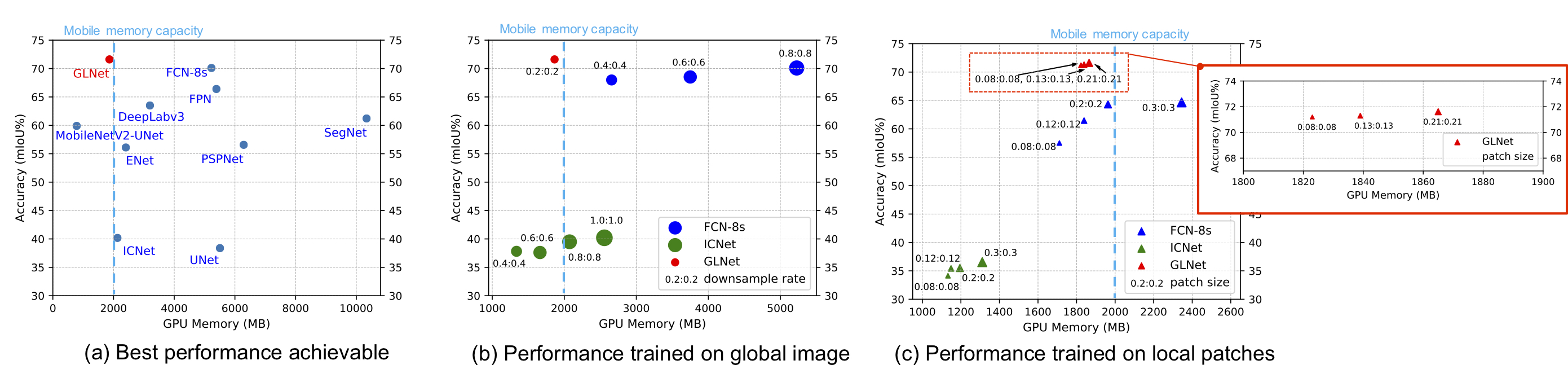
Inference memory v.s. mIoU on the DeepGlobe dataset.
GLNet (red dots) integrates both global and local information in a compact way, contributing to a well-balanced trade-off between accuracy and memory usage.
Examples
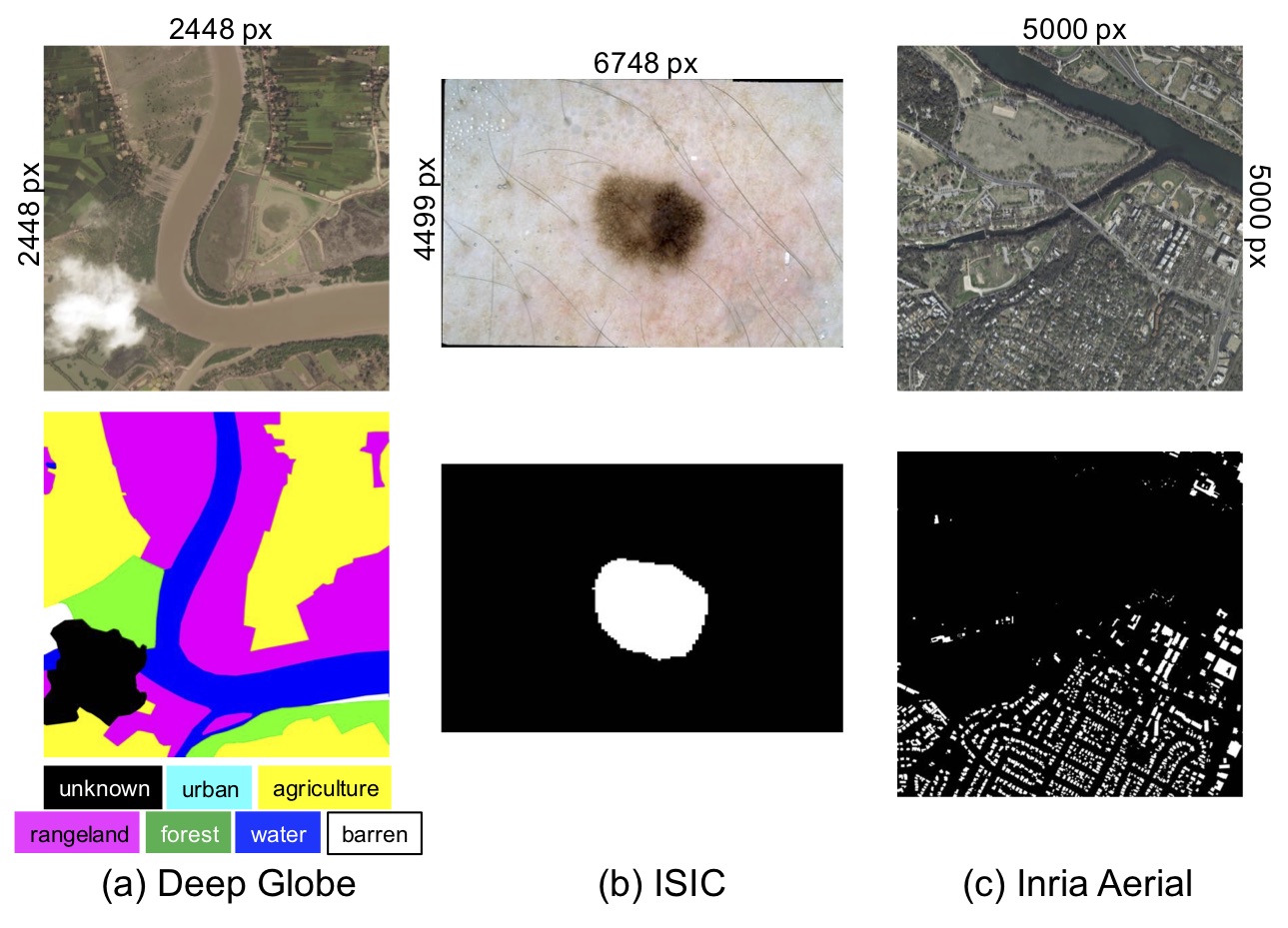
Ultra-high resolution Datasets: DeepGlobe, ISIC, Inria Aerial

Methods
GLNet
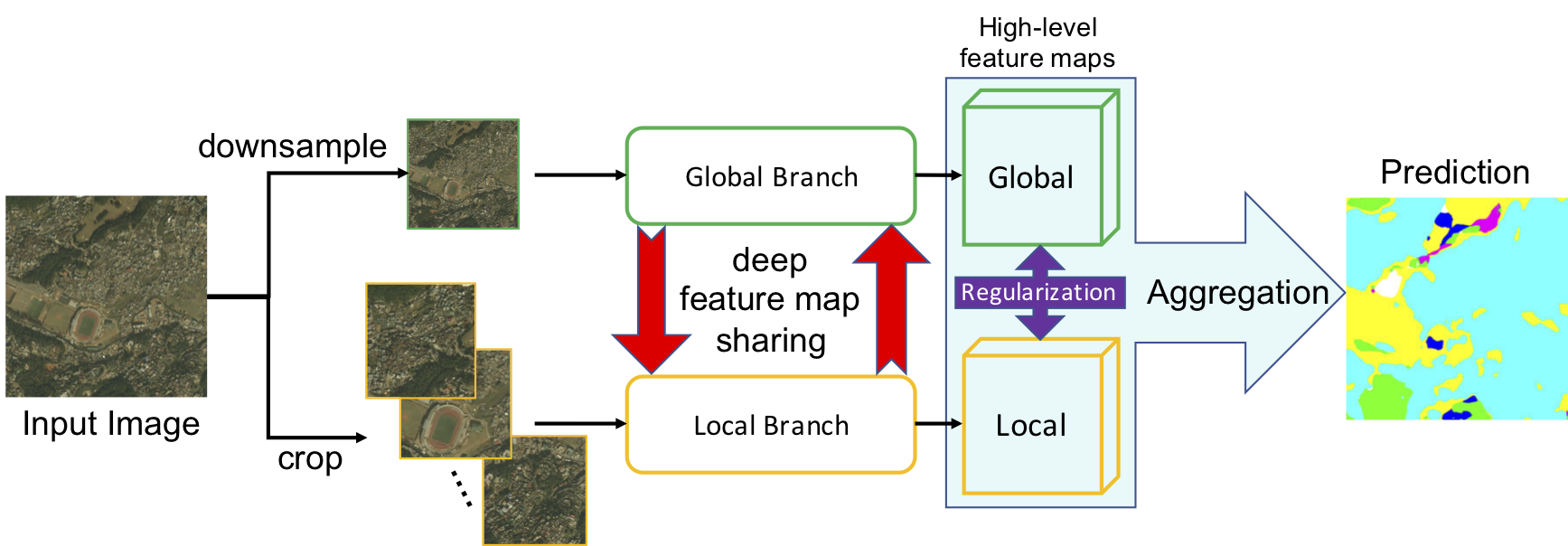
GLNet: the global and local branch takes downsampled and cropped images, respectively. Deep feature map sharing and feature map regularization enforce our global-local collaboration. The final segmentation is generated by aggregating high-level feature maps from two branches.
GLNet
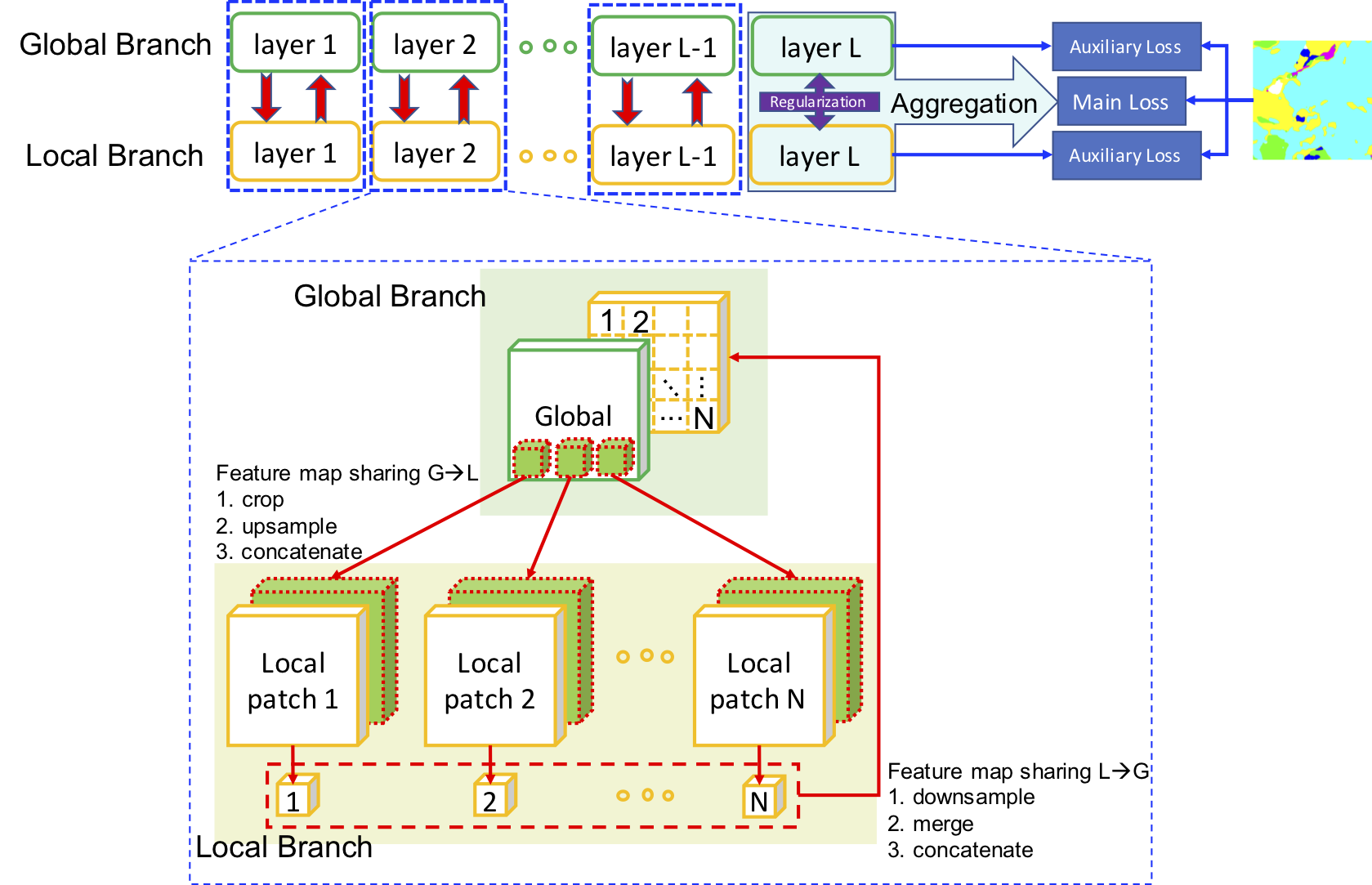
Deep feature map sharing: at each layer, feature maps with global context and ones with local fine structures are bidirectionally brought together, contributing to a complete patch-based deep global-local collaboration.

Training

Current this code base works for Python version >= 3.5.

Please install the dependencies: pip install -r requirements.txt

First, you could register and download the Deep Globe "Land Cover Classification" dataset here: https://competitions.codalab.org/competitions/18468

Then please sequentially finish the following steps:

  1. ./train_deep_globe_global.sh
  2. ./train_deep_globe_global2local.sh
  3. ./train_deep_globe_local2global.sh

The above jobs complete the following tasks:

  • create folder "saved_models" and "runs" to store the model checkpoints and logging files (you could configure the bash scrips to use your own paths).
  • step 1 and 2 prepare the trained models for step 2 and 3, respectively. You could use your own names to save the model checkpoints, but this requires to update values of the flag path_g and path_g2l.

Evaluation

  1. Please download the pre-trained models for the Deep Globe dataset and put them into folder "saved_models":
  1. Download (see above "Training" section) and prepare the Deep Globe dataset according to the train.txt and crossvali.txt: put the image and label files into folder "train" and folder "crossvali"
  2. Run script ./eval_deep_globe.sh

Citation

If you use this code for your research, please cite our paper.

@inproceedings{chen2019GLNET,
  title={Collaborative Global-Local Networks for Memory-Efficient Segmentation of Ultra-High Resolution Images},
  author={Chen, Wuyang and Jiang, Ziyu and Wang, Zhangyang and Cui, Kexin and Qian, Xiaoning},
  booktitle={Proceedings of the IEEE Conference on Computer Vision and Pattern Recognition},
  year={2019}
}

Acknowledgement

We thank Prof. Andrew Jiang and Junru Wu for helping experiments.

Owner
VITA
Visual Informatics Group @ University of Texas at Austin
VITA
Code Release for Learning to Adapt to Evolving Domains

EAML Code release for "Learning to Adapt to Evolving Domains" (NeurIPS 2020) Prerequisites PyTorch = 0.4.0 (with suitable CUDA and CuDNN version) tor

23 Dec 07, 2022
This repository contains the implementations related to the experiments of a set of publicly available datasets that are used in the time series forecasting research space.

TSForecasting This repository contains the implementations related to the experiments of a set of publicly available datasets that are used in the tim

Rakshitha Godahewa 80 Dec 30, 2022
CVPR 2021 Challenge on Super-Resolution Space

Learning the Super-Resolution Space Challenge NTIRE 2021 at CVPR Learning the Super-Resolution Space challenge is held as a part of the 6th edition of

andreas 104 Oct 26, 2022
(3DV 2021 Oral) Filtering by Cluster Consistency for Large-Scale Multi-Image Matching

Scalable Cluster-Consistency Statistics for Robust Multi-Object Matching (3DV 2021 Oral Presentation) Filtering by Cluster Consistency (FCC) is a very

Yunpeng Shi 11 Sep 28, 2022
This repository contains a re-implementation of the code for the CVPR 2021 paper "Omnimatte: Associating Objects and Their Effects in Video."

Omnimatte in PyTorch This repository contains a re-implementation of the code for the CVPR 2021 paper "Omnimatte: Associating Objects and Their Effect

Erika Lu 728 Dec 28, 2022
CoReNet is a technique for joint multi-object 3D reconstruction from a single RGB image.

CoReNet CoReNet is a technique for joint multi-object 3D reconstruction from a single RGB image. It produces coherent reconstructions, where all objec

Google Research 80 Dec 25, 2022
Spherical Confidence Learning for Face Recognition, accepted to CVPR2021.

Sphere Confidence Face (SCF) This repository contains the PyTorch implementation of Sphere Confidence Face (SCF) proposed in the CVPR2021 paper: Shen

Maths 70 Dec 09, 2022
Large-Scale Pre-training for Person Re-identification with Noisy Labels (LUPerson-NL)

LUPerson-NL Large-Scale Pre-training for Person Re-identification with Noisy Labels (LUPerson-NL) The repository is for our CVPR2022 paper Large-Scale

43 Dec 26, 2022
SGPT: Multi-billion parameter models for semantic search

SGPT: Multi-billion parameter models for semantic search This repository contains code, results and pre-trained models for the paper SGPT: Multi-billi

Niklas Muennighoff 182 Dec 29, 2022
discovering subdomains, hidden paths, extracting unique links

python-website-crawler discovering subdomains, hidden paths, extracting unique links pip install -r requirements.txt discover subdomain: You can give

merve 4 Sep 05, 2022
[NeurIPS'21] Projected GANs Converge Faster

[Project] [PDF] [Supplementary] [Talk] This repository contains the code for our NeurIPS 2021 paper "Projected GANs Converge Faster" by Axel Sauer, Ka

798 Jan 04, 2023
ICON: Implicit Clothed humans Obtained from Normals (CVPR 2022)

ICON: Implicit Clothed humans Obtained from Normals Yuliang Xiu · Jinlong Yang · Dimitrios Tzionas · Michael J. Black CVPR 2022 News 🚩 [2022/04/26] H

Yuliang Xiu 1.1k Jan 04, 2023
A Lightweight Experiment & Resource Monitoring Tool 📺

Lightweight Experiment & Resource Monitoring 📺 "Did I already run this experiment before? How many resources are currently available on my cluster?"

170 Dec 28, 2022
🐦 Opytimizer is a Python library consisting of meta-heuristic optimization techniques.

Opytimizer: A Nature-Inspired Python Optimizer Welcome to Opytimizer. Did you ever reach a bottleneck in your computational experiments? Are you tired

Gustavo Rosa 546 Dec 31, 2022
DeepDiffusion: Unsupervised Learning of Retrieval-adapted Representations via Diffusion-based Ranking on Latent Feature Manifold

DeepDiffusion Introduction This repository provides the code of the DeepDiffusion algorithm for unsupervised learning of retrieval-adapted representat

4 Nov 15, 2022
An Abstract Cyber Security Simulation and Markov Game for OpenAI Gym

gym-idsgame An Abstract Cyber Security Simulation and Markov Game for OpenAI Gym gym-idsgame is a reinforcement learning environment for simulating at

Kim Hammar 29 Dec 03, 2022
A python program to hack instagram

hackinsta a program to hack instagram Yokoback_(instahack) is the file to open, you need libraries write on import. You run that file in the same fold

2 Jan 22, 2022
A Python framework for developing parallelized Computational Fluid Dynamics software to solve the hyperbolic 2D Euler equations on distributed, multi-block structured grids.

pyHype: Computational Fluid Dynamics in Python pyHype is a Python framework for developing parallelized Computational Fluid Dynamics software to solve

Mohamed Khalil 21 Nov 22, 2022
Implementation of average- and worst-case robust flatness measures for adversarial training.

Relating Adversarially Robust Generalization to Flat Minima This repository contains code corresponding to the MLSys'21 paper: D. Stutz, M. Hein, B. S

David Stutz 13 Nov 27, 2022
A basic reminder tool written in Python.

A simple Python Reminder Here's a basic reminder tool written in Python that speaks to the user and sends a notification. Run pip3 install pyttsx3 w

Sachit Yadav 4 Feb 05, 2022