A Tensorfflow implementation of Attend, Infer, Repeat

Overview

Attend, Infer, Repeat: Fast Scene Understanding with Generative Models

This is an unofficial Tensorflow implementation of Attend, Infear, Repeat (AIR), as presented in the following paper: S. M. Ali Eslami et. al., Attend, Infer, Repeat: Fast Scene Understanding with Generative Models.

  • Author (of the implementation): Adam Kosiorek, Oxford Robotics Institue, University of Oxford
  • Email: adamk(at)robots.ox.ac.uk
  • Webpage: http://akosiorek.github.io/

I describe the implementation and the issues I run into while working on it in this blog post.

Installation

Install Tensorflow v1.1.0rc1, Sonnet v1.1 and the following dependencies (using pip install -r requirements.txt (preferred) or pip install [package]):

  • matplotlib==1.5.3
  • numpy==1.12.1
  • attrdict==2.0.0
  • scipy==0.18.1

Sample Results

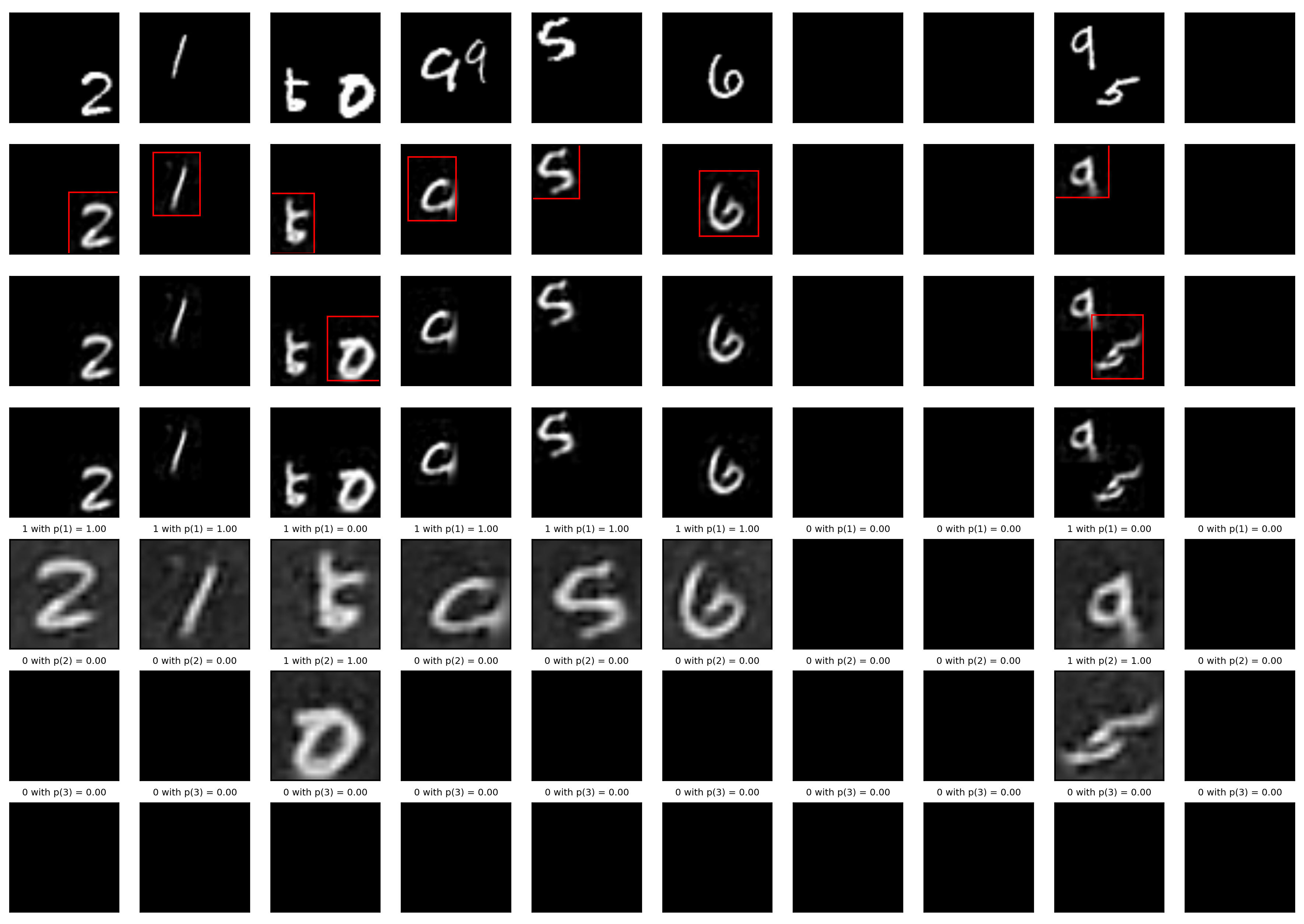
AIR learns to reconstruct objects by painting them one by one in a blank canvas. The below figure comes from a model trained for 175k iterations; the maximum number of steps is set to 3, but there are never more than 2 objects. The first row shows the input images, rows 2-4 are reconstructions at steps 1, 2 and 3 (with marked location of the attention glimpse in red, if it exists). Rows 4-7 are the reconstructed image crops, and above each crop is the probability of executing 1, 2 or 3 steps. If the reconstructed crop is black and there is "0 with ..." written above it, it means that this step was not used.
AIR results

Data

Run ./scripts/create_dataset.sh The script creates train and validation datasets of multi-digit MNIST.

Training

Run ./scripts/train_multi_mnist.sh The training script will run for 300k iteratios and will save model checkpoints and training progress figures every 10k iterations in results/multi_mnist. Tensorflow summaries are also stored in the same folder and Tensorboard can be used for monitoring.

The model seems to be very sensitive to initialisation. It might be necessary to run training multiple times before achieving count step accuracy close to the one reported in the paper.

Experimentation

The jupyter notebook available at attend_infer_repeat/experiment.ipynb can be used for experimentation.

Citation

If you find this repo useful in your research, please consider citing the original paper:

@incollection{Eslami2016,
    title = {Attend, Infer, Repeat: Fast Scene Understanding with Generative Models},
    author = {Eslami, S. M. Ali and Heess, Nicolas and Weber, Theophane and Tassa, Yuval and Szepesvari, David and kavukcuoglu, koray and Hinton, Geoffrey E},
    booktitle = {Advances in Neural Information Processing Systems 29},
    editor = {D. D. Lee and M. Sugiyama and U. V. Luxburg and I. Guyon and R. Garnett},
    pages = {3225--3233},
    year = {2016},
    publisher = {Curran Associates, Inc.},
    url = {http://papers.nips.cc/paper/6230-attend-infer-repeat-fast-scene-understanding-with-generative-models.pdf}
}

License

This program is free software; you can redistribute it and/or modify it under the terms of the GNU General Public License as published by the Free Software Foundation; either version 3 of the License, or (at your option) any later version.

This program is distributed in the hope that it will be useful, but WITHOUT ANY WARRANTY; without even the implied warranty of MERCHANTABILITY or FITNESS FOR A PARTICULAR PURPOSE. See the GNU General Public License for more details.

You should have received a copy of the GNU General Public License along with this program. If not, see http://www.gnu.org/licenses/.

Release Notes

Version 1.0

  • Original unofficial implementation; contains the multi-digit MNIST experiment.
Owner
Adam Kosiorek
I'm a PhD student at the Oxford Robotics Institute. I work on Machine Learning for perception - I'm looking into external memory and attention for RNNs.
Adam Kosiorek
Pytorch Implementation of LNSNet for Superpixel Segmentation

LNSNet Overview Official implementation of Learning the Superpixel in a Non-iterative and Lifelong Manner (CVPR'21) Learning Strategy The proposed LNS

42 Oct 11, 2022
Official implementation of "GS-WGAN: A Gradient-Sanitized Approach for Learning Differentially Private Generators" (NeurIPS 2020)

GS-WGAN This repository contains the implementation for GS-WGAN: A Gradient-Sanitized Approach for Learning Differentially Private Generators (NeurIPS

46 Nov 09, 2022
CBREN: Convolutional Neural Networks for Constant Bit Rate Video Quality Enhancement

CBREN This is the Pytorch implementation for our IEEE TCSVT paper : CBREN: Convolutional Neural Networks for Constant Bit Rate Video Quality Enhanceme

Zhao Hengrun 3 Nov 04, 2022
A flexible framework of neural networks for deep learning

Chainer: A deep learning framework Website | Docs | Install Guide | Tutorials (ja) | Examples (Official, External) | Concepts | ChainerX Forum (en, ja

Chainer 5.8k Jan 06, 2023
Code base of object detection

rmdet code base of object detection. 环境安装: 1. 安装conda python环境 - `conda create -n xxx python=3.7/3.8` - `conda activate xxx` 2. 运行脚本,自动安装pytorch1

3 Mar 08, 2022
Continuous Diffusion Graph Neural Network

We present Graph Neural Diffusion (GRAND) that approaches deep learning on graphs as a continuous diffusion process and treats Graph Neural Networks (GNNs) as discretisations of an underlying PDE.

Twitter Research 227 Jan 05, 2023
Official pytorch implementation of the IrwGAN for unaligned image-to-image translation

IrwGAN (ICCV2021) Unaligned Image-to-Image Translation by Learning to Reweight [Update] 12/15/2021 All dataset are released, trained models and genera

37 Nov 09, 2022
Provide baselines and evaluation metrics of the task: traffic flow prediction

Note: This repo is adpoted from https://github.com/UNIMIBInside/Smart-Mobility-Prediction. Due to technical reasons, I did not fork their code. Introd

Zhangzhi Peng 11 Nov 02, 2022
A Python module for parallel optimization of expensive black-box functions

blackbox: A Python module for parallel optimization of expensive black-box functions What is this? A minimalistic and easy-to-use Python module that e

Paul Knysh 426 Dec 08, 2022
Auto-Encoding Score Distribution Regression for Action Quality Assessment

DAE-AQA It is an open source program reference to paper Auto-Encoding Score Distribution Regression for Action Quality Assessment. 1.Introduction DAE

13 Nov 16, 2022
PyZebrascope - an open-source Python platform for brain-wide neural activity imaging in behaving zebrafish

PyZebrascope - an open-source Python platform for brain-wide neural activity imaging in behaving zebrafish

1 May 31, 2022
Hands-On Machine Learning for Algorithmic Trading, published by Packt

Hands-On Machine Learning for Algorithmic Trading Hands-On Machine Learning for Algorithmic Trading, published by Packt This is the code repository fo

Packt 981 Dec 29, 2022
Code for the paper "Generative design of breakwaters usign deep convolutional neural network as a surrogate model"

Generative design of breakwaters usign deep convolutional neural network as a surrogate model This repository contains the code for the paper "Generat

2 Apr 10, 2022
Official implementation of ETH-XGaze dataset baseline

ETH-XGaze baseline Official implementation of ETH-XGaze dataset baseline. ETH-XGaze dataset ETH-XGaze dataset is a gaze estimation dataset consisting

Xucong Zhang 134 Jan 03, 2023
A PyTorch implementation of "TokenLearner: What Can 8 Learned Tokens Do for Images and Videos?"

TokenLearner: What Can 8 Learned Tokens Do for Images and Videos? Source: Improving Vision Transformer Efficiency and Accuracy by Learning to Tokenize

Caiyong Wang 14 Sep 20, 2022
The 1st Place Solution of the Facebook AI Image Similarity Challenge (ISC21) : Descriptor Track.

ISC21-Descriptor-Track-1st The 1st Place Solution of the Facebook AI Image Similarity Challenge (ISC21) : Descriptor Track. You can check our solution

lyakaap 75 Jan 08, 2023
A python program to hack instagram

hackinsta a program to hack instagram Yokoback_(instahack) is the file to open, you need libraries write on import. You run that file in the same fold

2 Jan 22, 2022
SubOmiEmbed: Self-supervised Representation Learning of Multi-omics Data for Cancer Type Classification

SubOmiEmbed: Self-supervised Representation Learning of Multi-omics Data for Cancer Type Classification

Sayed Hashim 3 Nov 15, 2022
Automatic Data-Regularized Actor-Critic (Auto-DrAC)

Auto-DrAC: Automatic Data-Regularized Actor-Critic This is a PyTorch implementation of the methods proposed in Automatic Data Augmentation for General

89 Dec 13, 2022
A higher performance pytorch implementation of DeepLab V3 Plus(DeepLab v3+)

A Higher Performance Pytorch Implementation of DeepLab V3 Plus Introduction This repo is an (re-)implementation of Encoder-Decoder with Atrous Separab

linhua 326 Nov 22, 2022