Accelerated NLP pipelines for fast inference on CPU and GPU. Built with Transformers, Optimum and ONNX Runtime.

Overview

Optimum Transformers


Tests License PyPI

Accelerated NLP pipelines for fast inference 🚀 on CPU and GPU. Built with 🤗 Transformers, Optimum and ONNX runtime.

Installation:

With PyPI:

pip install optimum-transformers

Or directly from GitHub:

pip install git+https://github.com/AlekseyKorshuk/optimum-transformers

Usage:

The pipeline API is similar to transformers pipeline with just a few differences which are explained below.

Just provide the path/url to the model, and it'll download the model if needed from the hub and automatically create onnx graph and run inference.

from optimum_transformers import pipeline

# Initialize a pipeline by passing the task name and 
# set onnx to True (default value is also True)
nlp = pipeline("sentiment-analysis", use_onnx=True)
nlp("Transformers and onnx runtime is an awesome combo!")
# [{'label': 'POSITIVE', 'score': 0.999721109867096}]  

Or provide a different model using the model argument.

from optimum_transformers import pipeline

nlp = pipeline("question-answering", model="deepset/roberta-base-squad2", use_onnx=True)
nlp(question="What is ONNX Runtime ?",
         context="ONNX Runtime is a highly performant single inference engine for multiple platforms and hardware")
# {'answer': 'highly performant single inference engine for multiple platforms and hardware', 'end': 94,
# 'score': 0.751201868057251, 'start': 18}
from optimum_transformers import pipeline

nlp = pipeline("ner", model="mys/electra-base-turkish-cased-ner", use_onnx=True, optimize=True,
                    grouped_entities=True)
nlp("adana kebap ülkemizin önemli lezzetlerinden biridir.")
# [{'entity_group': 'B-food', 'score': 0.869149774312973, 'word': 'adana kebap'}]

Set use_onnx to False for standard torch inference. Set optimize to True for quantize with ONNX. ( set use_onnx to True)

Supported pipelines

You can create Pipeline objects for the following down-stream tasks:

  • feature-extraction: Generates a tensor representation for the input sequence
  • ner and token-classification: Generates named entity mapping for each word in the input sequence.
  • sentiment-analysis: Gives the polarity (positive / negative) of the whole input sequence. Can be used for any text classification model.
  • question-answering: Provided some context and a question referring to the context, it will extract the answer to the question in the context.
  • text-classification: Classifies sequences according to a given number of classes from training.
  • zero-shot-classification: Classifies sequences according to a given number of classes directly in runtime.
  • fill-mask: The task of masking tokens in a sequence with a masking token, and prompting the model to fill that mask with an appropriate token.
  • text-generation: The task of generating text according to the previous text provided.

Calling the pipeline for the first time loads the model, creates the onnx graph, and caches it for future use. Due to this, the first load will take some time. Subsequent calls to the same model will load the onnx graph automatically from the cache.

Benchmarks

Note: For some reason, onnx is slow on colab notebook, so you won't notice any speed-up there. Benchmark it on your own hardware.

Check our example of benchmarking: example.

For detailed benchmarks and other information refer to this blog post and notebook.

Note: These results were collected on my local machine. So if you have high performance machine to benchmark, please contact me.

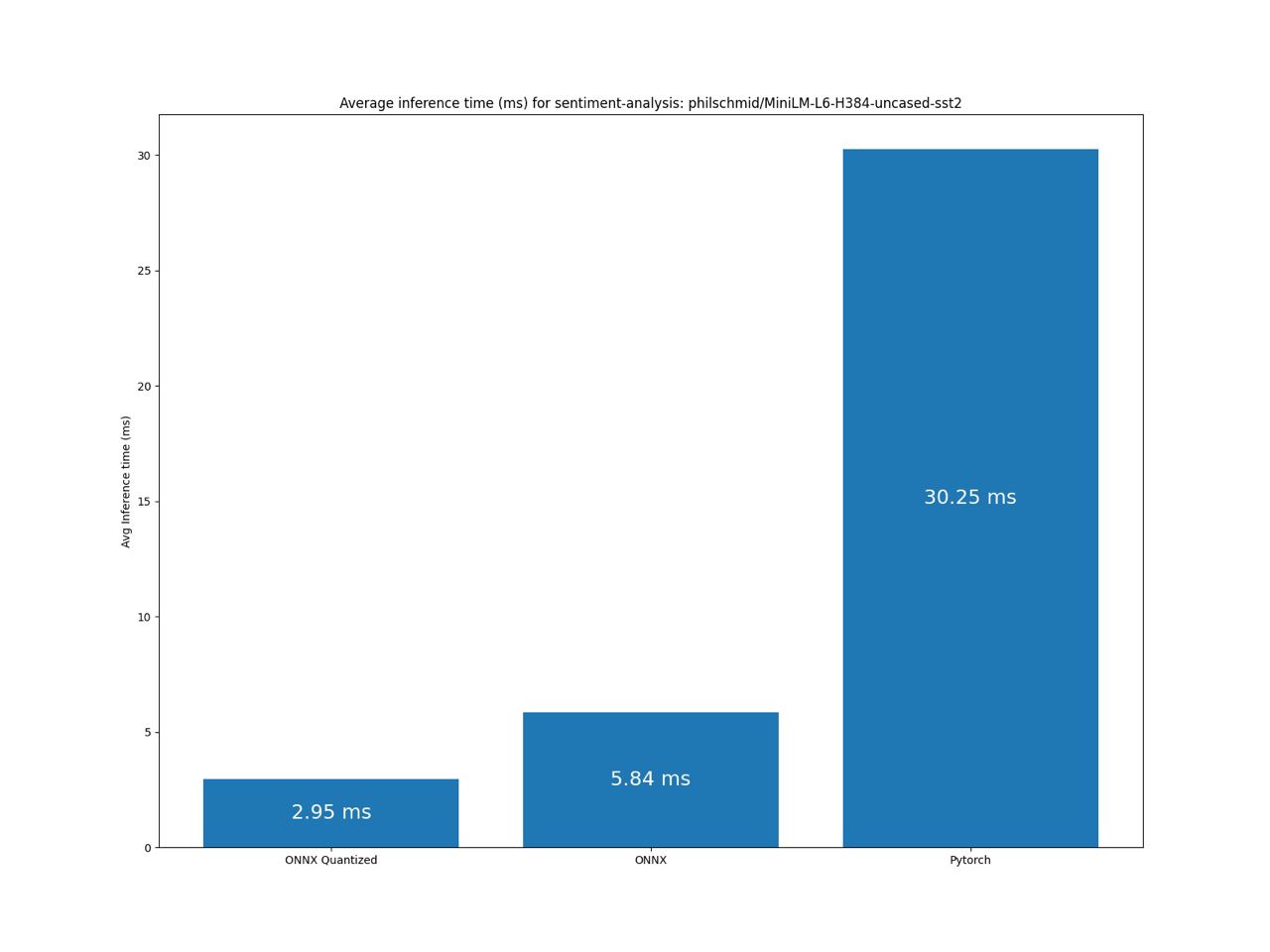
Benchmark sentiment-analysis pipeline
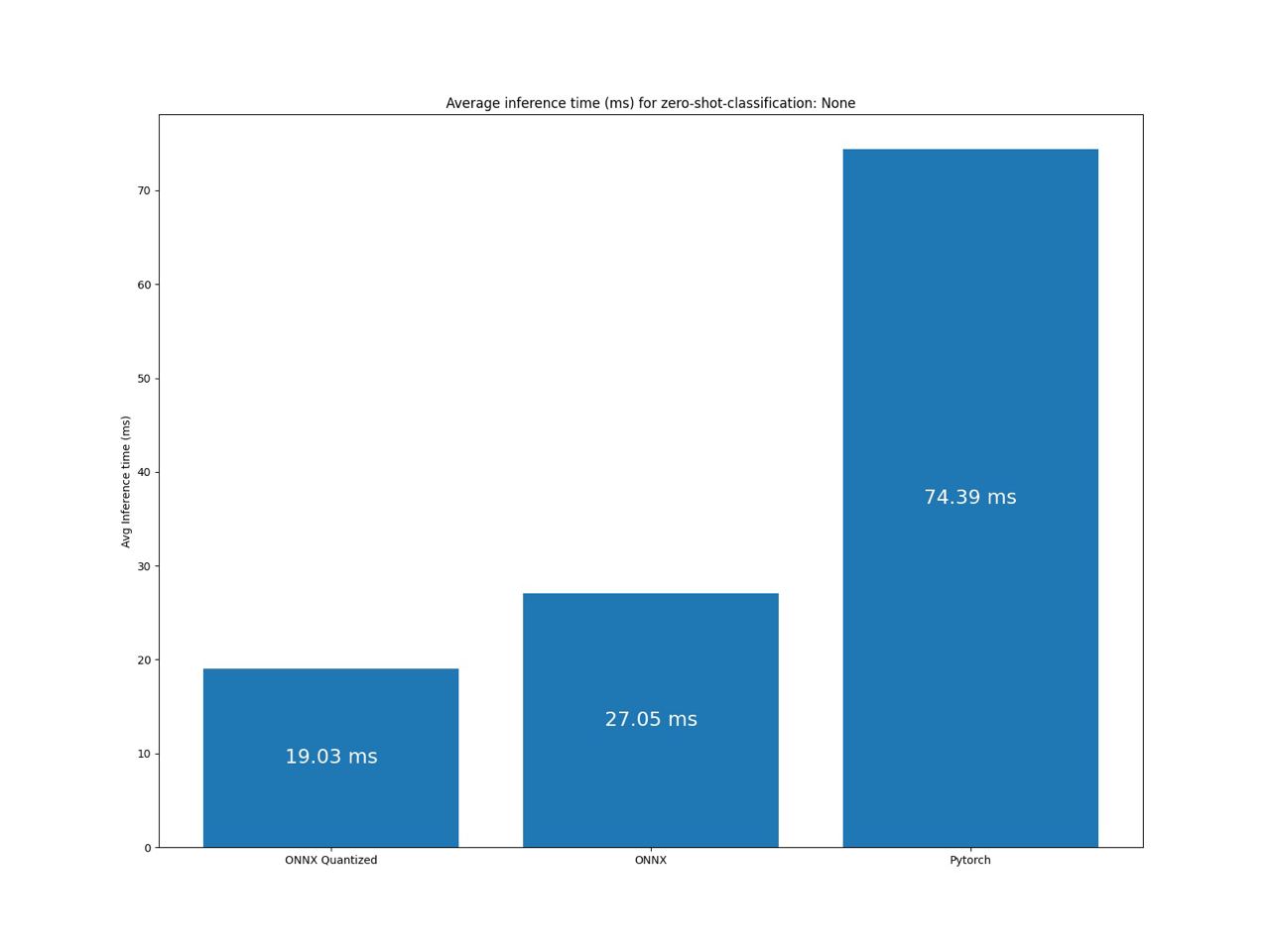
Benchmark zero-shot-classification pipeline
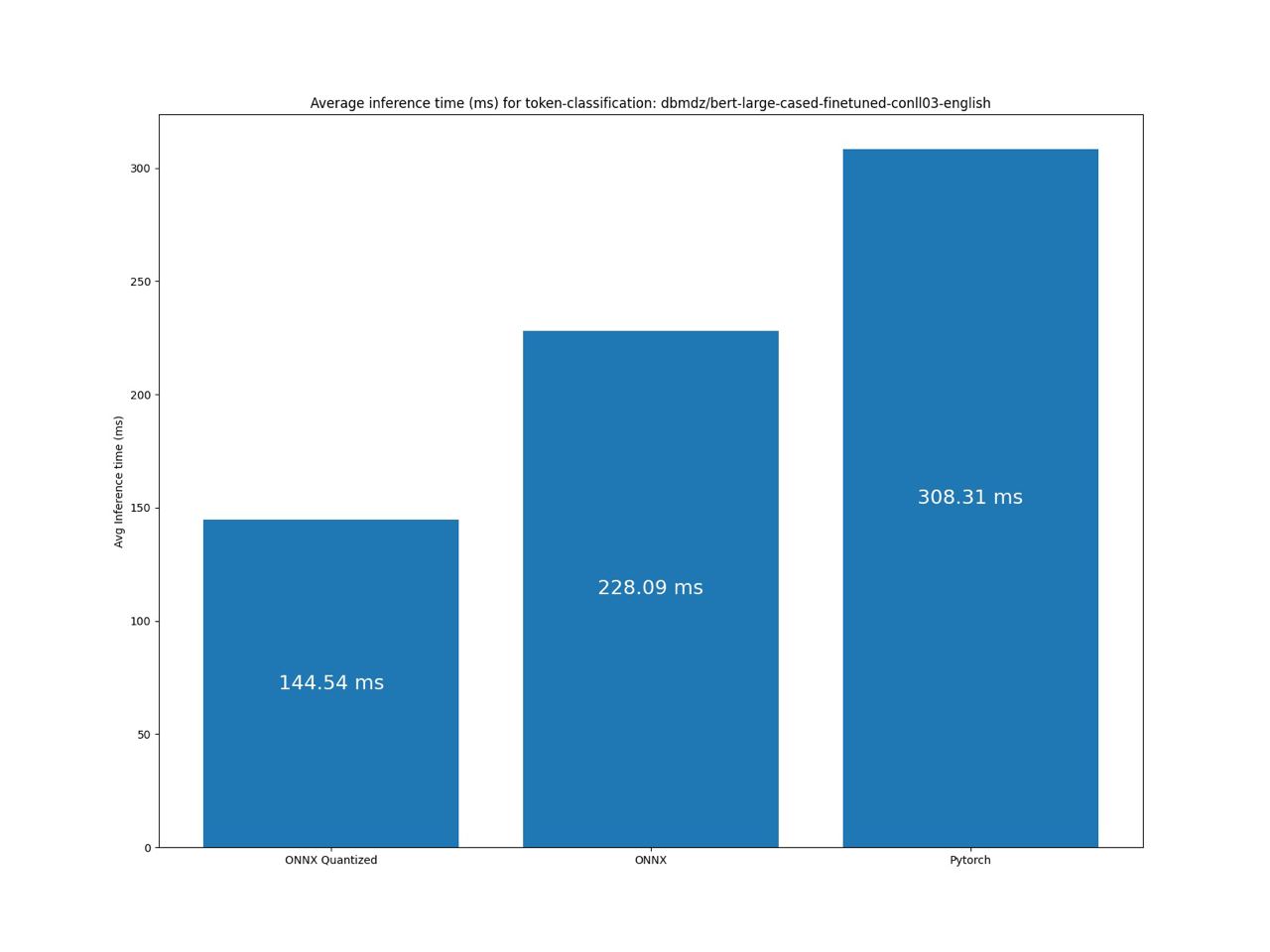
Benchmark token-classification pipeline
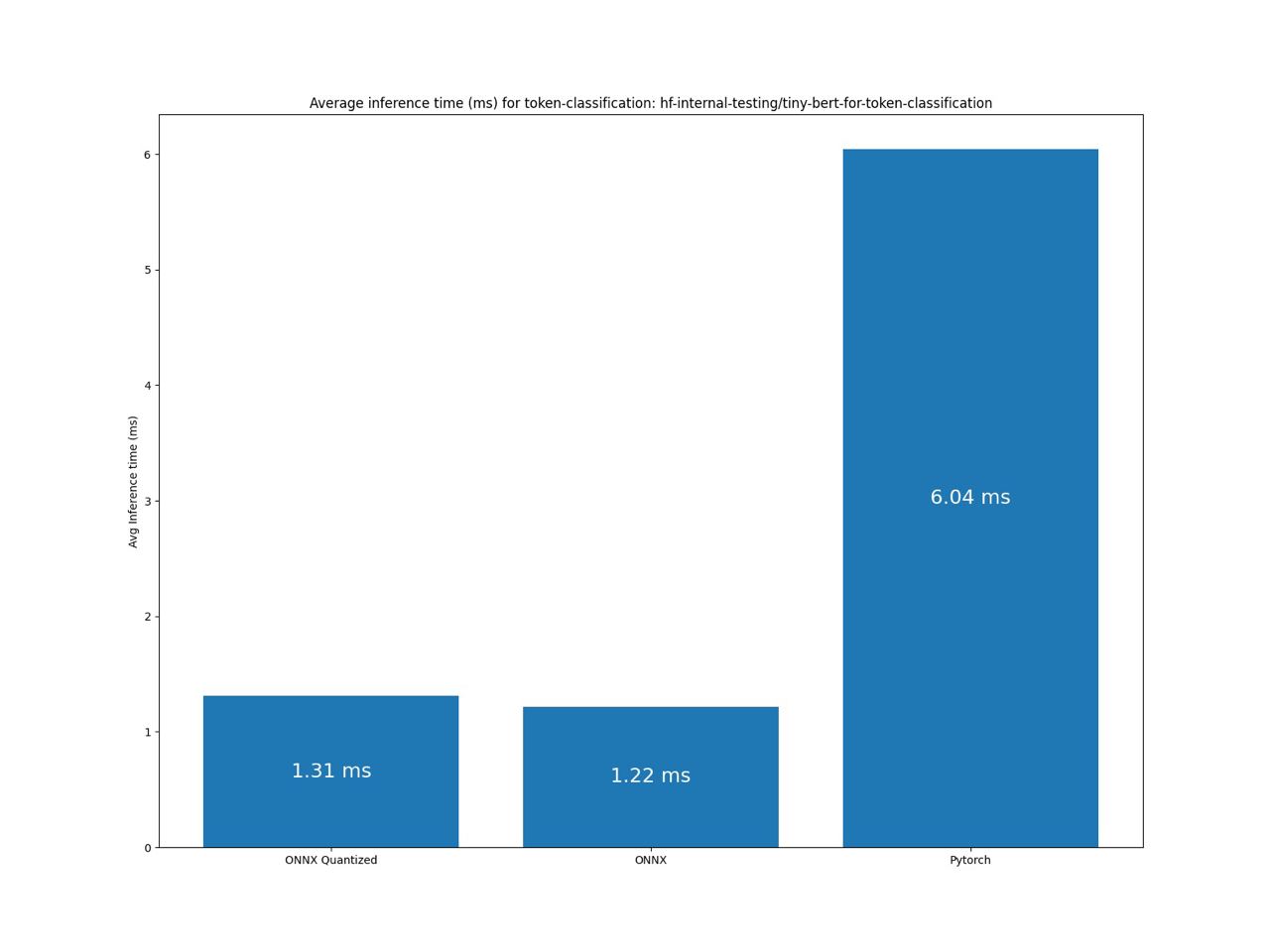
Benchmark question-answering pipeline

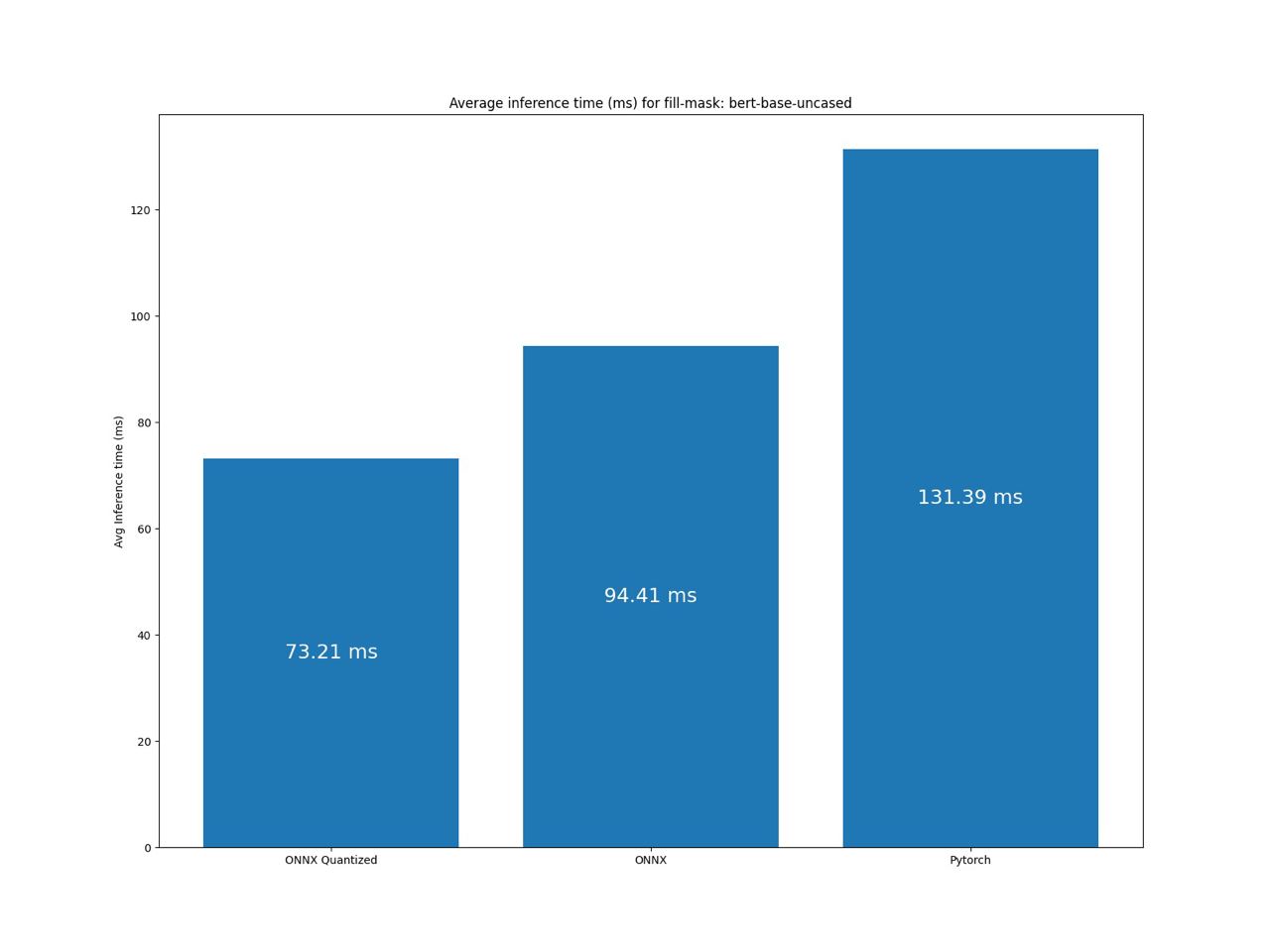
Benchmark fill-mask pipeline
About

Built by Aleksey Korshuk

Follow

Follow

Follow

🚀 If you want to contribute to this project OR create something cool together — contact me: link

Star this repository:

GitHub stars

Resources

You might also like...
ONNX Runtime: cross-platform, high performance ML inferencing and training accelerator

ONNX Runtime is a cross-platform inference and training machine-learning accelerator. ONNX Runtime inference can enable faster customer experiences an

Very simple NCHW and NHWC conversion tool for ONNX. Change to the specified input order for each and every input OP. Also, change the channel order of RGB and BGR. Simple Channel Converter for ONNX.

scc4onnx Very simple NCHW and NHWC conversion tool for ONNX. Change to the specified input order for each and every input OP. Also, change the channel

A very simple tool to rewrite parameters such as attributes and constants for OPs in ONNX models. Simple Attribute and Constant Modifier for ONNX.

sam4onnx A very simple tool to rewrite parameters such as attributes and constants for OPs in ONNX models. Simple Attribute and Constant Modifier for

A repository that shares tuning results of trained models generated by TensorFlow / Keras. Post-training quantization (Weight Quantization, Integer Quantization, Full Integer Quantization, Float16 Quantization), Quantization-aware training. TensorFlow Lite. OpenVINO. CoreML. TensorFlow.js. TF-TRT. MediaPipe. ONNX. [.tflite,.h5,.pb,saved_model,tfjs,tftrt,mlmodel,.xml/.bin, .onnx] ONNX-GLPDepth - Python scripts for performing monocular depth estimation using the GLPDepth model in ONNX
ONNX-GLPDepth - Python scripts for performing monocular depth estimation using the GLPDepth model in ONNX

ONNX-GLPDepth - Python scripts for performing monocular depth estimation using the GLPDepth model in ONNX

ONNX-PackNet-SfM: Python scripts for performing monocular depth estimation using the PackNet-SfM model in ONNX

Python scripts for performing monocular depth estimation using the PackNet-SfM model in ONNX

A very simple tool for situations where optimization with onnx-simplifier would exceed the Protocol Buffers upper file size limit of 2GB, or simply to separate onnx files to any size you want.

sne4onnx A very simple tool for situations where optimization with onnx-simplifier would exceed the Protocol Buffers upper file size limit of 2GB, or

Simple ONNX operation generator. Simple Operation Generator for ONNX.

sog4onnx Simple ONNX operation generator. Simple Operation Generator for ONNX. https://github.com/PINTO0309/simple-onnx-processing-tools Key concept V

Simple tool to combine(merge) onnx models.  Simple Network Combine Tool for ONNX.
Simple tool to combine(merge) onnx models. Simple Network Combine Tool for ONNX.

snc4onnx Simple tool to combine(merge) onnx models. Simple Network Combine Tool for ONNX. https://github.com/PINTO0309/simple-onnx-processing-tools 1.

Releases(v0.2.1-upd)
Owner
Aleksey Korshuk
Aleksey Korshuk
Voxel Set Transformer: A Set-to-Set Approach to 3D Object Detection from Point Clouds (CVPR 2022)

Voxel Set Transformer: A Set-to-Set Approach to 3D Object Detection from Point Clouds (CVPR2022)[paper] Authors: Chenhang He, Ruihuang Li, Shuai Li, L

Billy HE 141 Dec 30, 2022
This is the official implementation of VaxNeRF (Voxel-Accelearated NeRF).

VaxNeRF Paper | Google Colab This is the official implementation of VaxNeRF (Voxel-Accelearated NeRF). This codebase is implemented using JAX, buildin

naruya 132 Nov 21, 2022
Implementation for paper: Self-Regulation for Semantic Segmentation

Self-Regulation for Semantic Segmentation This is the PyTorch implementation for paper Self-Regulation for Semantic Segmentation, ICCV 2021. Citing SR

Dong ZHANG 30 Nov 21, 2022
Creative Applications of Deep Learning w/ Tensorflow

Creative Applications of Deep Learning w/ Tensorflow This repository contains lecture transcripts and homework assignments as Jupyter Notebooks for th

Parag K Mital 1.5k Dec 30, 2022
A curated list of awesome papers for Semantic Retrieval (TOIS Accepted: Semantic Models for the First-stage Retrieval: A Comprehensive Review).

A curated list of awesome papers for Semantic Retrieval (TOIS Accepted: Semantic Models for the First-stage Retrieval: A Comprehensive Review).

Yinqiong Cai 189 Dec 28, 2022
Orange Chicken: Data-driven Model Generalizability in Crosslinguistic Low-resource Morphological Segmentation

Orange Chicken: Data-driven Model Generalizability in Crosslinguistic Low-resource Morphological Segmentation This repository contains code and data f

Zoey Liu 0 Jan 07, 2022
Image Deblurring using Generative Adversarial Networks

DeblurGAN arXiv Paper Version Pytorch implementation of the paper DeblurGAN: Blind Motion Deblurring Using Conditional Adversarial Networks. Our netwo

Orest Kupyn 2.2k Jan 01, 2023
Improving 3D Object Detection with Channel-wise Transformer

"Improving 3D Object Detection with Channel-wise Transformer" Thanks for the OpenPCDet, this implementation of the CT3D is mainly based on the pcdet v

Hualian Sheng 107 Dec 20, 2022
A clean and robust Pytorch implementation of PPO on continuous action space.

PPO-Continuous-Pytorch I found the current implementation of PPO on continuous action space is whether somewhat complicated or not stable. And this is

XinJingHao 56 Dec 16, 2022
An open-source Deep Learning Engine for Healthcare that aims to treat & prevent major diseases

AlphaCare Background AlphaCare is a work-in-progress, open-source Deep Learning Engine for Healthcare that aims to treat and prevent major diseases. T

Siraj Raval 44 Nov 05, 2022
U2-Net: Going Deeper with Nested U-Structure for Salient Object Detection

The code for our newly accepted paper in Pattern Recognition 2020: "U^2-Net: Going Deeper with Nested U-Structure for Salient Object Detection."

Xuebin Qin 6.5k Jan 09, 2023
A curated list of long-tailed recognition resources.

Awesome Long-tailed Recognition A curated list of long-tailed recognition and related resources. Please feel free to pull requests or open an issue to

Zhiwei ZHANG 542 Jan 01, 2023
Implementation for ACProp ( Momentum centering and asynchronous update for adaptive gradient methdos, NeurIPS 2021)

This repository contains code to reproduce results for submission NeurIPS 2021, "Momentum Centering and Asynchronous Update for Adaptive Gradient Meth

Juntang Zhuang 15 Jun 11, 2022
Seach Losses of our paper 'Loss Function Discovery for Object Detection via Convergence-Simulation Driven Search', accepted by ICLR 2021.

CSE-Autoloss Designing proper loss functions for vision tasks has been a long-standing research direction to advance the capability of existing models

Peidong Liu(刘沛东) 54 Dec 17, 2022
Self-labelling via simultaneous clustering and representation learning. (ICLR 2020)

Self-labelling via simultaneous clustering and representation learning 🆗 🆗 🎉 NEW models (20th August 2020): Added standard SeLa pretrained torchvis

Yuki M. Asano 469 Jan 02, 2023
Empower Sequence Labeling with Task-Aware Language Model

LM-LSTM-CRF Check Our New NER Toolkit 🚀 🚀 🚀 Inference: LightNER: inference w. models pre-trained / trained w. any following tools, efficiently. Tra

Liyuan Liu 838 Jan 05, 2023
This is a official repository of SimViT.

SimViT This is a official repository of SimViT. We will open our models and codes about object detection and semantic segmentation soon. Our code refe

ligang 57 Dec 15, 2022
Implement A3C for Mujoco gym envs

pytorch-a3c-mujoco Disclaimer: my implementation right now is unstable (you ca refer to the learning curve below), I'm not sure if it's my problems. A

Andrew 70 Dec 12, 2022
Code, pre-trained models and saliency results for the paper "Boosting RGB-D Saliency Detection by Leveraging Unlabeled RGB Images".

Boosting RGB-D Saliency Detection by Leveraging Unlabeled RGB This repository is the official implementation of the paper. Our results comming soon in

Xiaoqiang Wang 8 May 22, 2022
Official git repo for the CHIRP project

CHIRP Project This is the official git repository for the CHIRP project. Pull requests are accepted here, but for the moment, the main repository is s

Dan Smith 77 Jan 08, 2023