Neural Radiance Fields Using PyTorch

Overview

Neural Radiance Fields Using PyTorch

NeRF (Neural Radiance Fields) is a method for achieving outcomes for synthesizing novel views of complex scenes. Posted below are a few videos generated by this project.

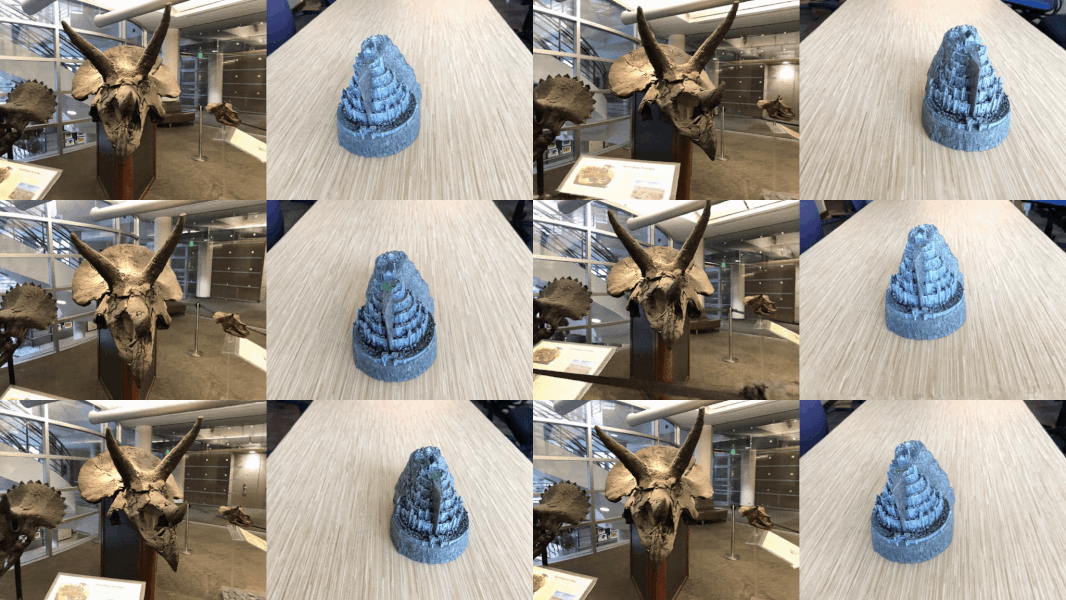
This project is a PyTorch implementation of NeRF that reproduces the results while running approximately 1.3x faster. The code is based on the TensorFlow implementation here of the author. PyTorch has been used for numerical testing and validation of the same.

Installation

git clone https://github.com/yenchenlin/nerf-pytorch.git
cd nerf-pytorch
pip install -r requirements.txt
cd torchsearchsorted
pip install .
cd ../
Dependencies (click to expand)

Dependencies

  • PyTorch 1.4
  • matplotlib
  • numpy
  • imageio
  • imageio-ffmpeg
  • configargparse

The LLFF data loader requires ImageMagick.

You will also need the LLFF code (and COLMAP) set up to compute poses if you want to run on your own real data.

How To Run?

Quick Start

Download data for two example datasets: lego and fern

bash download_example_data.sh

To train a low-res lego NeRF:

python run_nerf.py --config configs/config_lego.txt

After training for 100,000 iterations (~4 hours on a single 2080 Ti), you can find the following video at logs/lego_test/lego_test_spiral_100000_rgb.mp4.


To train a low-res fern NeRF:

python run_nerf.py --config configs/config_fern.txt

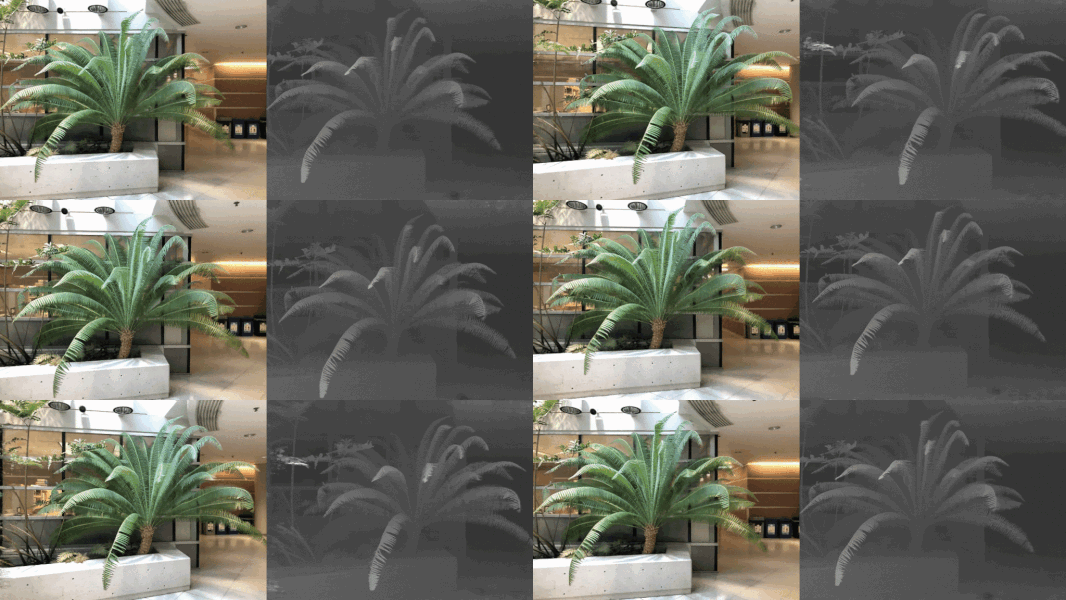
After training for 200k iterations (~8 hours on a single 2080 Ti), you can find the following video at logs/fern_test/fern_test_spiral_200000_rgb.mp4 and logs/fern_test/fern_test_spiral_200000_disp.mp4

More Datasets

To test out the other scenes presented in the paper, you can download the data here. Please place the downloaded dataset according to the following directory structure:

├── configs                                                                                                       
│   ├── ...                                                                                     
│                                                                                               
├── data                                                                                                                                                                                                       
│   ├── nerf_llff_data                                                                                                  
│   │   └── fern                                                                                                                             
│   │   └── flower  # downloaded llff dataset                                                                                  
│   │   └── horns   # downloaded llff dataset
|   |   └── ...
|   ├── nerf_synthetic
|   |   └── lego
|   |   └── ship    # downloaded synthetic dataset
|   |   └── ...

To train NeRF on different datasets:

python run_nerf.py --config configs/config_{DATASET}.txt

replace {DATASET} with trex | horns | flower | fortress | lego | etc.


To test NeRF trained on different datasets:

python run_nerf.py --config configs/config_{DATASET}.txt --render_only

replace {DATASET} with trex | horns | flower | fortress | lego | etc.

Pre-trained Models

You can download the pre-trained models here. Please place the downloaded directory in ./logs in order to test it later. Check the following directory structure for an example:

├── logs 
│   ├── fern_test
│   ├── flower_test  # downloaded logs
│   ├── trex_test    # downloaded logs

Reproducibility

The tests that ensure the results of all functions and training loop match the official implentation are contained in a different branch reproduce. One can check it out and run the tests:

git checkout reproduce
py.test

Method

NeRF: Representing Scenes as Neural Radiance Fields for View Synthesis
Ben Mildenhall*1, Pratul P. Srinivasan*1, Matthew Tancik*1, Jonathan T. Barron2, Ravi Ramamoorthi3, Ren Ng1
1UC Berkeley, 2Google Research, 3UC San Diego
*denotes equal contribution

A Neural Radiance Field is a simple fully connected network (weights are ~5MB) trained to reproduce input views of a single scene using a rendering loss. The network directly maps from spatial location and viewing direction (5D input) to color and opacity (4D output), acting as the "volume" so we can use volume rendering to differentiably render new views

Citation

A big thank-you to the authors (below) for their amazing work and results:

@misc{mildenhall2020nerf,
    title={NeRF: Representing Scenes as Neural Radiance Fields for View Synthesis},
    author={Ben Mildenhall and Pratul P. Srinivasan and Matthew Tancik and Jonathan T. Barron and Ravi Ramamoorthi and Ren Ng},
    year={2020},
    eprint={2003.08934},
    archivePrefix={arXiv},
    primaryClass={cs.CV}
}
Owner
Vedant Ghodke
Technical Undergraduate Intern At Cisco | Ex-AI Intern At Microsoft, India
Vedant Ghodke
Official Implementation of 'UPDeT: Universal Multi-agent Reinforcement Learning via Policy Decoupling with Transformers' ICLR 2021(spotlight)

UPDeT Official Implementation of UPDeT: Universal Multi-agent Reinforcement Learning via Policy Decoupling with Transformers (ICLR 2021 spotlight) The

hhhusiyi 96 Dec 22, 2022
[CVPR 2021] Counterfactual VQA: A Cause-Effect Look at Language Bias

Counterfactual VQA (CF-VQA) This repository is the Pytorch implementation of our paper "Counterfactual VQA: A Cause-Effect Look at Language Bias" in C

Yulei Niu 94 Dec 03, 2022
Solving reinforcement learning tasks which require language and vision

Multimodal Reinforcement Learning JAX implementations of the following multimodal reinforcement learning approaches. Dual-coding Episodic Memory from

Henry Prior 31 Feb 26, 2022
StarGAN - Official PyTorch Implementation (CVPR 2018)

StarGAN: Unified Generative Adversarial Networks for Multi-Domain Image-to-Image Translation

Yunjey Choi 5.1k Dec 30, 2022
Code for one-stage adaptive set-based HOI detector AS-Net.

AS-Net Code for one-stage adaptive set-based HOI detector AS-Net. Mingfei Chen*, Yue Liao*, Si Liu, Zhiyuan Chen, Fei Wang, Chen Qian. "Reformulating

Mingfei Chen 45 Dec 09, 2022
traiNNer is an open source image and video restoration (super-resolution, denoising, deblurring and others) and image to image translation toolbox based on PyTorch.

traiNNer traiNNer is an open source image and video restoration (super-resolution, denoising, deblurring and others) and image to image translation to

202 Jan 04, 2023
code for TCL: Vision-Language Pre-Training with Triple Contrastive Learning, CVPR 2022

Vision-Language Pre-Training with Triple Contrastive Learning, CVPR 2022 News (03/16/2022) upload retrieval checkpoints finetuned on COCO and Flickr T

187 Jan 02, 2023
Code for Contrastive-Geometry Networks for Generalized 3D Pose Transfer

CGTransformer Code for our AAAI 2022 paper "Contrastive-Geometry Transformer network for Generalized 3D Pose Transfer" Contrastive-Geometry Transforme

18 Jun 28, 2022
Offcial repository for the IEEE ICRA 2021 paper Auto-Tuned Sim-to-Real Transfer.

Offcial repository for the IEEE ICRA 2021 paper Auto-Tuned Sim-to-Real Transfer.

47 Jun 30, 2022
A modular, open and non-proprietary toolkit for core robotic functionalities by harnessing deep learning

A modular, open and non-proprietary toolkit for core robotic functionalities by harnessing deep learning Website • About • Installation • Using OpenDR

OpenDR 304 Dec 28, 2022
Implementation of Convolutional LSTM in PyTorch.

ConvLSTM_pytorch This file contains the implementation of Convolutional LSTM in PyTorch made by me and DavideA. We started from this implementation an

Andrea Palazzi 1.3k Dec 29, 2022
An algorithm study of the 6th iOS 10 set of Boost Camp Web Mobile

알고리즘 스터디 🔥 부스트캠프 웹모바일 6기 iOS 10조의 알고리즘 스터디 입니다. 개인적인 사정 등으로 S034, S055만 참가하였습니다. 스터디 목적 상진: 코테 합격 + 부캠끝나고 아침에 일어나기 위해 필요한 사이클 기완: 꾸준하게 자리에 앉아 공부하기 +

2 Jan 11, 2022
Lightweight mmm - Lightweight (Bayesian) Media Mix Model

Lightweight (Bayesian) Media Mix Model This is not an official Google product. L

Google 342 Jan 03, 2023
The implementation of the algorithm in the paper "Safe Deep Semi-Supervised Learning for Unseen-Class Unlabeled Data" published in ICML 2020.

DS3L This is the code for paper "Safe Deep Semi-Supervised Learning for Unseen-Class Unlabeled Data" published in ICML 2020. Setups The code is implem

Guolz 36 Oct 19, 2022
Unsupervised CNN for Single View Depth Estimation: Geometry to the Rescue

Realtime Unsupervised Depth Estimation from an Image This is the caffe implementation of our paper "Unsupervised CNN for single view depth estimation:

Ravi Garg 227 Nov 28, 2022
CUda Matrix Multiply library.

cumm CUda Matrix Multiply library. cumm is developed during learning of CUTLASS, which use too much c++ template and make code unmaintainable. So I de

49 Dec 27, 2022
Image Segmentation using U-Net, U-Net with skip connections and M-Net architectures

Brain-Image-Segmentation Segmentation of brain tissues in MRI image has a number of applications in diagnosis, surgical planning, and treatment of bra

Angad Bajwa 8 Oct 27, 2022
Experiments on Flood Segmentation on Sentinel-1 SAR Imagery with Cyclical Pseudo Labeling and Noisy Student Training

Flood Detection Challenge This repository contains code for our submission to the ETCI 2021 Competition on Flood Detection (Winning Solution #2). Acco

Siddha Ganju 108 Dec 28, 2022
Planning from Pixels in Environments with Combinatorially Hard Search Spaces -- NeurIPS 2021

PPGS: Planning from Pixels in Environments with Combinatorially Hard Search Spaces Environment Setup We recommend pipenv for creating and managing vir

Autonomous Learning Group 11 Jun 26, 2022
Rendering Point Clouds with Compute Shaders

Compute Shader Based Point Cloud Rendering This repository contains the source code to our techreport: Rendering Point Clouds with Compute Shaders and

Markus Schütz 460 Jan 05, 2023