This repository contains the code for the paper "Hierarchical Motion Understanding via Motion Programs"

Overview

Hierarchical Motion Understanding via Motion Programs (CVPR 2021)

Paper

This repository contains the official implementation of:

Hierarchical Motion Understanding via Motion Programs

full paper | short talk | long talk | project webpage
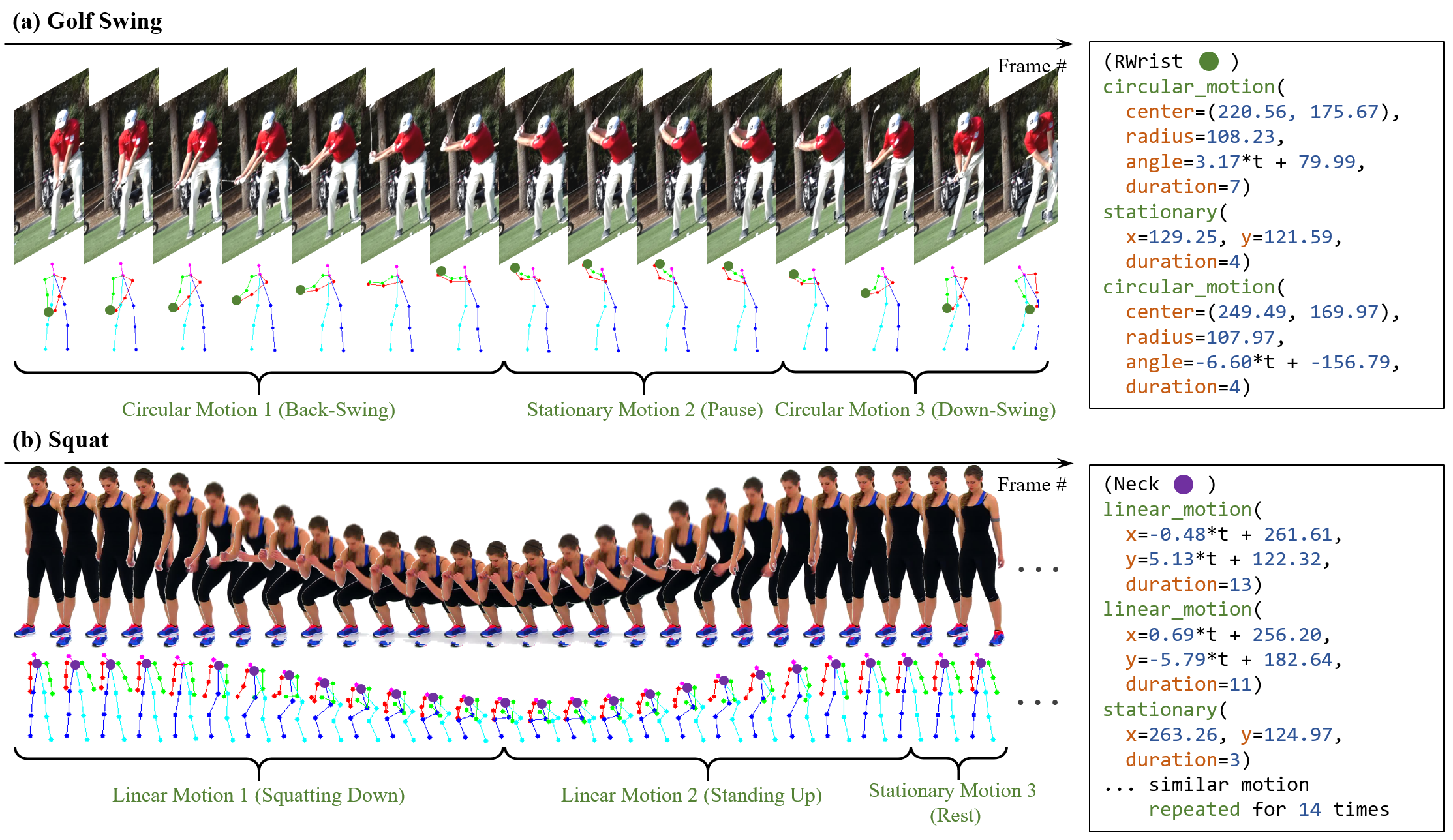
Motion Programs example

Running motion2prog

0. We start with video file and first prepare the input data

$ ffmpeg -i ${video_dir}/video.mp4 ${video_dir}/frames/%05d.jpg
$ python AlphaPose/scripts/demo_inference.py \
    --cfg AlphaPose/pretrained_models/256x192_res50_lr1e-3_1x.yaml \
    --checkpoint AlphaPose/pretrained_models/halpe26_fast_res50_256x192.pth \
    --indir ${video_dir}/frames --outdir ${video_dir}/pose_mpii_track \
    --pose_track --showbox --flip --qsize 256
$ mv ${video_dir}/pose_mpii_track/alphapose-results.json \
    ${video_dir}/alphapose-results-halpe26-posetrack.json

We packaged a demo video with necessary inputs for quickly testing our code

$ wget https://sumith1896.github.io/motion2prog/static/demo.zip
$ mv demo.zip data/  && cd data/ && unzip demo.zip && cd ..
  • We need 2D pose detection results & extracted frames of video (for visualization)

  • We support loading from different pose detector formats in the load function in lkeypoints.py.

  • We used AlphaPose with the above commands for all pose detection results.

Run motion program synthesis pipeline

1. With the data prepared, you can run the synthesis with the following command:

$ python fit.py -d data/demo/276_reg -k coco -a -x -c -p 1 -w 20 --no-acc \
--stat-thres 5 --span-thres 5 --cores 9 -r 1600 -o ./visualization/static/data/demo
  • The various options and their descriptions are explained in the fit.py file.

  • The results can be found under ./visualization/static/data/demo.

Visualizing the synthesized programs

2. We package a visualization server for visualizing the generated programs

$ cd visualization/
$ bash deploy.sh p
  • Open the directed the webpage and browse the results interactively.

Citations

If you find our code or paper useful to your research, please consider citing:

@inproceedings{motion2prog2021,
    Author = {Sumith Kulal and Jiayuan Mao and Alex Aiken and Jiajun Wu},
    Title = {Hierarchical Motion Understanding via Motion Programs},
    booktitle={CVPR},
    year={2021},
}

Checklist

Please open a GitHub issue or contact [email protected] for any issues or questions!

  • Upload pre-processed data used in paper.
  • Add for-loop synthesis layer.

Acknowledgements

We thank Karan Chadha, Shivam Garg and Shubham Goel for helpful discussions. This work is in part supported by Magic Grant from the Brown Institute for Media Innovation, the Samsung Global Research Outreach (GRO) Program, Autodesk, Amazon Web Services, and Stanford HAI for AWS Cloud Credits.

Parts of this repo use materials from SCANimate and fit.

Owner
Sumith Kulal
Insanely passionate about Computer Science.
Sumith Kulal
Revisiting Self-Training for Few-Shot Learning of Language Model.

SFLM This is the implementation of the paper Revisiting Self-Training for Few-Shot Learning of Language Model. SFLM is short for self-training for few

15 Nov 19, 2022
UnivNet: A Neural Vocoder with Multi-Resolution Spectrogram Discriminators for High-Fidelity Waveform Generation

UnivNet UnivNet: A Neural Vocoder with Multi-Resolution Spectrogram Discriminators for High-Fidelity Waveform Generation. Training python train.py --c

Rishikesh (ऋषिकेश) 55 Dec 26, 2022
Learning to Reconstruct 3D Manhattan Wireframes from a Single Image

Learning to Reconstruct 3D Manhattan Wireframes From a Single Image This repository contains the PyTorch implementation of the paper: Yichao Zhou, Hao

Yichao Zhou 50 Dec 27, 2022
Official implementation for the paper "Attentive Prototypes for Source-free Unsupervised Domain Adaptive 3D Object Detection"

Attentive Prototypes for Source-free Unsupervised Domain Adaptive 3D Object Detection PyTorch code release of the paper "Attentive Prototypes for Sour

Deepti Hegde 23 Oct 17, 2022
PyTorch implementation of Densely Connected Time Delay Neural Network

Densely Connected Time Delay Neural Network PyTorch implementation of Densely Connected Time Delay Neural Network (D-TDNN) in our paper "Densely Conne

Ya-Qi Yu 64 Oct 11, 2022
Tensorflow python implementation of "Learning High Fidelity Depths of Dressed Humans by Watching Social Media Dance Videos"

Learning High Fidelity Depths of Dressed Humans by Watching Social Media Dance Videos This repository is the official tensorflow python implementation

Yasamin Jafarian 287 Jan 06, 2023
The Most Efficient Temporal Difference Learning Framework for 2048

moporgic/TDL2048+ TDL2048+ is a highly optimized temporal difference (TD) learning framework for 2048. Features Many common methods related to 2048 ar

Hung Guei 5 Nov 23, 2022
Differentiable rasterization applied to 3D model simplification tasks

nvdiffmodeling Differentiable rasterization applied to 3D model simplification tasks, as described in the paper: Appearance-Driven Automatic 3D Model

NVIDIA Research Projects 336 Dec 30, 2022
PyTorch implementation of U-TAE and PaPs for satellite image time series panoptic segmentation.

Panoptic Segmentation of Satellite Image Time Series with Convolutional Temporal Attention Networks (ICCV 2021) This repository is the official implem

71 Jan 04, 2023
Open-L2O: A Comprehensive and Reproducible Benchmark for Learning to Optimize Algorithms

Open-L2O This repository establishes the first comprehensive benchmark efforts of existing learning to optimize (L2O) approaches on a number of proble

VITA 161 Jan 02, 2023
QA-GNN: Question Answering using Language Models and Knowledge Graphs

QA-GNN: Question Answering using Language Models and Knowledge Graphs This repo provides the source code & data of our paper: QA-GNN: Reasoning with L

Michihiro Yasunaga 434 Jan 04, 2023
FS2KToolbox FS2K Dataset Towards the translation between Face

FS2KToolbox FS2K Dataset Towards the translation between Face -- Sketch. Download (photo+sketch+annotation): Google-drive, Baidu-disk, pw: FS2K. For

Deng-Ping Fan 5 Jan 03, 2023
Open-Set Recognition: A Good Closed-Set Classifier is All You Need

Open-Set Recognition: A Good Closed-Set Classifier is All You Need Code for our paper: "Open-Set Recognition: A Good Closed-Set Classifier is All You

194 Jan 03, 2023
Pytorch implementation of ICASSP 2022 paper Attention Probe: Vision Transformer Distillation in the Wild

Attention Probe: Vision Transformer Distillation in the Wild Jiahao Wang, Mingdeng Cao, Shuwei Shi, Baoyuan Wu, Yujiu Yang In ICASSP 2022 This code is

IIGROUP 6 Sep 21, 2022
rliable is an open-source Python library for reliable evaluation, even with a handful of runs, on reinforcement learning and machine learnings benchmarks.

Open-source library for reliable evaluation on reinforcement learning and machine learning benchmarks. See NeurIPS 2021 oral for details.

Google Research 529 Jan 01, 2023
Code-free deep segmentation for computational pathology

NoCodeSeg: Deep segmentation made easy! This is the official repository for the manuscript "Code-free development and deployment of deep segmentation

André Pedersen 26 Nov 23, 2022
Few-Shot Graph Learning for Molecular Property Prediction

Few-shot Graph Learning for Molecular Property Prediction Introduction This is the source code and dataset for the following paper: Few-shot Graph Lea

Zhichun Guo 94 Dec 12, 2022
Fast algorithms to compute an approximation of the minimal volume oriented bounding box of a point cloud in 3D.

ApproxMVBB Status Build UnitTests Homepage Fast algorithms to compute an approximation of the minimal volume oriented bounding box of a point cloud in

Gabriel Nützi 390 Dec 31, 2022
Independent and minimal implementations of some reinforcement learning algorithms using PyTorch (including PPO, A3C, A2C, ...).

PyTorch RL Minimal Implementations There are implementations of some reinforcement learning algorithms, whose characteristics are as follow: Less pack

Gemini Light 4 Dec 31, 2022