Computational modelling of ray propagation through optical elements using the principles of geometric optics (Ray Tracer)

Overview

Computational modelling of ray propagation through optical elements using the principles of geometric optics (Ray Tracer)

Introduction

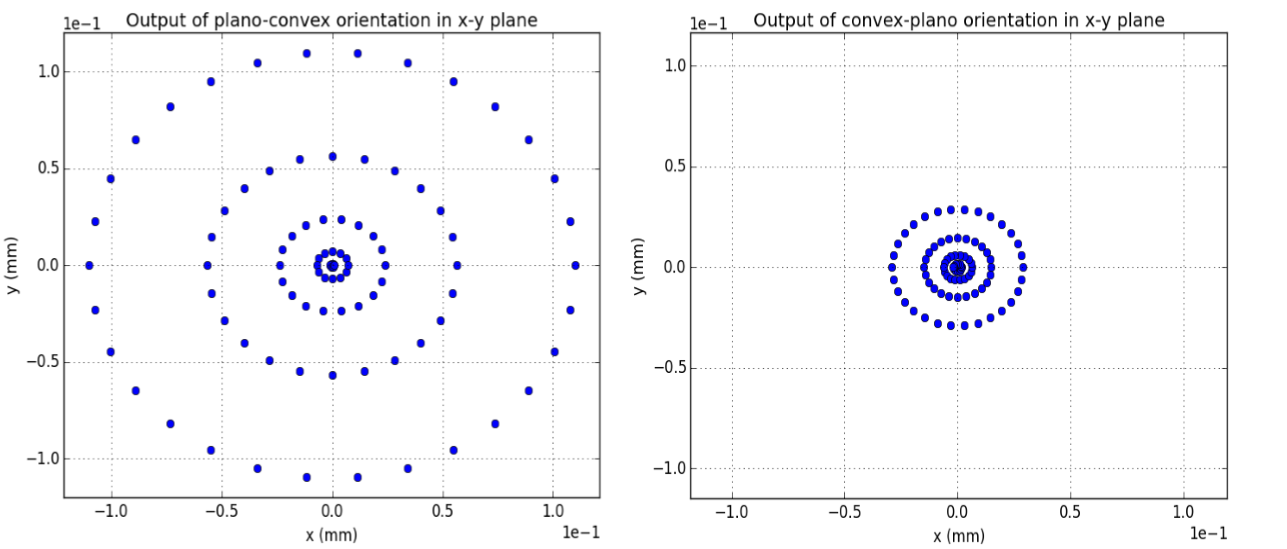
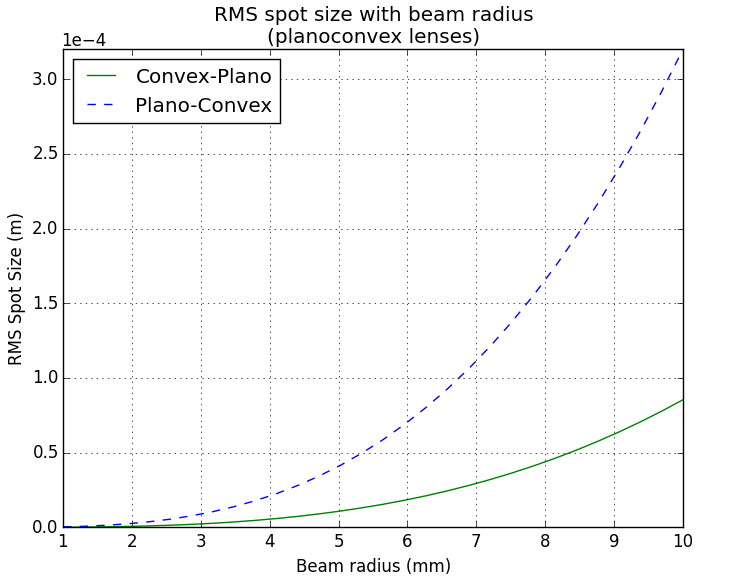
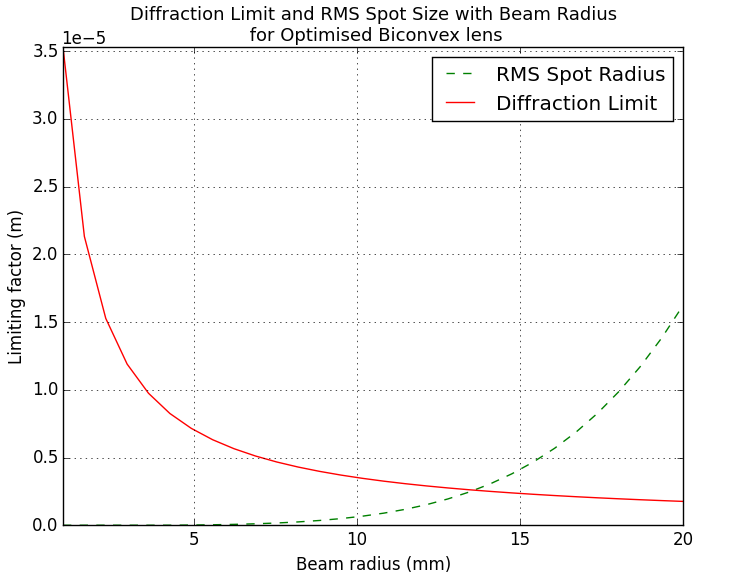
By applying the principles of geometric optics, imaging performances of lenses were investigated via examining the propagation of optical rays through various optical systems. The optical system and its elements were modelled with an object-oriented approach using the Python programming language. Through utilising a ray bundle with specific parameters, the performances of a planoconvex lens with different orientations were analysed. The orientation with the convex surface facing the incident beam was found to be more effective at minimising the spherical aberration. This was evident from the value of the geometric RMS spot radius of 1.85 x 10^-5} m at the paraxial focus compared to 7.04 x 10^-5 m for the plano-convex orientation. This was further supported by the relatively slow rate of increase in the RMS spot radius with the beam size for the convex-plano orientation. Furthermore, by optimising the curvatures of a singlet lens with a image distance of 100 mm, the best form curvatures were approximated as 0.01417 mm^-1 and -0.00532 mm^-1 with the RMS spot radius of 6.07 x 10^-8 m, leading to a conclusion that the system was diffraction limited and the effect of diffraction was substantial when using a beam radius smaller than 13.60 mm.

Requirements

Python 2.x is required to run the scripts (except for those with name beginning with 'ODE_').

Create an environment using conda as follows:

  conda create -n python2 python=2.x

Then activate the new environment by:

  conda activate python2

Results

In an ideal case, optical rays refracting through a spherical lens can be made to converge at a single point known as the focal point. However, in practice, rays fail to converge at a single point and a blurring effect occurs. This optical effect, known as the spherical aberration, is a result of the rays propagating parallel to the optical axis through a spherical lens at different distances from the axis.$^{1, 3}$ The rays further away from the optical axis experience greater refraction and thus they intersect the optical axis slightly behind the paraxial focus before diverging (FIG. 1).

For a single lens, spherical aberration can be minimised either by changing the orientation of the lens or by carefully choosing the curvatures of the spherical surfaces into the best form. In this investigation, both cases are examined using collimated ray bundles with uniformly distributed rays of various diameters with the aim to minimise this effect.
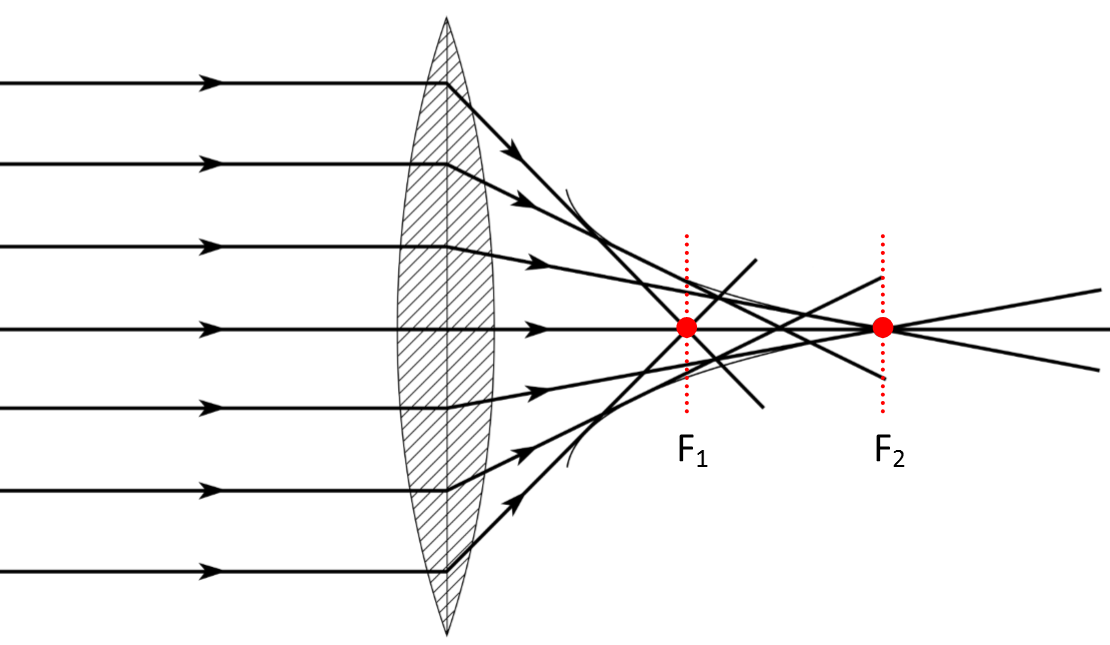
SA Figure 1: A lens displaying spherical aberration - the marginal and paraxial rays focus at the points F_1 and F_2 respectively.

single

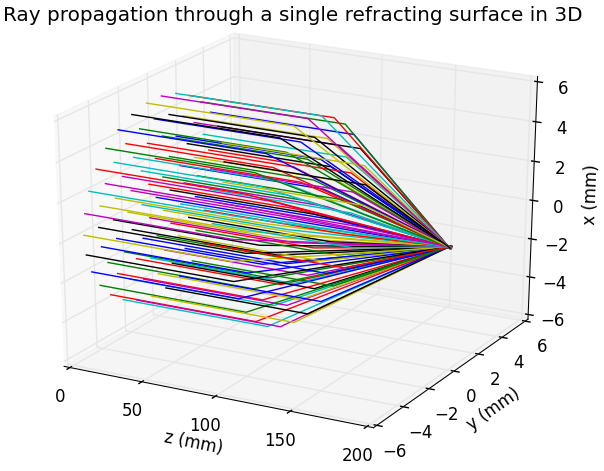
Figure 2: A ray bundle of radius 5 mm propagating through a single spherical surface with a curvature of 0.03 mm^-1 and refracting towards the optical axis.

spotplot2

Figure 3: The non-uniform ring pattern that is shown in the figure is symbolic of the spherical aberration effect. The aberration is significantly reduced using the convex-plano orientation.

RMSPC

Figure 4: A graph depicting the change in the RMS spot radius at the paraxial focus with increasing beam size.

RMSDL

Figure 5: A graph showing the relationships of the diffraction limit and the RMS spot radius with increasing beam size.


🔗 Links

linkedin

License

MIT License

Owner
Son Gyo Jung
Son Gyo Jung
Code for HodgeNet: Learning Spectral Geometry on Triangle Meshes, in SIGGRAPH 2021.

HodgeNet | Webpage | Paper | Video HodgeNet: Learning Spectral Geometry on Triangle Meshes Dmitriy Smirnov, Justin Solomon SIGGRAPH 2021 Set-up To ins

Dima Smirnov 61 Nov 27, 2022
Face Detection & Age Gender & Expression & Recognition

Face Detection & Age Gender & Expression & Recognition

Sajjad Ayobi 188 Dec 28, 2022
A simple library that implements CLIP guided loss in PyTorch.

pytorch_clip_guided_loss: Pytorch implementation of the CLIP guided loss for Text-To-Image, Image-To-Image, or Image-To-Text generation. A simple libr

Sergei Belousov 74 Dec 26, 2022
Unity Propagation in Bayesian Networks Handling Inconsistency via Unity Smoothing

This repository contains the scripts needed to generate the results from the paper Unity Propagation in Bayesian Networks Handling Inconsistency via U

0 Jan 19, 2022
NNR conformation conditional and global probabilities estimation and analysis in peptides or proteins fragments

NNR and global probabilities estimation and analysis in peptides or protein fragments This module calculates global and NNR conformation dependent pro

0 Jul 15, 2021
A sketch extractor for anime/illustration.

Anime2Sketch Anime2Sketch: A sketch extractor for illustration, anime art, manga By Xiaoyu Xiang Updates 2021.5.2: Upload more example results of anim

Xiaoyu Xiang 1.6k Jan 01, 2023
Unsupervised Semantic Segmentation by Contrasting Object Mask Proposals.

Unsupervised Semantic Segmentation by Contrasting Object Mask Proposals This repo contains the Pytorch implementation of our paper: Unsupervised Seman

Wouter Van Gansbeke 335 Dec 28, 2022
Fine-Tune EleutherAI GPT-Neo to Generate Netflix Movie Descriptions in Only 47 Lines of Code Using Hugginface And DeepSpeed

GPT-Neo-2.7B Fine-Tuning Example Using HuggingFace & DeepSpeed Installation cd venv/bin ./pip install -r ../../requirements.txt ./pip install deepspe

Nikita 180 Jan 05, 2023
Dynamic Visual Reasoning by Learning Differentiable Physics Models from Video and Language (NeurIPS 2021)

VRDP (NeurIPS 2021) Dynamic Visual Reasoning by Learning Differentiable Physics Models from Video and Language Mingyu Ding, Zhenfang Chen, Tao Du, Pin

Mingyu Ding 36 Sep 20, 2022
A forwarding MPI implementation that can use any other MPI implementation via an MPI ABI

MPItrampoline MPI wrapper library: MPI trampoline library: MPI integration tests: MPI is the de-facto standard for inter-node communication on HPC sys

Erik Schnetter 31 Dec 22, 2022
Prometheus exporter for Cisco Unified Computing System (UCS) Manager

prometheus-ucs-exporter Overview Use metrics from the UCS API to export relevant metrics to Prometheus This repository is a fork of Drew Stinnett's or

Marshall Wace 6 Nov 07, 2022
Free-duolingo-plus - Duolingo account creator that uses your invite code to get you free duolingo plus

free-duolingo-plus duolingo account creator that uses your invite code to get yo

1 Jan 06, 2022
It is the assignment for COMP 576 in Rice University

COMP-576 It is the assignment for COMP 576 in Rice University There are two programming assignments and one Final Project. Assignment 1: It is a MLP a

Maojie Tang 1 Nov 25, 2021
implementation of the paper "MarginGAN: Adversarial Training in Semi-Supervised Learning"

MarginGAN This repository is the implementation of the paper "MarginGAN: Adversarial Training in Semi-Supervised Learning". 1."preliminary" is the imp

Van 7 Dec 23, 2022
Official Code Release for "CLIP-Adapter: Better Vision-Language Models with Feature Adapters"

Official Code Release for "CLIP-Adapter: Better Vision-Language Models with Feature Adapters" Pipeline of CLIP-Adapter CLIP-Adapter is a drop-in modul

peng gao 157 Dec 26, 2022
这是一个yolo3-tf2的源码,可以用于训练自己的模型。

YOLOV3:You Only Look Once目标检测模型在Tensorflow2当中的实现 目录 性能情况 Performance 所需环境 Environment 文件下载 Download 训练步骤 How2train 预测步骤 How2predict 评估步骤 How2eval 参考资料

Bubbliiiing 68 Dec 21, 2022
Facebook Research 605 Jan 02, 2023
A script that trains a model to recognize handwritten digits using the MNIST data set.

handwritten-digits-recognition A script that trains a model to recognize handwritten digits using the MNIST data set. Then it loads external files and

Hamza Sayih 1 Oct 30, 2021
Synthetic LiDAR sequential point cloud dataset with point-wise annotations

SynLiDAR dataset: Learning From Synthetic LiDAR Sequential Point Cloud This is official repository of the SynLiDAR dataset. For technical details, ple

78 Dec 27, 2022
pytorch implementation of Attention is all you need

A Pytorch Implementation of the Transformer: Attention Is All You Need Our implementation is largely based on Tensorflow implementation Requirements N

230 Dec 07, 2022