Breast-Cancer-Classification - Using SKLearn breast cancer dataset which contains 569 examples and 32 features classifying has been made with 6 different algorithms

Overview

Breast Cancer Classification

  Using SKLearn breast cancer dataset which contains 569 examples and 32 features classifying has been made with 6 different algorithms. The metrics below have been used to determine these algorithms performance.

  • Accuracy
  • Precision
  • Recall
  • F Score

Accuracy may produce misleading results so because of that I also added some metrics which some of them are more reliable (e.g. F Score).

Algorithms

  Logistic regression, SVM (Support Vector Machines), decision trees, random forest, naive bayes, k-nearest neighbor algorithms have been used and for each of them metrics are calculated and results are shown.

Data Preprocessing

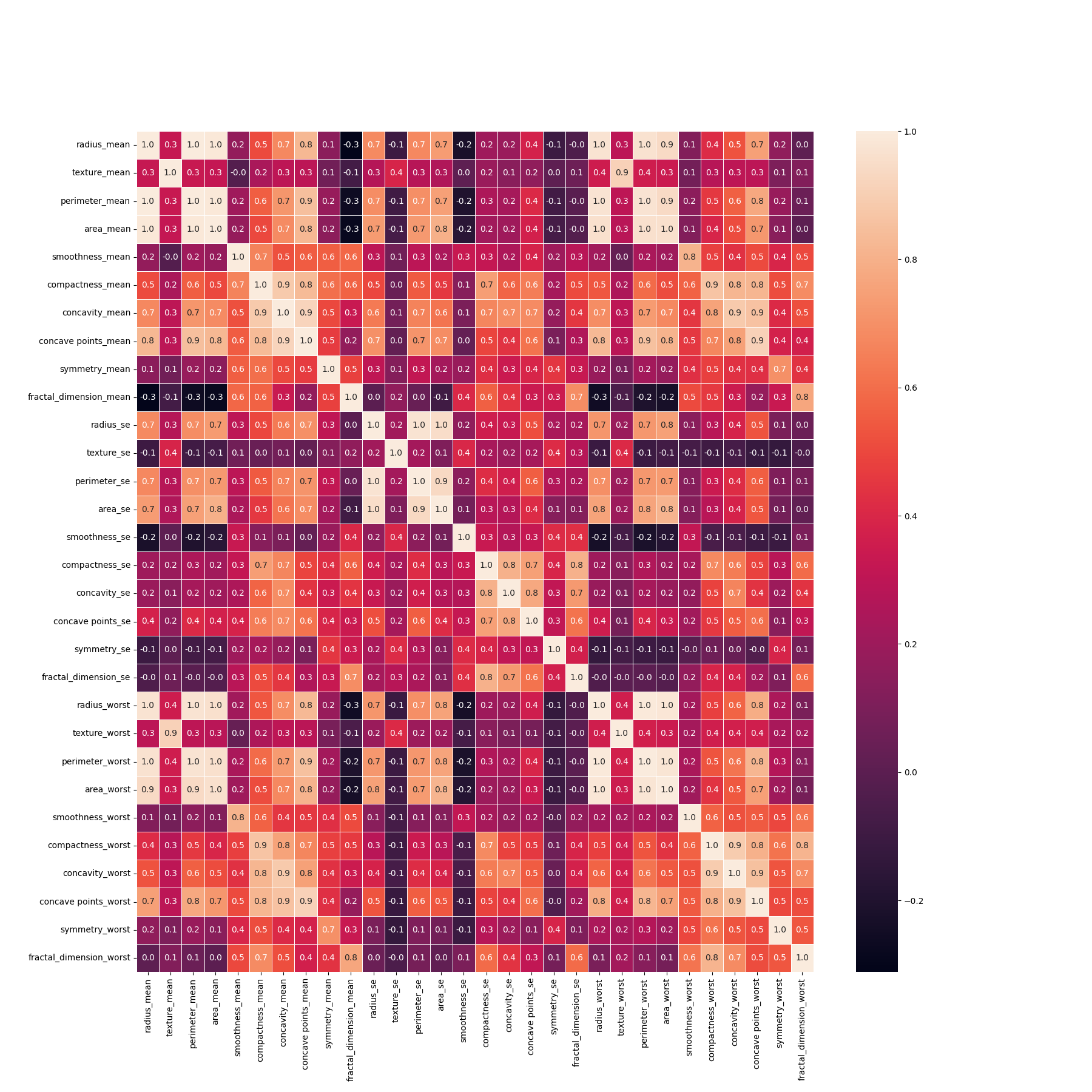
  The dataset contains no missing rows or columns so we can start feature selection. To do that I used correlation map to show the correlation between features. And I eliminated mostly correlated features like perimeter_mean and perimeter_worst. After this process we have 18 features.
image

Then we apply data normalization and our data is ready for classification.

# Data normalization
standardizer = StandardScaler()
X = standardizer.fit_transform(X)

Train and Test Split

I have split my dataset as %30 test, % 70 training and set random_state parameter to 0 as shown.

X_train, X_test, y_train, y_test = train_test_split(X, y, test_size=0.3, random_state=0)

After splitting dataset, I created dictionaries for algorithms and metrics. And in one for loop every model trained and tested.

models = {'Logistic Regression': LogisticRegression(), 'Support Vector Machines': LinearSVC(),
          'Decision Trees': DecisionTreeClassifier(), 'Random Forest': RandomForestClassifier(),
          'Naive Bayes': GaussianNB(), 'K-Nearest Neighbor': KNeighborsClassifier()}

accuracy, precision, recall, f_score = {}, {}, {}, {}

for key in models.keys():
    # Fit the classifier model
    models[key].fit(X_train, y_train)

    # Classification
    classification = models[key].predict(X_test)

    # Calculate Accuracy, Precision, Recall and F Score Metrics
    accuracy[key] = accuracy_score(classification, y_test)
    precision[key] = precision_score(classification, y_test)
    recall[key] = recall_score(classification, y_test)
    f_score[key] = f1_score(classification, y_test)

Results

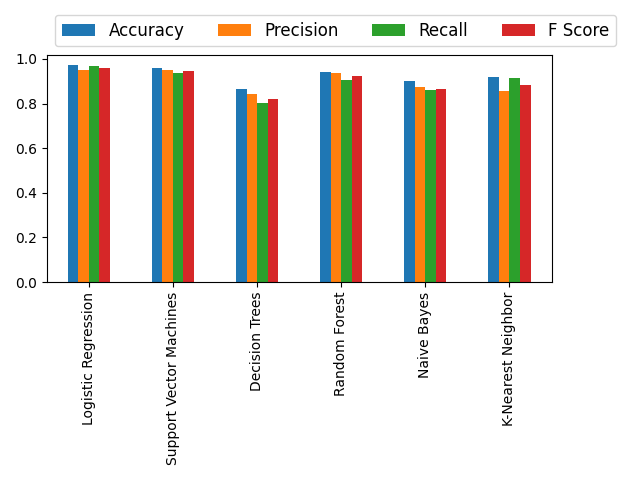
As you can see the figure below, most successful classification algorithm seems to logistic regression. And decision tress has the worst performance.
image

To see the values algorithms got for each metric see the table below.

Algorithm Accuracy Precision Recall F Score
Logistic Regression 0.97 0.95 0.96 0.96
SVM 0.95 0.95 0.93 0.94
Decision Trees 0.86 0.84 0.80 0.82
Random Forest 0.94 0.93 0.90 0.92
Naive Bayes 0.90 0.87 0.85 0.86
K-Nearest Neighbor 0.91 0.85 0.91 0.88

Conclusion

I have tuned few parameters for example training and test size, random state and most of the algorithms performed close enough to each other. For different datasets this code can be used. You may need to change feature selection part and if your dataset has missing values you should fill in these values as well. Other than these things you can perform classification with different kind of algorithms.

Owner
Mert Sezer Ardal
Mert Sezer Ardal
Apache Liminal is an end-to-end platform for data engineers & scientists, allowing them to build, train and deploy machine learning models in a robust and agile way

Apache Liminals goal is to operationalise the machine learning process, allowing data scientists to quickly transition from a successful experiment to an automated pipeline of model training, validat

The Apache Software Foundation 121 Dec 28, 2022
Painless Machine Learning for python based on scikit-learn

PlainML Painless Machine Learning Library for python based on scikit-learn. Install pip install plainml Example from plainml import KnnModel, load_ir

1 Aug 06, 2022
Automatically build ARIMA, SARIMAX, VAR, FB Prophet and XGBoost Models on Time Series data sets with a Single Line of Code. Now updated with Dask to handle millions of rows.

Auto_TS: Auto_TimeSeries Automatically build multiple Time Series models using a Single Line of Code. Now updated with Dask. Auto_timeseries is a comp

AutoViz and Auto_ViML 519 Jan 03, 2023
Winning solution for the Galaxy Challenge on Kaggle

Winning solution for the Galaxy Challenge on Kaggle

Sander Dieleman 483 Jan 02, 2023
Learn Machine Learning Algorithms by doing projects in Python and R Programming Language

Learn Machine Learning Algorithms by doing projects in Python and R Programming Language. This repo covers all aspect of Machine Learning Algorithms.

Ravi Chaubey 6 Oct 20, 2022
Predico Disease Prediction system based on symptoms provided by patient- using Python-Django & Machine Learning

Predico Disease Prediction system based on symptoms provided by patient- using Python-Django & Machine Learning

Felix Daudi 1 Jan 06, 2022
A python library for easy manipulation and forecasting of time series.

Time Series Made Easy in Python darts is a python library for easy manipulation and forecasting of time series. It contains a variety of models, from

Unit8 5.2k Jan 04, 2023
Predict profitability of trades based on indicator buy / sell signals

Predict profitability of trades based on indicator buy / sell signals Trade profitability analysis for trades based on various indicators signals: MAC

Tomasz Porzycki 1 Dec 15, 2021
Educational python for Neural Networks, written in pure Python/NumPy.

Educational python for Neural Networks, written in pure Python/NumPy.

127 Oct 27, 2022
Create large-scale ML-driven multiscale simulation ensembles to study the interactions

MuMMI RAS v0.1 Released: Nov 16, 2021 MuMMI RAS is the application component of the MuMMI framework developed to create large-scale ML-driven multisca

4 Feb 16, 2022
Machine Learning for Time-Series with Python.Published by Packt

Machine-Learning-for-Time-Series-with-Python Become proficient in deriving insights from time-series data and analyzing a model’s performance Links Am

Packt 124 Dec 28, 2022
PROTEIN EXPRESSION ANALYSIS FOR DOWN SYNDROME

PROTEIN-EXPRESSION-ANALYSIS-FOR-DOWN-SYNDROME Down syndrome (DS) is a chromosomal disorder where organisms have an extra chromosome 21, sometimes know

1 Jan 20, 2022
Python package for stacking (machine learning technique)

vecstack Python package for stacking (stacked generalization) featuring lightweight functional API and fully compatible scikit-learn API Convenient wa

Igor Ivanov 671 Dec 25, 2022
Bonsai: Gradient Boosted Trees + Bayesian Optimization

Bonsai is a wrapper for the XGBoost and Catboost model training pipelines that leverages Bayesian optimization for computationally efficient hyperparameter tuning.

24 Oct 27, 2022
Machine-care - A simple python script to take care of simple maintenance tasks

Machine care An simple python script to take care of simple maintenance tasks fo

2 Jul 10, 2022
Price Prediction model is used to develop an LSTM model to predict the future market price of Bitcoin and Ethereum.

Price Prediction model is used to develop an LSTM model to predict the future market price of Bitcoin and Ethereum.

2 Jun 14, 2022
Adaptive: parallel active learning of mathematical functions

adaptive Adaptive: parallel active learning of mathematical functions. adaptive is an open-source Python library designed to make adaptive parallel fu

741 Dec 27, 2022
Mesh TensorFlow: Model Parallelism Made Easier

Mesh TensorFlow - Model Parallelism Made Easier Introduction Mesh TensorFlow (mtf) is a language for distributed deep learning, capable of specifying

1.3k Dec 26, 2022
PLUR is a collection of source code datasets suitable for graph-based machine learning.

PLUR (Programming-Language Understanding and Repair) is a collection of source code datasets suitable for graph-based machine learning. We provide scripts for downloading, processing, and loading the

Google Research 76 Nov 25, 2022
Python package for concise, transparent, and accurate predictive modeling

Python package for concise, transparent, and accurate predictive modeling. All sklearn-compatible and easy to use. 📚 docs • 📖 demo notebooks Modern

Chandan Singh 983 Jan 01, 2023