Facial Image Inpainting with Semantic Control
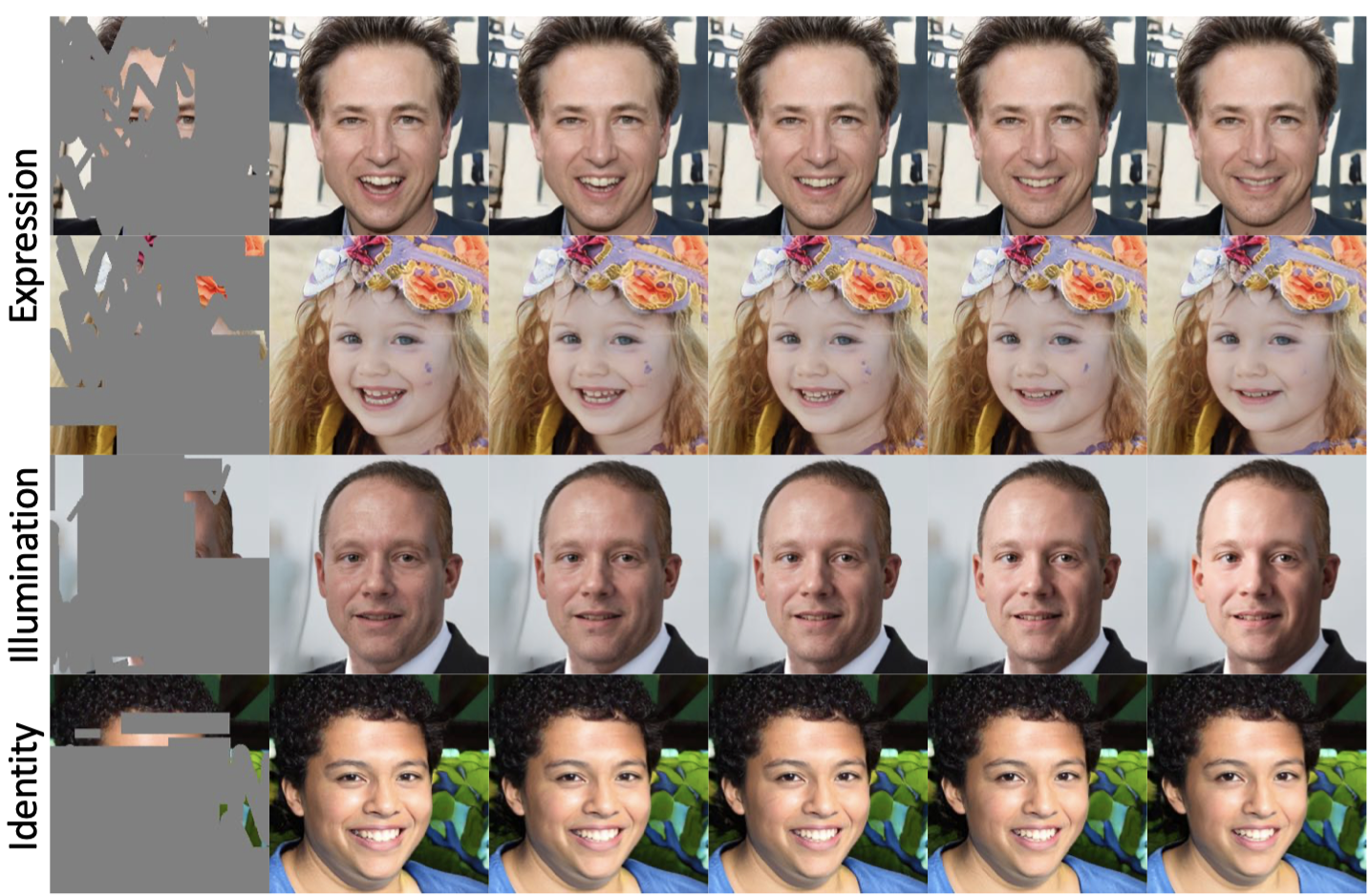
In this repo, we provide a model for the controllable facial image inpainting task. This model enables users to intuitively edit their images by using parametric 3D faces.
The technology report is comming soon.
-
Image Inpainting results

-
Fine-grained Control
Quick Start
Installation
- Clone the repository and set up a conda environment with all dependencies as follows
git clone https://github.com/RenYurui/Controllable-Face-Inpainting.git --recursive
cd Controllable-Face-Inpainting

# 1. Create a conda virtual environment.
conda create -n cfi python=3.6
source activate cfi
conda install -c pytorch pytorch=1.7.1 torchvision cudatoolkit=10.2

# 2. install pytorch3d
conda install -c fvcore -c iopath -c conda-forge fvcore iopath
conda install -c bottler nvidiacub
git clone https://github.com/facebookresearch/pytorch3d.git
cd pytorch3d && pip install -e .

# 3. Install other dependencies
pip install -r requirements.txt
Download Prerequisite Models
- Follow Deep3DFaceRecon to prepare
./BFMfolder. Download01_MorphableModel.matand Expression BasisExp_Pca.bin. Put the obtained files into the./Deep3DFaceRecon_pytorch/BFMfloder. Then link the folder to the root path.
ln -s /PATH_TO_REPO_ROOT/Deep3DFaceRecon_pytorch/BFM /PATH_TO_REPO_ROOT
- Clone the Arcface repo
cd third_part
git clone https://github.com/deepinsight/insightface.git
cp -r ./insightface/recognition/arcface_torch/ ./
The Arcface is used to extract identity features for loss computation. Download the pre-trained model from Arcface using this link. By default, the resnet50 backbone (ms1mv3_arcface_r50_fp16) is used. Put the obtained weights into ./third_part/arcface_torch/ms1mv3_arcface_r50_fp16/backbone.pth
- Download the pretrained weights of our model from Google Driven. Save the obtained files into folder
./result.
Inference
We provide some example images. Please run the following code for inference
CUDA_VISIBLE_DEVICES=0 python -m torch.distributed.launch --nproc_per_node=1 --master_port 1234 demo.py \
--config ./config/facial_image_renderer_ffhq.yaml \
--name facial_image_renderer_ffhq \
--output_dir ./visi_result \
--input_dir ./examples/inputs \
--mask_dir ./examples/masks
Train the model from scratch
Dataset Preparation
- Download dataset. We use Celeba-HQ and FFHQ for training and inference. Please download the datasets (image format) and put them under .
/datasetfolder. - Obtain 3D faces by using Deep3DFaceRecon. Follow the Deep3DFaceRecon repo to download the trained weights. And save it as:
./Deep3DFaceRecon_pytorch/checkpoints/face_recon/epoch_20.pth
# 1. Extract keypoints from the face images for cropping.
cd scripts
# extracted keypoints from celeba
python extract_kp.py \
--data_root PATH_TO_CELEBA_ROOT \
--output_dir PATH_TO_KEYPOINTS \
--dataset celeba \
--device_ids 0,1 \
--workers 6

# 2. Extract 3DMM coefficients from the face images.
cd .. #repo root
# we provide some scripts for easy of use. However, one can use the original repo to extract the coefficients.
cp scripts/inference_options.py ./Deep3DFaceRecon_pytorch/options
cp scripts/face_recon.py ./Deep3DFaceRecon_pytorch
cp scripts/facerecon_inference_model.py ./Deep3DFaceRecon_pytorch/models
cp scripts/pytorch_3d.py ./Deep3DFaceRecon_pytorch/util
ln -s /PATH_TO_REPO_ROOT/third_part/arcface_torch /PATH_TO_REPO_ROOT/Deep3DFaceRecon_pytorch/models

cd Deep3DFaceRecon_pytorch

python face_recon.py \
--input_dir PATH_TO_CELEBA_ROOT \
--keypoint_dir PATH_TO_KEYPOINTS \
--output_dir PATH_TO_3DMM_COEFFICIENT \
--inference_batch_size 100 \
--name=face_recon \
--dataset_name celeba \
--epoch=20 \
--model facerecon_inference

# 3. Save images and the coefficients into a lmdb file.
cd .. #repo root
python prepare_data.py \
--root PATH_TO_CELEBA_ROOT \
--coeff_file PATH_TO_3DMM_COEFFICIENT \
--dataset celeba \
--out PATH_TO_CELEBA_LMDB_ROOT
Train The Model
# we first train the semantic_descriptor_recommender
CUDA_VISIBLE_DEVICES=0,1,2,3 python -m torch.distributed.launch --nproc_per_node=4 --master_port 1234 train.py \
--config ./config/semantic_descriptor_recommender_celeba.yaml \
--name semantic_descriptor_recommender_celeba

# Then, we trian the facial_image_renderer for image inpainting
CUDA_VISIBLE_DEVICES=0,1,2,3 python -m torch.distributed.launch --nproc_per_node=4 --master_port 1234 train.py \
--config ./config/facial_image_renderer_celeba.yaml \
--name facial_image_renderer_celeba

 23 Dec 02, 2022
 67 Dec 01, 2022
 40 Dec 14, 2022
 10 Feb 10, 2022
 1 Jan 20, 2022
 0 Oct 30, 2021
 2 Dec 06, 2021
 [email protected]">
84 Dec 12, 2022
[email protected]">
84 Dec 12, 2022
 100 Dec 25, 2022
 13 Dec 27, 2022
 204 Dec 15, 2022
 12 Oct 21, 2022
 1 Jul 18, 2022
 7 Nov 10, 2022
 6 Sep 05, 2022
 21 Oct 27, 2022
 8 Dec 17, 2022
 256 Dec 28, 2022
 12 Nov 11, 2022
 529 Jan 03, 2023